Cement vs Cement: ASTM Performance Ratings & Specs
Compare Portland, masonry, and rapid-set cement performance ratings. 2026 ASTM specifications, compressive strength data, and pricing for contractors.
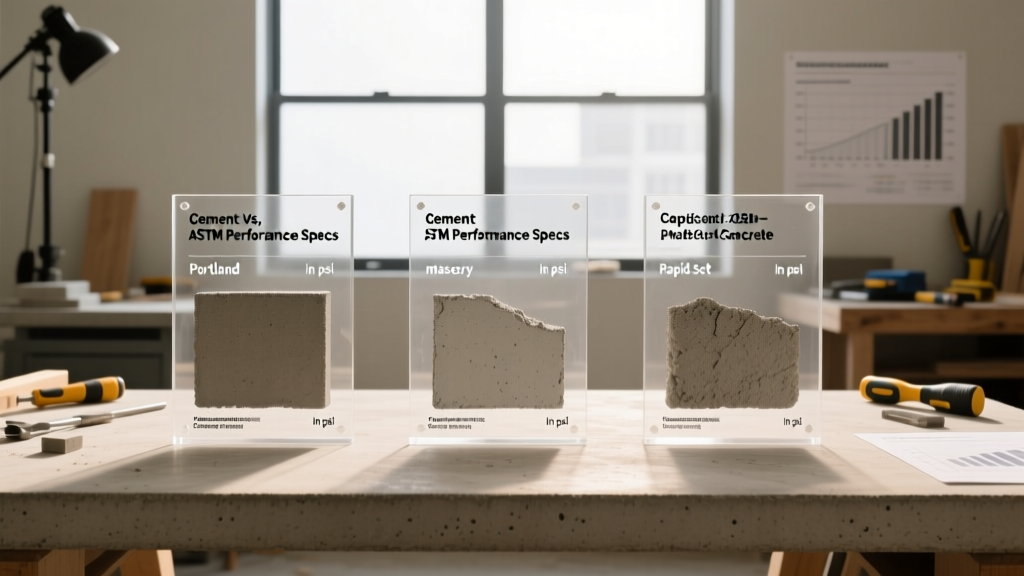
Decoding the 'Cement vs Cement' Dilemma: Core ASTM Standards
When engineers and masonry contractors search for 'cement, cement' comparisons, they are typically trying to differentiate between the vastly different performance profiles of Portland, masonry, and specialty binders. Specifying the wrong product is not merely a suboptimal choice; it is a direct pathway to structural spalling, efflorescence, cold-joint failures, and sulfate degradation. In 2026, with updated environmental exposure classifications in the building codes, understanding the exact ASTM performance ratings for each cement type is mandatory for structural longevity.
The fundamental error in construction documentation is treating 'cement' as a monolithic material. Cement is a powdered binder, and its chemical composition dictates its heat of hydration, setting time, and ultimate compressive strength. Below is a technical breakdown of the three primary cement categories governed by ASTM International standards.
Quick Reference: The Three Primary Binder Categories
- Portland Cement (ASTM C150 / C595): The structural backbone. High compressive strength, rigid, used in concrete and structural mortar.
- Masonry & Mortar Cement (ASTM C91 / C1329): Formulated for workability, water retention, and flexural bond strength. Lower compressive strength than Portland.
- Rapid-Set / CSA Cement (ASTM C1600): Calcium sulfoaluminate-based. Engineered for ultra-fast strength gain and cold-weather patching.
Performance Matrix: Portland vs. Masonry vs. Rapid-Set
The following matrix outlines the baseline performance specifications required for material submittals. Note that 28-day compressive strength is measured on standard 2-inch cube specimens per ASTM C109.
| Cement Type | ASTM Standard | 28-Day Compressive Strength | Initial Set Time (Vicat) | Heat of Hydration | Primary Application |
|---|---|---|---|---|---|
| Type I Portland | C150 | 4,500 - 5,500 psi | 45 - 190 mins | High | General structural concrete, flatwork |
| Type II Portland | C150 | 4,200 - 5,000 psi | 60 - 210 mins | Moderate | Moderate sulfate exposure, mass pours |
| Type N Masonry | C91 | 1,800 - 2,400 psi | 90 - 240 mins | Low | Above-grade exterior masonry walls |
| Type S Mortar | C1329 | 2,800 - 3,500 psi | 90 - 240 mins | Low-Moderate | Below-grade foundations, high-load bearing |
| Rapid Set (CSA) | C1600 | 5,000+ psi (at 2 hours) | 10 - 15 mins | Very High (Early) | Highway patching, cold-weather anchoring |
Deep Dive: Portland Cement (ASTM C150) Specifications
Portland cement performance is dictated by its Bogue compounds—the four primary chemical phases formed during clinkering. According to the Portland Cement Association (PCA), manipulating these compounds creates the different 'Types' of Portland cement.
The Bogue Compounds and Structural Impact
- Tricalcium Silicate (C3S): Comprises 45-65% of the mix. Responsible for early strength gain (1-28 days) and initial set. High C3S cements generate significant early heat.
- Dicalcium Silicate (C2S): Comprises 15-30%. Hydrates slowly, providing long-term strength gain (after 28 days) and low heat generation. Critical for mass concrete pours like dams.
- Tricalcium Aluminate (C3A): The most reactive compound. Dictates flash set and early heat. Crucially, C3A is highly vulnerable to sulfate attack. Type V (Sulfate Resistant) Portland cement strictly limits C3A to less than 5%.
- Tetracalcium Aluminoferrite (C4AF): Lowers the clinkering temperature in the kiln. Contributes minimally to strength but gives cement its gray color.
Masonry Cement (ASTM C91) vs. Mortar Cement (ASTM C1329)
A common failure mode in masonry construction is the use of pure Portland cement for mortar joints. Pure Portland is too rigid, lacks water retention, and will crack under minor thermal expansion. This is where the 'cement vs cement' distinction between masonry and mortar cements becomes vital.
Masonry Cement (ASTM C91)
Masonry cement is a blend of Portland cement and limestone, with air-entraining agents added at the mill. The Air Content Factor: ASTM C91 allows air content up to 12% for Type N and 14% for Type S. This microscopic air bubble structure acts as a lubricant, providing excellent workability and board life (up to 2.5 hours). However, this high air content significantly reduces compressive strength and flexural bond strength.
Mortar Cement (ASTM C1329)
Mortar cement is engineered for structural performance. It contains no limestone filler and strictly limits air content to a maximum of 10%. More importantly, ASTM C1329 mandates a minimum water retention rate of 70%. This ensures the masonry units (which act like sponges) do not suck the water out of the mortar before hydration is complete, preventing powdery, friable joints.
Expert Rule of Thumb: Use ASTM C91 Masonry Cement for non-load-bearing veneers and interior partitions where workability is paramount. Specify ASTM C1329 Mortar Cement for seismic zones, below-grade retaining walls, and high-load bearing structural masonry.
2026 Market Pricing & Yield Specifications
Material costs fluctuate based on regional kiln capacity and energy prices. As of early 2026, the following pricing reflects average North American retail and contractor-bulk rates for standard 94 lb (1 cubic foot yield) bags.
| Product Category | Standard Bag Size | Avg. Retail Price (2026) | Contractor Pallet Rate (per bag) | Cubic Foot Yield |
|---|---|---|---|---|
| Type I/II Portland | 94 lb | $13.50 - $15.00 | $11.20 - $12.50 | 1.00 cu ft |
| Type N Masonry | 75 lb | $14.00 - $16.50 | $12.00 - $13.80 | 0.85 cu ft |
| Type S Mortar | 80 lb | $16.00 - $19.00 | $14.50 - $16.00 | 0.90 cu ft |
| Rapid Set CSA | 50 lb | $28.00 - $36.00 | $24.00 - $29.00 | 0.45 cu ft |
Note: When calculating masonry estimates, remember that masonry and mortar cements are packaged in lighter bags (75-80 lbs) compared to Portland (94 lbs) to account for the lower specific gravity of the limestone fillers and air-entraining agents.
Specifying for Extreme Environments: A Decision Framework
To ensure structural integrity, use the following American Concrete Institute (ACI) aligned decision framework when drafting material specifications for challenging site conditions.
Scenario A: Cold Weather Pouring (Ambient Temp < 40°F / 4°C)
- The Problem: Standard Portland hydration slows dramatically below 40°F. If water in the mix freezes before reaching 500 psi, the concrete matrix is permanently destroyed.
- The Specification: Specify ASTM C150 Type III (High Early Strength) Portland cement. Type III is ground significantly finer than Type I, increasing the surface area for rapid hydration. Combine with accelerating admixtures (calcium nitrate, avoiding calcium chloride if steel rebar is present).
Scenario B: Mass Concrete Elements (Footings > 3 feet thick)
- The Problem: The heat of hydration generated by C3S and C3A cannot escape thick cross-sections. Internal temperatures can exceed 160°F, leading to delayed ettringite formation (DEF) and thermal cracking as the core cools.
- The Specification: Specify ASTM C595 Type IL (Portland-Limestone Cement) or Type IP (Portland-Pozzolan). The limestone or fly ash dilutes the reactive clinker, reducing peak heat generation by up to 30% while maintaining 28-day strength targets. Alternatively, use ASTM C150 Type IV (Low Heat), though it is increasingly rare and often replaced by blended cements.
Scenario C: Emergency Highway or Airport Runway Patching
- The Problem: Standard concrete requires 7-28 days to reach sufficient strength for heavy vehicular traffic. Downtime costs thousands of dollars per hour.
- The Specification: Specify ASTM C1600 Rapid Set Cement (Calcium Sulfoaluminate). CSA cement forms ettringite crystals almost instantly upon contact with water. It achieves 3,000 psi in 2 hours and 5,000 psi in 24 hours, allowing runways and highways to reopen in the same shift. Be aware that CSA cement has a lower alkaline pH (~10.5) compared to Portland (~13), meaning it offers less inherent corrosion protection for embedded carbon steel; use epoxy-coated rebar or fiberglass GFRP dowels in CSA patches.
Final Verification for Submittals
Before approving any material submittal, cross-reference the manufacturer's mill test report (MTR) against the project specifications. Verify the C3A percentage for sulfate resistance, the fineness (Blaine air permeability) for set times, and the autoclave expansion limits to ensure soundness. In modern construction, treating cement as a generic commodity is a liability; specifying it as a precision chemical binder is the hallmark of professional engineering.