Choosing the Right Concrete Stain and Sealer: A Taxonomy
Discover the material taxonomy of concrete stain and sealer products. Compare acid, water-based, and penetrating options for optimal substrate protection.
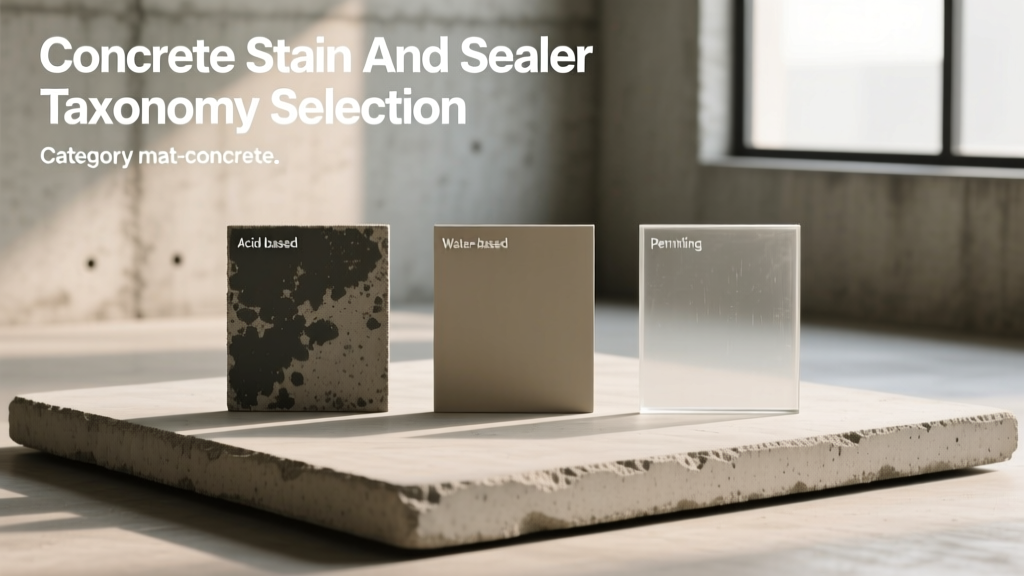
The Chemistry of Color: Taxonomy of Concrete Stains
Selecting the correct concrete stain and sealer requires understanding the fundamental chemical divide in colorant technologies. Stains are not merely surface paints; they interact with the cementitious matrix at varying depths. The taxonomy of concrete stains splits into three distinct chemical categories, each dictating specific substrate preparation and sealer compatibility requirements.
1. Acid (Reactive) Stains
Acid stains consist of metallic salts suspended in a mild acidic solution (typically hydrochloric or phosphoric acid). The acid etches the surface, allowing metallic ions to react with the hydrated lime (calcium hydroxide) in the concrete to form permanent, insoluble metallic oxides. Because the reaction depends entirely on the mineral composition and age of the concrete, the resulting colors are limited to earth tones—browns, tans, terra-cottas, and soft blue-greens. Critical Limitation: If a concrete slab has been acid-etched during previous coating removal, or if it was power-troweled to a burnished finish that pushed calcium hydroxide away from the surface, acid stains will fail to react, resulting in a washed-out, mottled appearance.
2. Water-Based (Non-Reactive) Acrylic Stains
Unlike reactive stains, water-based stains rely on high-quality acrylic polymers to carry microscopic pigments into the concrete's open pores. There is no chemical reaction. This taxonomy allows for an unlimited color palette, including vibrant reds, deep blacks, and bright whites. They are UV-stable and do not require neutralization after application, significantly reducing labor time. However, because they sit in the uppermost pores rather than becoming part of the mineral matrix, they require a more aggressive Concrete Surface Profile (CSP) to prevent delamination under heavy traffic.
3. Concrete Dyes
Dyes utilize ultra-fine colorants dissolved in a carrier agent—either water or a volatile solvent like acetone or alcohol. The carrier penetrates the concrete capillary network, depositing color deep within the slab before evaporating. Dyes are non-reactive and offer intense, translucent coloration. Edge Case Warning: Solvent-based dyes are highly flammable and emit high VOCs, making them unsuitable for occupied interior spaces without massive ventilation. Furthermore, most dyes lack inherent UV stability and will degrade under direct sunlight unless locked beneath a UV-resistant topcoat.
Never specify an acid concrete stain and sealer system for exterior slabs that have been exposed to acid rain for over a decade, or interior floors that have been aggressively cleaned with muriatic acid. The depletion of calcium hydroxide will render the acid stain chemically inert. In these scenarios, pivot to a water-based acrylic stain or a penetrating dye.
Protective Topcoats: Sealer Taxonomy & Performance Matrix
The sealer is the sacrificial wear layer that dictates the floor's lifecycle, maintenance schedule, and visual depth. Sealers are taxonomized by their penetration depth and film-forming characteristics. According to the Concrete Network's sealer guidelines, matching the sealer's permeability to the substrate's moisture profile is the most common point of failure in decorative concrete.
| Sealer Category | Mil Build (Dry) | UV Stability | MVTR Permeability | Cost / Sq Ft (Material) |
|---|---|---|---|---|
| Silane/Siloxane (Penetrating) | 0 mils | Excellent | Highly Breathable | $0.15 - $0.30 |
| Acrylic (Film-Forming) | 1 - 3 mils | Good (Non-Yellowing) | Semi-Breathable | $0.25 - $0.50 |
| Epoxy (Film-Forming) | 8 - 15 mils | Poor (Ambers/Chalks) | Non-Breathable (Vapor Barrier) | $0.80 - $1.50 |
| Aliphatic Polyurethane | 2 - 4 mils | Excellent | Low Breathability | $0.60 - $1.10 |
| Polyaspartic (Aliphatic) | 4 - 8 mils | Excellent | Non-Breathable | $1.20 - $2.50 |
Penetrating Sealers: Silanes and Siloxanes
These sealers do not form a surface film. Instead, they penetrate the capillary network and cross-link with the silica in the concrete to form a hydrophobic resin. They provide zero color enhancement (no 'wet look') and no abrasion resistance. They are strictly used for exterior freeze-thaw protection and water repellency. Because they allow high Moisture Vapor Transmission Rates (MVTR), they will never blister or delaminate due to subsurface hydrostatic pressure.
Film-Forming Sealers: The Polyaspartic Advantage
For high-traffic interior stained floors, aliphatic polyurethanes have historically been the standard. However, polyaspartic esters have largely displaced them in commercial applications. Polyaspartics offer the same UV stability and abrasion resistance as polyurethanes but cure in under two hours, allowing same-day return-to-service. Furthermore, they can be applied in much thicker single coats without trapping solvents, reducing the risk of solvent-pop blistering.
Selection Framework: Matching Stain and Sealer to the Substrate
Specifying a concrete stain and sealer system without prior substrate diagnostics is a primary cause of coating failure. Follow this decision framework based on empirical testing standards outlined by the American Concrete Institute and surface prep guidelines.
- Step 1: Moisture Testing (ASTM F2170). Perform in-situ relative humidity testing. If RH levels exceed 75%, you cannot use a non-breathable film-forming sealer (Epoxy or Polyaspartic) without first applying a moisture-mitigating primer. If RH is high and mitigation is out of budget, pivot to a water-based acrylic stain paired with a breathable acrylic or siloxane sealer.
- Step 2: Surface Profiling (ICRI CSP). Acid stains require a CSP 1 or 2 (light etch). Epoxies and thick polyurethanes require a CSP 2 or 3 (shot blasting or aggressive diamond grinding). If the slab is burnished (CSP 0), no stain will penetrate properly without mechanical scarification.
- Step 3: UV Exposure Analysis. For exterior patios with direct sunlight, eliminate aromatic epoxies and standard solvent-based dyes entirely. Specify water-based acrylic stains topped with a UV-stable aliphatic acrylic or a penetrating silane-siloxane blend.
Application Sequencing & Compatibility Rules
The interaction between the stain carrier and the sealer solvent dictates the chemical bond. Violating these compatibility rules results in immediate aesthetic failure.
If you apply a water-based concrete stain, it must be 100% dry before applying a solvent-based sealer. If trapped water meets the aggressive solvents in a polyurethane or epoxy topcoat, the sealer will emulsify and turn opaque white—a catastrophic defect known as 'blushing' that requires complete mechanical removal to fix.
The 28-Day Cure Mandate
Freshly poured concrete contains massive amounts of unreacted water and alkaline salts. Applying any concrete stain and sealer before the slab has cured for a minimum of 28 days (or reached an internal RH of 75% or less) will trap alkaline moisture beneath the film. This leads to saponification, where the alkaline salts literally eat the ester bonds in acrylic and polyurethane sealers, turning them into a soapy, delaminated mess.
Cost Expectations & Coverage Rates
When budgeting for a decorative concrete project, material costs are only a fraction of the total. However, understanding the coverage rates prevents severe under-ordering. Based on current market formulations, here are the baseline material expectations:
- Acid Stains: Cover approximately 200 to 250 square feet per gallon. Material cost: $0.15 - $0.25 per sq ft.
- Water-Based Stains: Cover 250 to 300 square feet per gallon. Material cost: $0.20 - $0.35 per sq ft.
- Acrylic Sealers: Cover 300 to 400 square feet per gallon (requires two coats). Material cost: $0.15 - $0.25 per sq ft per coat.
- Polyaspartic Topcoats: Cover 200 to 250 square feet per gallon (single thick coat). Material cost: $0.80 - $1.20 per sq ft.
By aligning the chemical taxonomy of the stain with the performance matrix of the sealer, and validating both against the substrate's moisture and profile data, contractors and architects can specify concrete stain and sealer systems that deliver decades of structural and aesthetic integrity.