Different Types of Concrete Anchors for Heavy Structural Loads
Compare different types of concrete anchors for heavy structural loads. Learn wedge, sleeve, and epoxy anchor specs, capacities, and installation tips.
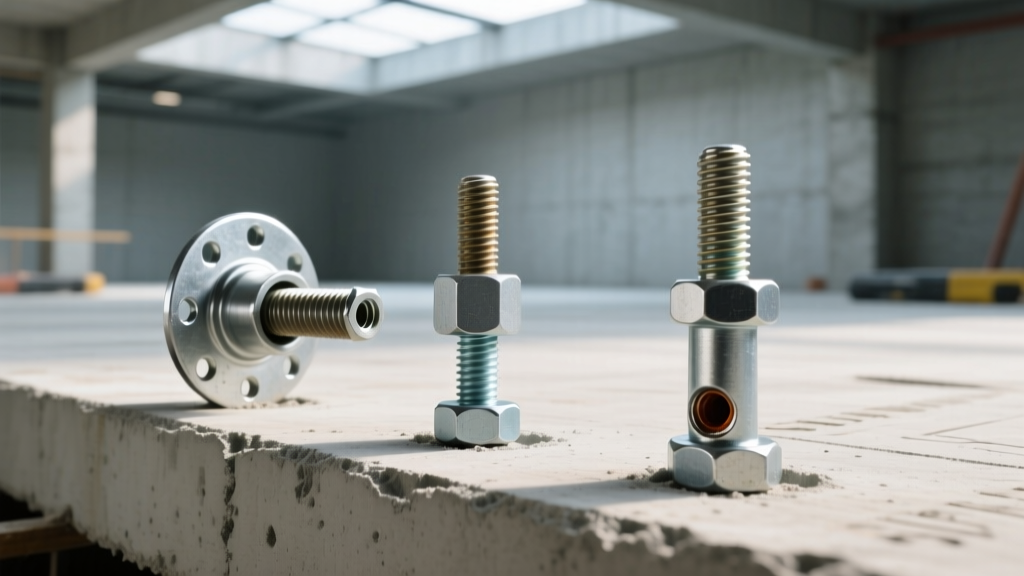
The Mechanics of Concrete Anchorage
Selecting the correct fastener for concrete requires understanding the three primary load-transfer mechanisms: friction, mechanical interlock, and chemical bond. When designing for heavy structural loads, engineers and contractors must navigate the stringent requirements of ACI 318 Chapter 17 (formerly Appendix D), which governs anchoring to concrete. The distinction between cracked and uncracked concrete assumptions fundamentally dictates which of the different types of concrete anchors are permissible for a given structural application, particularly in seismic design categories (SDC) C through F.
Pro Tip: Always assume concrete is cracked when calculating structural tensile loads unless a rigorous analysis proves the section remains uncracked under service loads. This conservative approach aligns with standard structural engineering practices and ICC-ES evaluation reports.
Mechanical Expansion Anchors
Mechanical anchors rely on expansion forces against the walls of the drilled hole. They are highly sensitive to the quality of the base material and the precision of the drilled hole diameter.
Wedge Anchors
Wedge anchors feature a threaded stud with a conical expansion clip at the base. As the nut is torqued, the clip is pulled up the cone, expanding outward to create massive friction against the concrete.
- Best Application: Heavy static loads in uncracked concrete (e.g., securing structural steel columns, heavy machinery).
- Specifications: A standard 1/2-inch diameter by 5-1/2-inch long carbon steel wedge anchor (such as the Red Head Trubolt+) provides approximately 4,000 lbs of tensile capacity and 5,500 lbs of shear capacity in 3,000 psi normal-weight uncracked concrete.
- Limitations: Wedge anchors are generally not approved for cracked concrete or seismic applications. The expansion clip can lose grip if the concrete crack width cycles during an earthquake.
Sleeve Anchors
Sleeve anchors utilize a full-length or partial-length expansion sleeve that compresses against the hole wall. They offer more forgiving tolerances for slightly oversized holes compared to wedge anchors.
- Best Application: Medium-duty attachments, hollow-base materials, and masonry block.
- Specifications: A 5/8-inch sleeve anchor typically yields 2,500 lbs in tension and 3,200 lbs in shear in solid concrete.
- Limitations: Lower load capacities than wedge or undercut anchors. Not suitable for critical life-safety or heavy structural tie-downs.
Drop-In Anchors
Drop-in anchors are female, internally threaded anchors set flush with the concrete surface. They require a specialized setting tool to expand the internal plug.
- Best Application: Overhead pipe hangers, HVAC duct supports, and electrical tray suspensions where a flush surface is required.
- Limitations: Strictly limited to uncracked concrete. Installation requires precise hammer strikes with the setting tool; under-setting results in pullout, while over-setting can shatter the surrounding concrete.

Chemical and Adhesive Anchors
Chemical anchors use high-strength resins to bond a threaded rod or rebar to the concrete. Because they do not exert expansion forces, they can be installed closer to edges and are the premier choice for cracked concrete and seismic zones.
Pure Epoxy Anchors
Two-part pure epoxy systems (e.g., Simpson SET-3G or Hilti HIT-RE 500 V4) offer the highest tensile capacities available in post-installed anchoring. They are the standard for rebar doweling and structural retrofits.
- Cure Times: Highly temperature-dependent. At 75°F (24°C), full cure takes roughly 4 to 6 hours. At 50°F (10°C), cure times extend to 24 hours or more. Below 40°F, most pure epoxies will not cure properly without supplemental heating.
- Edge Distance: Can be installed at edge distances as close as 5 times the anchor diameter (5d), compared to the 10d to 12d required for mechanical expansion anchors.
- Cost: High. A standard 22 oz cartridge costs between $70 and $110, plus the cost of the threaded rod or rebar.
Vinyl Ester and Hybrid Resins
Vinyl ester anchors provide a middle ground. They cure significantly faster than pure epoxy and offer better moisture tolerance in the drilled hole, making them ideal for rapid turnaround projects or outdoor applications where hole moisture is difficult to eliminate entirely.
Safety Warning: When using chemical anchors for overhead applications or life-safety fall protection tie-offs (per OSHA 1926.502), the drilled hole must be meticulously cleaned. The standard protocol requires blowing out with compressed air, brushing with a wire tube brush, and blowing out again—repeated at least twice. Dust left in the hole reduces epoxy bond strength by up to 60%.
Undercut and Screw Anchors
Undercut Anchors
Undercut anchors require a specialized drill bit to create a bell-shaped cavity at the base of the hole. The anchor expands into this cavity, creating a true mechanical interlock rather than relying on friction. Because they do not exert radial expansion stress on the concrete, they are approved for cracked concrete and high seismic zones. They are frequently used in nuclear facilities and critical infrastructure.
Concrete Screw Anchors
Concrete screws (e.g., Tapcon or Hilti HUS) cut threads directly into the base material. Modern structural screw anchors feature hardened, serrated threads that provide excellent holding power in both cracked and uncracked concrete.
- Advantage: Fully removable and adjustable. Ideal for temporary structural shoring, formwork, and scaffolding.
- Limitation: Susceptible to thread stripping in low-strength or highly abrasive concrete if over-torqued during installation.
Decision Matrix: Selecting the Right Anchor
Use the following framework to narrow down the different types of concrete anchors based on your specific project parameters. Always verify final selections against the manufacturer's ICC-ES Evaluation Service Report (ICC-ES ESR) for the specific product batch.
| Anchor Type | Cracked Concrete Approved? | Seismic (SDC C-F) Approved? | Relative Tensile Capacity | Edge Distance Requirement | Best Use Case |
|---|---|---|---|---|---|
| Wedge Anchor | No | No | High | Large (10d+) | Static heavy machinery, uncracked slabs |
| Sleeve Anchor | No | No | Medium | Large (10d+) | Light/medium fixtures, masonry block |
| Drop-In Anchor | No | No | Medium | Medium (8d+) | Overhead pipe, flush-mount HVAC |
| Pure Epoxy | Yes | Yes | Very High | Small (5d) | Rebar doweling, seismic retrofits, edge anchors |
| Vinyl Ester | Yes | Yes (Specific products) | High | Small (5d) | Fast-turnaround structural, damp holes |
| Undercut Anchor | Yes | Yes | Very High | Medium (6d-8d) | Critical infrastructure, nuclear, high seismic |
| Structural Screw | Yes | Yes (Specific products) | Medium/High | Small (4d-5d) | Temporary shoring, removable attachments |
Critical Installation Failures and Edge Cases
Even the highest-rated anchor will fail if installation parameters are violated. The most common field failures stem from the following edge cases:
1. Hole Blowout and Spalling
When drilling near the edge of a concrete slab, the aggregate can blow out the side of the hole, destroying the concrete's ability to resist shear loads. Solution: If drilling within 12 inches of an edge, use a rotary hammer with a vacuum attachment to monitor dust flow, and drill at a slight angle away from the edge before straightening, or switch to a chemical anchor which requires less aggressive expansion forces.
2. Torque Over-Tightening
Contractors frequently use impact wrenches to set mechanical anchors, applying torque far exceeding the manufacturer's specified installation torque (e.g., applying 150 ft-lbs to a 1/2-inch wedge anchor rated for 40 ft-lbs). This strips the threads, snaps the stud, or crushes the concrete at the base of the anchor, creating a hidden failure point. Always use a calibrated torque wrench for final tightening.
3. Epoxy Freeze/Thaw and Moisture Trapping
In exterior applications, if a water-filled hole freezes before the epoxy is injected, the ice blocks the resin from reaching the base of the hole. Conversely, if water is trapped in the hole and the epoxy cures around it, the freeze-thaw cycle will expand the water and fracture the bond line. Solution: Use water-saturated surface dry (SSD) rated epoxies for exterior applications, and utilize compressed air and specialized drying foams to remove standing water prior to injection.
4. Rebar Strike During Drilling
Hitting reinforcing steel while drilling compromises both the rebar (reducing the slab's structural capacity) and the anchor. Solution: Always use a ground-penetrating radar (GPR) or a magnetic rebar locator to map the slab before drilling. If rebar is struck, abandon the hole, fill it with structural grout or epoxy, and relocate the anchor according to the engineer's approved offset pattern.
Sourcing and Quality Assurance
For structural applications, never substitute generic, unbranded anchors from bulk bins for specified structural fasteners. Authentic structural anchors from established manufacturers like Simpson Strong-Tie, Hilti, and Powers Fasteners come with traceable lot numbers and published ICC-ES ESR reports. These reports provide the exact reduction factors (phi factors) for tension, shear, and combined loading required by the structural engineer of record to sign off on the installation.
Written by
Priya KapoorPriya Kapoor is a real estate market analyst and construction economics researcher with expertise in housing affordability, development feasibility, and infrastructure investment. She holds a Master of Regional Planning from Cornell University and previously worked as a senior analyst at CBRE's Investment Properties group, where she modeled returns for $4B in mixed-use development pipelines. Priya now runs an independent research practice advising developers, municipalities, and REITs on construction cost forecasting and market timing. She publishes the quarterly "BuildMat Market Pulse" report tracking material price indices across 12 commodity categories. Based in Austin, TX, Priya serves on the board of Habitat for Humanity Austin and is a marathon runner.
More from Priya Kapoor
View all
Construction Cost
Cost to Build a 1600 Sq Ft Home in 2026: Full Breakdown
Accurate 2026 cost to build a 1600 sq ft home—material, labor, and regional pricing breakdowns included. Plan your budget with real-time estimates.
Aug 11, 2026

Wood & Lumber
Name the Types of Wood for Pressure Treatment and Preservation
Learn how to name the types of wood best suited for pressure treatment. Compare species treatability, chemical retention levels, and 2026 preservation costs.
Aug 4, 2026

Stone & Masonry
Stone Veneer Suppliers Lindenhurst: 2026 Cost Analysis
Analyze 2026 stone veneer costs in Lindenhurst, NY. Compare local supplier pricing, delivery fees, and Suffolk County installation labor rates.
Aug 4, 2026