Material Selection Guide: How to Fix Cement Cracks Permanently
Discover the exact material taxonomy to fix cement cracks. Compare epoxy, polyurethane, hydraulic cement, and vinyl patchers for permanent slab repair.
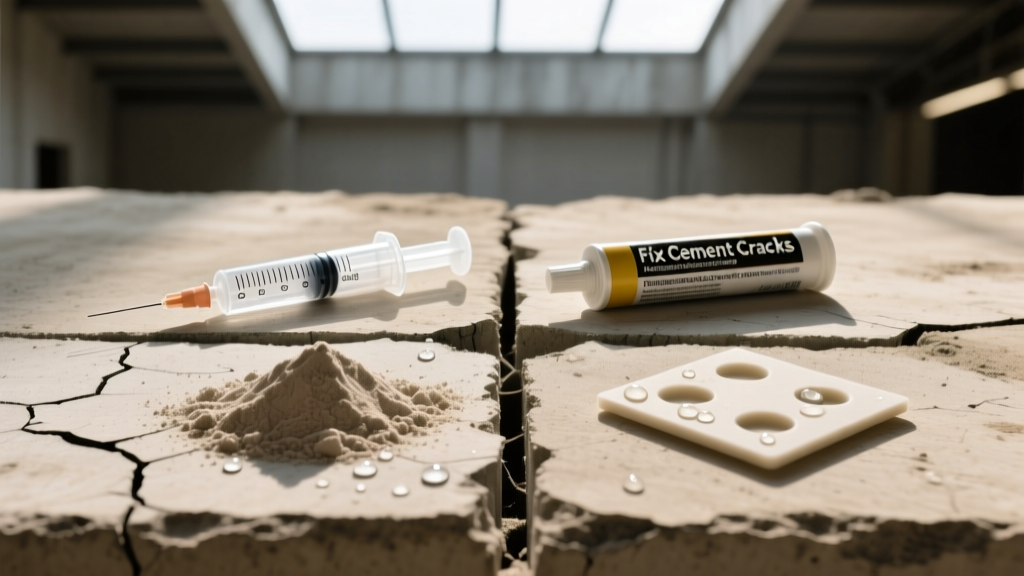
The Physics of Failure: Why Material Mismatch Causes Repair Breakdowns
While industry professionals distinguish between cement (the binder) and concrete (the composite matrix), homeowners and contractors universally search for ways to fix cement cracks when their slabs, driveways, or foundations fracture. The fundamental error in 80% of DIY and commercial repairs is not poor workmanship, but material mismatch. A rigid epoxy injected into an active thermal expansion joint will shatter within one freeze-thaw cycle. Conversely, a flexible polyurethane sealant applied to a structural shear crack will fail to restore load transfer capacity.
According to the Portland Cement Association, concrete is designed to crack in tension. The objective of repair is not merely cosmetic concealment, but restoring structural continuity, halting water ingress, or accommodating future kinetic movement. Selecting the correct chemistry requires a strict taxonomy of repair materials based on crack geometry, moisture presence, and structural load requirements.
Taxonomy of Crack Repair Materials
To permanently fix cement cracks, you must match the chemical and physical properties of the repair material to the specific failure mode of the slab. Below is the definitive taxonomy of modern cementitious and polymeric repair compounds.
1. Hydraulic Cement (Active Leak Plugging)
Hydraulic cement (e.g., DRYLOK Water Plug) is a fast-setting, non-shrink blend of Portland cement and specialized accelerators. It undergoes an exothermic (heat-generating) chemical reaction that allows it to set in 3 to 5 minutes, even against active hydrostatic pressure.
- Best For: Stopping active water leaks in basement walls, elevator pits, and below-grade foundations.
- Limitations: Extremely rigid and brittle. It possesses low tensile strength and will crack again if the substrate shifts. It cannot be feather-edged; requires a minimum 1-inch depth and width.
- Cost: $15 - $25 per 10 lb. tub.
2. Epoxy Injection Systems (Structural Welding)
Low-viscosity, 100% solids epoxy resins (e.g., RadonSeal CrackWeld, Sikadur-52) are the industry standard for restoring structural integrity. Once cured, high-modulus epoxies exhibit tensile strengths exceeding 7,000 psi, effectively welding the concrete back together so it is stronger than the original matrix.
- Best For: Static structural cracks in foundation walls, suspended slabs, and structural beams (1/16" to 1/4" width).
- Limitations: Requires a completely dry substrate for standard formulations. Will not bridge moving joints. Application is temperature-sensitive (requires ambient and surface temps above 40°F / 4°C).
- Cost: $120 - $180 per dual-cartridge kit (covers approx. 10 linear feet of 1/8" crack).
3. Polyurethane Foam & Elastomeric Sealants (Movement & Water-Stopping)
Polyurethanes are highly elastic polymers that can elongate up to 400% without tearing. They are categorized into hydrophilic (reacts with water to expand into a closed-cell foam) and hydrophobic (repels water, cures into a flexible rubber) types.
- Best For: Active cracks, expansion joints, control joints, and cracks subject to soil settlement or thermal cycling.
- Limitations: Does not restore structural load transfer. UV degradation occurs if left exposed to direct sunlight without a topcoat.
- Cost: $80 - $150 per injection kit; $12 - $20 per tube of self-leveling elastomeric sealant (e.g., SikaFlex SL).
4. Polymer-Modified Vinyl Concrete (Surface Spalls & Shallow Defects)
Vinyl concrete patchers are pre-mixed, polymer-modified mortars designed for high bond strength and feather-edge capability. Unlike standard sand mixes, the vinyl polymers allow the material to adhere in layers as thin as 1/16" without flaking.
- Best For: Horizontal surface spalls, pop-outs, scaling, and shallow non-structural cracks in driveways and sidewalks.
- Limitations: Not suitable for deep structural voids or vertical wall repairs (will sag before curing).
- Cost: $18 - $30 per 10 lb. bucket.
Decision Matrix: Matching Material to Crack Geometry
Use the following matrix to diagnose your specific crack profile and select the optimal repair chemistry. This framework aligns with the evaluation protocols established by ACI Committee 224 (Cracking).
| Crack Geometry & Profile | Movement State | Moisture Presence | Optimal Material Class | Est. Cost (per LF) |
|---|---|---|---|---|
| Hairline (< 1/16"), Structural | Static (Dormant) | Dry | Low-Viscosity Gravity-Fed Epoxy | $4.00 - $6.00 |
| 1/8" to 1/2", Structural Shear | Static (Dormant) | Dry / Damp | High-Pressure Epoxy Injection | $12.00 - $18.00 |
| 1/4" to 1", Expansion/Control Joint | Active (Thermal/Kinetic) | Dry | Self-Leveling Polyurethane Sealant | $3.00 - $5.00 |
| Varying, Below-Grade Foundation | Active (Hydrostatic) | Actively Leaking | Hydrophilic Polyurethane Foam | $25.00 - $40.00 |
| Shallow Spall / Surface Craze | Static | Dry | Polymer-Modified Vinyl Patch | $2.00 - $4.00 |
Advanced Routing and Injection Protocols
The longevity of your repair depends heavily on substrate preparation. The International Concrete Repair Institute (ICRI) mandates specific routing geometries based on the material being applied.
The V-Groove vs. U-Groove Routing Standard
For surface patching with vinyl concrete or rigid epoxies, use a diamond-blade angle grinder to route the crack into a V-groove (typically 1/4" wide at the surface, tapering to a point). This maximizes the bonding surface area and creates a mechanical lock. For flexible polyurethane sealants in expansion joints, route a U-groove (1/2" wide by 1/2" deep) to maintain a 2:1 width-to-depth ratio, which allows the sealant to stretch uniformly without tearing at the bond line.
Common Selection Mistakes and Edge Cases
Even experienced contractors fall victim to non-obvious edge cases in concrete repair. Avoid these frequent failure modes:
- Ignoring Alkali-Silica Reaction (ASR): If a crack exhibits a gel-like residue and a map-cracking pattern, the aggregate is reacting with the cement's alkalis. Injecting standard epoxy will not stop the internal expansion. ASR requires penetrating lithium-silicate treatments to neutralize the reaction before any structural epoxy welding is attempted.
- Trapping Moisture with Epoxy: Standard 100% solids epoxies will not bond to damp concrete; the moisture creates an amine blush (a waxy, oily film) that ruins the adhesive bond. If the crack is damp but not actively flowing, you must use a moisture-tolerant epoxy (e.g., Sikadur-35 Hi-Mod LV), which is chemically engineered to displace water molecules at the pore level.
- Over-Troweling Vinyl Patchers: Polymer-modified vinyl patchers rely on internal moisture for the curing process. Over-troweling or adding water to the surface to smooth it out draws the polymers to the top, creating a weak, flaky crust. Use a steel trowel for the initial strike-off, followed by a light pass with a damp sponge float for a perfect texture match.
FAQ: Advanced Troubleshooting
Can I use standard silicone caulk to fix exterior driveway cracks?
No. Standard 100% silicone lacks the abrasion resistance and structural modulus required for horizontal traffic surfaces. Vehicle tires will tear the silicone from the bond line within months. Always use a traffic-rated, self-leveling polyurethane sealant (like SikaFlex SL) that cures to a Shore A hardness of 25-30, allowing it to withstand tire shear forces while remaining flexible.
How deep does a crack need to be before I switch from surface patching to injection?
If the crack penetrates deeper than 1/3 of the total slab thickness, surface routing and patching will not restore structural load transfer. For a standard 4-inch residential sidewalk slab, any crack deeper than 1.25 inches requires low-pressure epoxy or polyurethane injection to ensure the repair reaches the subgrade interface.