Concrete Fiber vs Rebar: Troubleshooting Slab Cracks & Repairs
Diagnose and repair concrete slab failures. Compare concrete fiber vs rebar failure modes, crack patterns, and 2026 repair protocols.

Diagnostic Triage: Identifying the Reinforcement Failure
When a concrete slab cracks, spalls, or fails under load, the repair protocol is entirely dictated by the internal reinforcement. The debate of concrete fiber vs rebar is not just about new construction; it fundamentally changes how forensic engineers and contractors approach restoration. Rebar provides high tensile strength but introduces corrosion vulnerabilities, while synthetic fibers offer three-dimensional micro-reinforcement but lack the structural load-bearing capacity of steel. Misdiagnosing the reinforcement type leads to failed patches, recurring cracks, and wasted material budgets.
Rebar Failure Modes & Repair Protocols
Symptom: Rust Jacking and Spalling
Steel rebar (typically Grade 60, #4 or #5) is the standard for structural driveways, commercial pads, and suspended slabs. However, its primary failure mode is chloride-induced corrosion. When steel oxidizes, the resulting iron oxide expands up to six times the volume of the original metal. This internal pressure exceeds the concrete's tensile strength, causing the top layer to delaminate and pop off—a phenomenon known as spalling.
According to the Portland Cement Association, corrosion initiates when the passive oxide layer protecting the steel is destroyed by carbonation or chloride ingress, typically from deicing salts or marine environments. If the concrete cover is less than the code-mandated 2 inches, failure accelerates exponentially.
Step-by-Step Rebar Spall Repair
- Delamination Mapping: Use a chain drag or sounding hammer to identify hollow-sounding areas extending at least 6 inches beyond the visible spall.
- Substrate Removal: Chip away the damaged concrete using a pneumatic scaler. You must expose the rebar completely, removing concrete at least 1 inch behind the steel to allow for full encapsulation of the patching mortar.
- Surface Preparation: Clean the exposed rebar to bright metal using a wire wheel or sandblasting (SSPC-SP7 standard). Remove all dust with compressed air.
- Corrosion Inhibition: Apply a migrating corrosion inhibitor (MCI) like Cortec MCI-2020 or a zinc-rich primer directly to the steel.
- Patch Application: Form the edges and apply a shrinkage-compensated, polymer-modified repair mortar such as SikaTop Patch 122 or Euclid Chemical EucoPatch. Trowel smooth and cure with a wet burlap or liquid membrane for 48 hours.
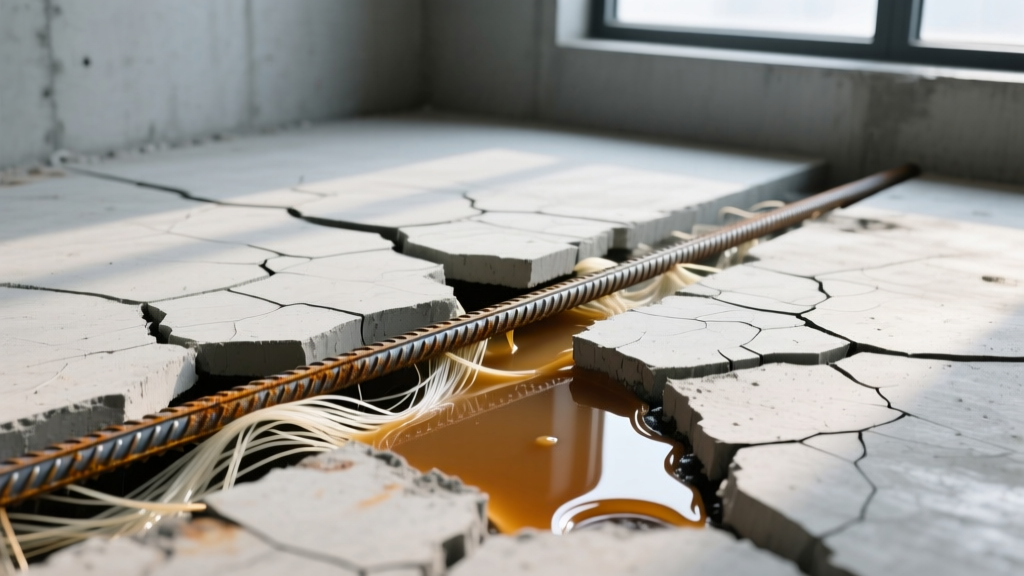
Fiber Reinforcement Failures & Repair Protocols
Symptom: Mid-Panel Cracking & Fiber Pull-Out
When evaluating concrete fiber vs rebar for flatwork, contractors often choose synthetic fibers to reduce labor costs. However, fiber failures usually stem from batch-plant dosing errors or joint-spacing miscalculations. Unlike rebar, which yields and bends under extreme stress, fibers either hold the matrix together or pull out entirely once the concrete's tensile limit is breached.
The National Ready Mixed Concrete Association (NRMCA) clearly distinguishes between micro-synthetic fibers (used solely for plastic shrinkage control) and macro-synthetic fibers (used for temperature and shrinkage steel replacement). A common edge-case failure occurs when a contractor orders 1.0 lb/cy of microfiber expecting it to replace a rebar grid, resulting in catastrophic structural cracking under vehicular loads.
Micro vs. Macro Fiber Dosing Errors
- Microfiber Under-dosing: Results in plastic shrinkage map cracking within the first 24 hours. Repair requires routing the cracks to a 1/4-inch depth and filling with a low-modulus polyurethane sealant like SikaFlex-1a.
- Macrofiber Pull-Out: If macro-fibers (e.g., Forta-Ferro or GCP Strux) are used at 3 to 5 lbs/cy but the control joints are sawed too late (beyond 12 hours in high heat), the slab will crack randomly. You will see plastic fibrils bridging the crack edges. Repair involves epoxy stitching (e.g., Simpson Strong-Tie FX-70) across the crack at 12-inch intervals to restore structural continuity.
Concrete Fiber vs Rebar: Overlay & Resurfacing Matrix
When an existing slab is too damaged for spot repairs and requires a 2-inch to 4-inch concrete overlay, the choice of reinforcement shifts. You cannot easily embed a #4 rebar grid in a 2-inch overlay without violating the 3/4-inch aggregate and cover rules. The matrix below dictates the optimal reinforcement strategy for repair overlays based on traffic loads.
| Overlay Scenario | Recommended Reinforcement | Why Not the Alternative? |
|---|---|---|
| Pedestrian Walkway (2-inch overlay) | Micro-synthetic fiber (1.5 lbs/cy) | Rebar requires 3+ inches of thickness for proper cover. |
| Residential Driveway (3-inch overlay) | Macro-synthetic fiber (5 lbs/cy) or WWM | Rebar is too thick; WWM can be pushed down during screeding. |
| Heavy-Duty Commercial Pad (4+ inch overlay) | #4 Rebar Grid (18-inch O.C.) | Fibers cannot handle the heavy dynamic point-loads of forklifts. |
2026 Material Costs & Dosing Economics
Understanding the financial impact of concrete fiber vs rebar is critical when bidding repair and overlay projects. While fibers drastically reduce labor time, the raw material costs per cubic yard vary significantly based on the polymer type and dosage rate.
- #4 Grade 60 Steel Rebar: Material costs range from $0.85 to $1.25 per linear foot. Installed in a standard 24-inch on-center grid, expect to pay $1.90 to $2.50 per square foot in labor and tie-wire.
- Micro-Synthetic Fiber (Polypropylene): Typically dosed at 0.5 to 1.5 lbs per cubic yard. Adds roughly $6.00 to $10.00 per cubic yard to the batch ticket. Negligible labor cost as it is added at the plant.
- Macro-Synthetic Fiber (Embossed/Fibrillated): Dosages range from 3.0 to 7.5 lbs per cubic yard to achieve equivalent temperature steel replacement. Adds $22.00 to $35.00 per cubic yard. For a standard 4-inch driveway slab, this equates to an added material cost of about $0.45 to $0.70 per square foot, yielding massive savings over hand-tying rebar.
For further technical specifications on synthetic fiber dosing and structural equivalency, contractors should consult the guidelines established by ACI Committee 544 on Fiber Reinforced Concrete, which provides the foundational testing matrices for post-cracking flexural performance.
Final Troubleshooting Directive
Always core-drill a 2-inch diameter sample from an existing slab before specifying an overlay or repair mortar. Visually confirming the presence, depth, and corrosion state of rebar—or the complete absence of fibers in a slab that was supposed to be fiber-reinforced—will prevent you from applying a cosmetic fix to a structural failure.
Written by
Sarah WhitfieldSarah Whitfield is a chartered quantity surveyor (MRICS) and construction cost analyst with 15 years of experience in material pricing, procurement strategy, and project budgeting. She earned her degree in Construction Management from the University of Reading (UK) and has worked on projects ranging from $2M custom homes to $180M mixed-use developments across North America and Europe. Sarah currently leads cost estimating for BuildMat Insight, maintaining a proprietary database of 4,000+ material price points updated quarterly. She is a frequent contributor to RSMeans cost data panels and has presented at the International Cost Engineering Council (ICEC) congress. Based in Denver, CO, Sarah is an avid trail runner and volunteer mentor for Women in Construction.
More from Sarah Whitfield
View all
Wood & Lumber
What Are the Different Types of Wood? A Builder's Guide
Compare structural softwoods, finish hardwoods, and engineered lumber. Analyze Janka ratings, MOE values, and 2026 pricing for construction.
Aug 4, 2026

Walls & Panels
Steel Framing vs Wood Framing: Corrosion and Moisture Defense
Compare steel framing vs wood framing for moisture resistance. Learn about galvanized coatings, condensation risks, and corrosion protection strategies.
Jul 21, 2026

Stone & Masonry
How to Cut Stone Veneer: Wet Saw vs Grinder Comparison
Compare the best tools for cutting stone veneer. We review wet saws, angle grinders, and chop saws to help you achieve clean, chip-free cuts.
Jul 21, 2026