What Type of Concrete for Countertops: The Ultimate Mix Guide
Discover what type of concrete for countertops yields the best results. Compare GFRC, wet cast, and topping mixes with expert ratios and costs.

Deciding What Type of Concrete for Countertops Fits Your Project
When fabricating architectural surfaces, standard bagged sidewalk concrete is a guaranteed path to failure. Determining what type of concrete for countertops will yield a durable, aesthetically pleasing surface requires understanding the unique structural demands of horizontal cantilevered slabs. Countertop concrete must achieve a minimum compressive strength of 5,000 PSI, exhibit near-zero shrinkage to prevent curling, and possess a specific rheology that allows it to capture intricate edge profiles without honeycombing.
The wrong mix design leads to plastic shrinkage cracking, efflorescence, and edge chipping. The right mix design—engineered with precise water-to-cement (w/c) ratios, pozzolans, and specialized aggregates—creates a dense, non-porous surface that rivals natural stone. Below, we break down the three primary concrete mix categories used in modern countertop fabrication, complete with exact ratios, product recommendations, and application showcases.
The Big Three: Countertop Concrete Mix Categories
Fabricators generally choose between three distinct mix designs based on the desired thickness, weight restrictions, and edge complexity of the project. Here is a comparison matrix of the primary mix types used in the industry today.
| Mix Category | Max Aggregate Size | Target w/c Ratio | Thickness Range | Weight (per sq. ft. at 1.5') | Best Application |
|---|---|---|---|---|---|
| Wet Cast (Traditional) | 3/8 inch | 0.35 - 0.40 | 1.5' to 2.0' | ~18.5 lbs | Standard kitchen counters, integral sinks |
| GFRC (Glass Fiber) | 1/4 inch (Face: 1/8') | 0.30 - 0.35 | 3/4' to 1.0' | ~9.0 lbs | Waterfall edges, cantilevers, wall cladding |
| Topping / Micro-topping | 1/16 inch (Sand) | 0.38 - 0.42 | 1/8' to 1/2' | ~2.5 lbs | Overlays on existing laminate or plywood |
Deep Dive: Glass Fiber Reinforced Concrete (GFRC)
GFRC has revolutionized the concrete countertop industry. By replacing traditional steel rebar with alkali-resistant (AR) glass fibers, fabricators can cast slabs that are 50% lighter and significantly more flexible than wet cast concrete, virtually eliminating structural cracking.
The Two-Coat Application Method
GFRC countertops are not poured; they are sprayed or troweled in two distinct layers:
- The Face Coat (Mist Coat): A 1/8-inch to 1/4-inch thick layer applied directly to the mold. This layer contains no glass fibers (to prevent them from ghosting through the polished surface) and uses finely graded silica sand (30-60 mesh). White Portland cement is often used here to ensure consistent, vibrant integral coloring.
- The Backup Coat: Applied immediately after the face coat loses its wet sheen. This layer contains the structural AR glass fibers (typically chopped to 3/4-inch lengths and dosed at 3% to 5% by weight of the total mix).
Essential GFRC Additives
To achieve the low w/c ratio required for GFRC without the mix becoming unworkable, an acrylic polymer is mandatory. Buddy Rhodes, a pioneer in GFRC countertop mixes, popularized the use of acrylic polymers like Forton VF-774. This polymer acts as a superplasticizer, a curing compound, and a flexural strength enhancer all in one. According to the Concrete Network, polymer-modified GFRC mixes can achieve flexural strengths exceeding 1,500 PSI, compared to just 400-600 PSI for standard wet cast concrete.
Wet Cast Traditional Mixes: When and How to Use Them
While GFRC dominates high-end architectural showcases, traditional wet cast concrete remains the standard for heavy, monolithic looks, integral drop-in sinks, and thick, rustic edge profiles like the Roman Ogee or Bullnose.
The Problem with Standard Bagged Mixes
A common beginner mistake is using standard Quikrete 5000 or similar big-box store mixes. These contain 3/4-inch gravel. When casting a 1.5-inch thick countertop with a detailed edge profile, the large aggregate gets blocked by the mold geometry, leaving voids (honeycombing) along the visible edges.
For wet cast countertops, you need a specialized mix with a maximum aggregate size of 3/8-inch or smaller. Products like Quikrete Countertop Mix (Model #1101-80) are formulated specifically for this, featuring a fine sand aggregate and a flowable consistency. However, professional fabricators often blend their own using Type I/II Portland cement, fine silica sand, and pozzolans.
The Role of Pozzolans and Superplasticizers
To reduce the cement content (which lowers heat of hydration and shrinkage) while increasing density, incorporate pozzolans:
- Metakaolin (10-15% replacement): Increases early strength, brightens the base color for integral pigments, and drastically reduces efflorescence by consuming free calcium hydroxide.
- Silica Fume (5-10% replacement): Fills microscopic voids between cement particles, creating an incredibly dense, low-porosity surface that resists staining.
Application Showcase: Matching Mix to Edge Profiles
The type of concrete you choose directly dictates what edge profiles you can successfully execute. Here is how the mixes perform in real-world fabrication scenarios:
- Eased / Square Edge: Works perfectly with all three mix types. GFRC is highly recommended here for large islands to reduce weight on cabinetry.
- Bullnose (Half or Full): Best achieved with Wet Cast mixes. The slight vibration required to settle wet cast concrete into a rounded melamine mold ensures a dense, void-free radius. GFRC face coats can struggle to stay packed into deep curved molds without sagging.
- Ogee / Chiseled Edge: Requires a highly flowable Wet Cast face coat or a specialized Topping Mix pressed by hand. Intricate details trap air; the mix must be fluid enough to self-level into the crevices of the mold.
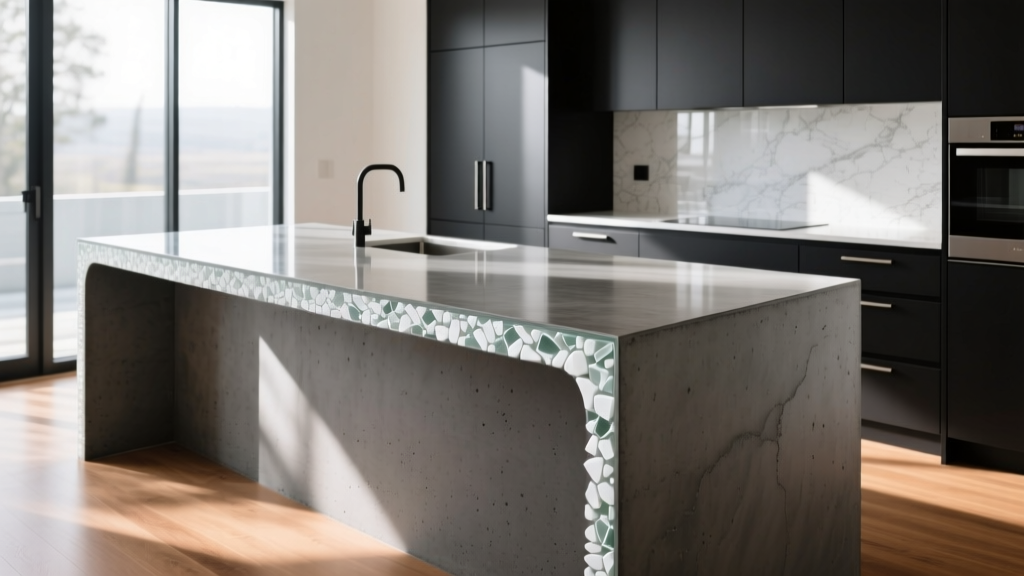
- Waterfall Miter Joints: Exclusively the domain of GFRC. The lightweight nature and high flexural strength of GFRC allow fabricators to create 45-degree mitered drop edges that extend to the floor without requiring heavy steel support armatures.
Curing and Sealing: Preventing the Dreaded 'Curl'
Knowing what type of concrete for countertops to use is only half the battle; improper curing will ruin a perfect mix. Concrete cures via hydration, not drying. If the top surface dries faster than the bottom, the slab will curl upward at the edges.
Step-by-Step Curing Protocol
- Initial Set (0-24 Hours): Cover the cast slab immediately with 6-mil plastic sheeting to trap bleed water. Do not expose to ambient air.
- Demolding (24-48 Hours): Carefully strip the melamine forms. The concrete will have reached roughly 1,500 PSI.
- Wet Curing (Days 2-7): Lay damp burlap or paper towels over the top and bottom of the slab, and re-cover with plastic. This ensures uniform hydration and prevents differential shrinkage.
- Drying Phase (Days 7-28): Remove the wet blankets. Allow the slab to dry uniformly in a climate-controlled environment before sealing. Trapping moisture under a topical sealer will cause cloudy blushing and adhesion failure.
Sealing Strategies for 2026
Modern countertop sealing has moved away from waxes and basic acrylics. The current industry standard involves a two-step hybrid approach:
- Densifier: Apply a lithium silicate penetrating densifier to harden the surface matrix and prevent micro-scratching.
- Topical Urethane/Polyaspartic: Apply a high-solids, water-based polyurethane (like Omega Concrete Countertop Sealer) or a polyaspartic coating. These provide UV stability, heat resistance up to 300°F, and complete resistance to acidic spills like lemon juice and red wine.
Cost Breakdown: DIY vs. Professional Fabrication
Understanding the financial implications of your chosen mix type helps set realistic project budgets. The costs below reflect average material and labor rates for custom architectural concrete.
| Project Scope | Mix Type Used | Material Cost (per sq. ft.) | Total Installed Cost (per sq. ft.) |
|---|---|---|---|
| DIY Wet Cast (Basic) | Bagged Countertop Mix | $4.00 - $7.00 | $4.00 - $7.00 (Sweat Equity) |
| DIY GFRC (Advanced) | Custom Sand/Cement + Polymer | $9.00 - $14.00 | $9.00 - $14.00 (Sweat Equity) |
| Pro Fabricated (Standard) | Wet Cast / Integral Color | $25.00 - $40.00 | $85.00 - $115.00 |
| Pro Fabricated (High-End) | GFRC / Exposed Aggregate | $35.00 - $60.00 | $120.00 - $165.00+ |
Frequently Asked Questions
Can I use regular concrete mix and just sand it down?
Technically yes, but practically no. Standard concrete mixes contain large gravel (up to 3/4 inch). When you sand or polish the surface to expose the aggregate for a terrazzo look, the large stones will pull out of the matrix, leaving deep, unsightly craters. Furthermore, standard mixes lack the pozzolans required to prevent efflorescence (white, powdery salt deposits) from ruining your finish.
Does concrete crack on countertops?
Micro-crazing (hairline surface cracking) is a natural characteristic of cementitious materials and is generally accepted as part of the aesthetic. However, structural cracking is a sign of failure, usually caused by a high w/c ratio, lack of reinforcement, or inadequate curing. Using GFRC or adding PVA (polyvinyl alcohol) microfibers to wet cast mixes effectively eliminates structural cracking.
How thick does a concrete countertop need to be?
For traditional wet cast concrete, 1.5 inches is the standard minimum thickness to accommodate the 3/8-inch aggregate and provide adequate mass for polishing. For GFRC, because the tensile strength is provided by the glass fibers rather than mass, slabs can be cast as thin as 3/4 inch while maintaining structural integrity, significantly reducing the load on kitchen cabinetry.
Written by
James ThorntonJames Thornton is a construction industry veteran with 25 years of hands-on experience in wood framing, lumber grading, and residential building codes. He started as a framing carpenter in rural Oregon, earned his ICC Residential Building Inspector certification, and eventually became a senior plan reviewer for the City of Portland Bureau of Development Services. James holds a B.S. in Wood Science & Technology from Oregon State University and is a certified lumber grader through the West Coast Lumber Inspection Bureau (WCLIB). He has inspected over 3,000 residential construction sites and authored the city's internal guide on advanced framing techniques (2x6 at 24" O.C.). James lives in Bend, OR, where he builds custom timber-frame cabins and competes in lumberjack sports.
More from James Thornton
View all
Insulation
Best Home Insulation Materials: Complete 2026 Guide
Compare top home insulation materials for 2026. Find R-values, installed costs per square foot, and best uses for fiberglass, spray foam, and mineral wool.
Aug 4, 2026

Sustainable Building
Certify Your Green Building Material for LEED and WELL
Step-by-step guide to certifying a green building material for LEED v5 and WELL v2. Master EPDs, HPDs, and VOC limits for 2026 project specifications.
Aug 4, 2026

Stone & Masonry
Veneer Stacked Stone Panels: Interior Design & Style Showcase
Discover how veneer stacked stone panels transform interiors. Explore modern design profiles, material pairings, and technical installation specs.
Aug 4, 2026