Repairing a Crack in Concrete Slab Foundation: Top Brand Guide
Compare top epoxy and polyurethane brands to repair a crack in concrete slab foundation. Includes product lines, costs, and structural triage.
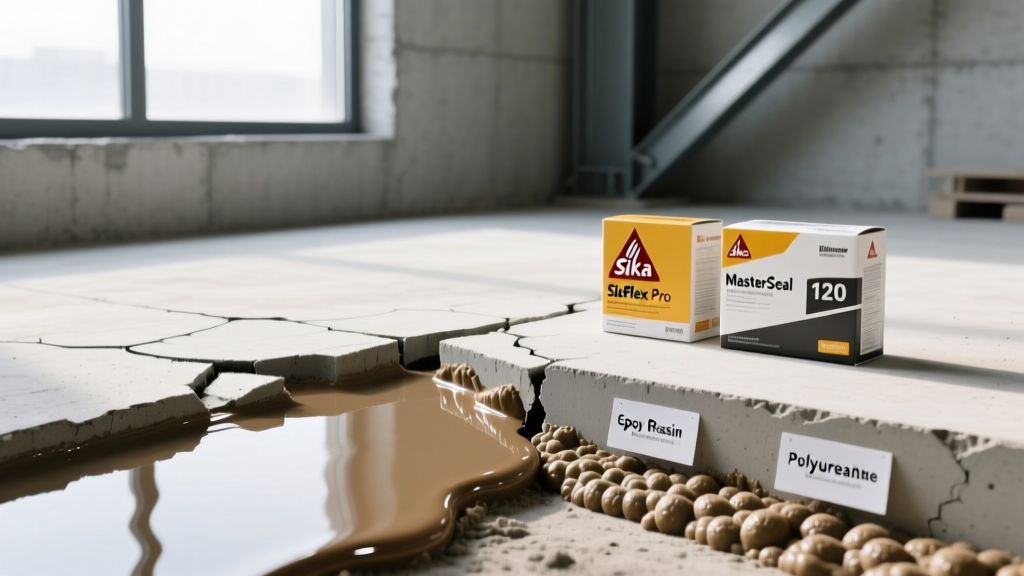
Diagnostic Triage: Identifying Your Slab Crack Profile
Before selecting a chemical repair system, you must accurately classify the crack in concrete slab foundation you are dealing with. The Portland Cement Association categorizes slab cracking into three primary failure modes: plastic shrinkage, drying shrinkage, and structural settlement. Selecting the wrong product line for the wrong failure mode guarantees repair failure within 12 to 18 months.
- Non-Structural / Shrinkage Cracks: Typically less than 1/8 inch wide, meandering, and uniform in width. Best treated with flexible polyurethane sealants or low-modulus epoxies.
- Structural / Settlement Cracks: Wider at the top than the bottom, often accompanied by drywall cracks above. Require high-modulus structural epoxies or professional foam jacking.
- Active Leak Cracks: Cracks that weep water during heavy rain. Require hydrophilic polyurethane injection foams that expand upon contact with moisture.
Brand Deep-Dive: Sika (Polyurethane & Epoxy Injections)
Sika remains the industry standard for both commercial and high-end residential concrete repair. Their product line is strictly divided between flexible sealants and rigid structural adhesives. For a non-structural crack in concrete slab foundation that is subject to minor thermal expansion and contraction, Sikaflex-11 FC+ is the go-to polyurethane sealant. It offers a movement capability of ±15% and adheres to damp concrete, costing roughly $9 to $12 per 10.1 oz cartridge.
When to Use SikaDur for Structural Repair
If the crack is structural and requires the restoration of the slab's original tensile strength, you must upgrade to the SikaDur line. SikaDur 35 Hi-Mod is a high-modulus, high-build epoxy adhesive. Unlike polyurethane, which remains flexible, SikaDur 35 cures to a compressive strength of over 10,000 psi, effectively welding the concrete back together. It is sold in dual-cartridge systems (approx. $45 to $60 per cartridge) and requires a specialized static-mixing nozzle and a heavy-duty caulking gun capable of a 1:1 mix ratio.
Brand Deep-Dive: RadonSeal (DIY & Pro Injection Kits)
For contractors and advanced DIYers looking for a complete, low-pressure injection system, RadonSeal’s CrackWeld product line dominates the market. The CrackWeld PRO kit (priced between $160 and $220 in 2026) includes everything needed to inject a two-part, hydrophobic polyurethane resin deep into the slab.
The primary advantage of the CrackWeld line is its expansion ratio. The resin expands up to 20 times its liquid volume, forcing the material into microscopic capillaries and secondary fissures branching off the main crack. Because it is hydrophobic, it will not degrade when exposed to soil moisture beneath the slab. However, it is strictly for dry cracks; if the crack is actively leaking water during the injection process, the foam will not properly cure against the substrate.
Brand Deep-Dive: Simpson Strong-Tie (Heavy-Duty Anchoring & Repair)
While widely known for structural connectors, Simpson Strong-Tie manufactures some of the most reliable structural epoxies on the market. Their SET-XP (Structural Epoxy Tie) is an acrylic-epoxy hybrid designed primarily for anchoring, but its high tensile strength makes it an excellent choice for stitching or gravity-filling severe structural cracks in thick slabs (6 inches or deeper). SET-XP costs roughly $55 per 8.5 oz cartridge. It is NSF-certified for potable water contact, making it a mandatory choice if the crack in concrete slab foundation is located beneath a basement floor drain or sump pit where groundwater interaction is a concern.
Product Line Comparison Matrix
| Brand / Product | Chemistry | Best Application | Est. Cost (2026) |
|---|---|---|---|
| Sikaflex-11 FC+ | Polyurethane | Non-structural, surface sealing | $9 - $12 / tube |
| SikaDur 35 Hi-Mod | High-Modulus Epoxy | Structural welding of rigid cracks | $45 - $60 / cart |
| RadonSeal CrackWeld PRO | Hydrophobic Polyurethane | Deep injection, dry active cracks | $160 - $220 / kit |
| Simpson SET-XP | Acrylic-Epoxy Hybrid | Deep structural, wet environments | $55 / cartridge |
| Emecole Metro 555 | Hydrophilic Polyurethane | Actively leaking, weeping cracks | $130 - $150 / kit |
Advanced Structural Stabilization: PolyLevel & Foam Jacking
If your diagnostic triage reveals that the crack in concrete slab foundation is caused by soil subsidence (the dirt beneath the slab has washed away or compacted), no liquid epoxy or polyurethane sealant will fix the root cause. The slab must be lifted and supported. This is where brands like PolyLevel (a proprietary high-density polyurethane foam used by the Foundation Supportworks network) come into play.
PolyLevel is injected beneath the slab through 5/8-inch drilled ports. The foam expands with controlled force, lifting the sunken concrete back to its original grade while compacting the loose soil below. Unlike traditional mudjacking (which uses a heavy slurry of cement and topsoil that can weigh 120 lbs per cubic foot and cause further subsidence), PolyLevel weighs only 2 to 4 lbs per cubic foot. In 2026, professional PolyLevel slab jacking averages $15 to $25 per square foot of lifted area, depending on regional soil conditions and the depth of the void.
Step-by-Step Protocol for Low-Pressure Polyurethane Injection
For DIYers using the RadonSeal CrackWeld or similar low-pressure injection kits, strict adherence to the application protocol is required to prevent blowouts and ensure deep penetration.
- Surface Preparation: Use a wire brush and a shop-vac to remove all loose concrete dust, debris, and efflorescence from the crack. The substrate must be structurally sound.
- Port Installation: Drill 1/2-inch holes at a 45-degree angle to intersect the crack below the surface. Space ports every 8 to 10 inches along the crack length. Insert and glue the plastic injection ports using a fast-setting surface epoxy paste.
- Surface Sealing: Trowel the surface epoxy paste over the entire length of the crack, embedding the ports. This creates a pressure seal. Allow 2 to 4 hours for the surface seal to cure completely.
- Resin Injection: Load the dual-cartridge polyurethane resin into the dispensing gun. Begin injecting at the lowest port (gravity assists the flow). Inject slowly until resin begins to purge from the next adjacent port.
- Port Capping: Cap the purging port, move the gun to the newly filled port, and continue the sequence until the entire crack is packed.
- Cure and Grind: Allow 24 hours for full chemical cure. Use an angle grinder with a diamond cup wheel to grind the hardened surface epoxy and ports flush with the slab.
When to Abandon DIY and Call a Structural Engineer
The American Concrete Institute (ACI) provides strict tolerances for concrete deflection and cracking. If a crack in concrete slab foundation exceeds 1/4 inch in width, exhibits a stair-step pattern in adjacent masonry, or causes doors and windows in the framing above to bind, chemical injection is merely a cosmetic band-aid. At this threshold, you must hire a licensed structural engineer (typically costing $400 to $800 for an on-site assessment) to design a helical pier or push pier underpinning system before any cosmetic crack repair is executed.