Concrete Leveling vs Replacement: Cost Breakdown Analysis
Analyze the true costs of concrete leveling vs replacement. Compare polyjacking, mudjacking, and full slab tear-out with expert financial data.

The Financial Baseline: Concrete Leveling vs Replacement Costs
When evaluating sunken, uneven, or mildly damaged concrete slabs, property owners and facility managers face a critical capital allocation decision: rehabilitate the existing substrate or execute a full tear-out and repour. The choice between concrete leveling vs replacement hinges on a precise intersection of structural viability, subgrade conditions, and long-term return on investment. A superficial cost comparison often misleads decision-makers because it ignores secondary variables like demolition tipping fees, subgrade remediation, and material cure times.
The following cost matrix outlines the 2026 baseline pricing for a standard 400-square-foot residential driveway or commercial sidewalk slab (4 inches thick). These figures encompass materials, labor, equipment mobilization, and standard site preparation.
| Remediation Method | Material Cost (per sq ft) | Labor & Equipment (per sq ft) | Total Project Average (400 sq ft) | Time to Service |
|---|---|---|---|---|
| Mudjacking (Slurry) | $1.50 - $2.50 | $2.50 - $4.00 | $1,600 - $2,600 | 24 - 48 hours |
| Polyurethane Foam Jacking | $3.00 - $5.50 | $3.50 - $5.00 | $2,600 - $4,200 | 15 - 30 minutes |
| Full Replacement (Tear-out & Pour) | $4.50 - $7.00 | $6.50 - $11.00 | $4,400 - $7,200+ | 7 - 14 days (incl. cure) |
Leveling Technologies: Cementitious Slurry vs. Structural Polyurethane
Concrete leveling is not a monolithic process. The two primary methodologies—mudjacking and polyurethane foam jacking (polyjacking)—utilize vastly different materials with distinct geotechnical implications.
Mudjacking: The Traditional Slurry Approach
Mudjacking involves pumping a cementitious slurry beneath the sunken slab through 1.5-inch to 2-inch diameter drill holes. The slurry typically consists of topsoil, sand, water, and Type I or Type II Portland cement.
- Density: Approximately 100 to 120 lbs per cubic foot.
- Drawbacks: The heavy slurry adds significant dead load to an already compromised subgrade. In regions with high water tables or expansive clay soils, the soil-heavy mixture is susceptible to hydro-erosion, meaning the underlying cause of the settlement may recur within 3 to 5 years.
- Best Application: Large, heavy municipal slabs (highway approaches, thick warehouse floors) where the added weight is negligible and budget constraints are strict.
Polyurethane Foam Jacking: The Modern Standard
Polyjacking utilizes a two-part, high-density, closed-cell structural polyurethane foam injected through 5/8-inch holes.
- Density: 2.5 to 4.0 lbs per cubic foot, expanding to 20-30 times its liquid volume.
- Advantages: The foam is hydro-insensitive and impermeable to water, effectively sealing the subgrade against future erosion. It adds virtually no dead load to the underlying soil. According to geotechnical data reviewed by the Federal Highway Administration, closed-cell polymers maintain structural integrity without degrading in saturated soil environments.
- Best Application: Residential driveways, pool decks, commercial walkways, and interior warehouse floors where minimal downtime and precise elevation control (within 1/10th of an inch) are required.
Diagnostic Framework: When Replacement is Mandatory
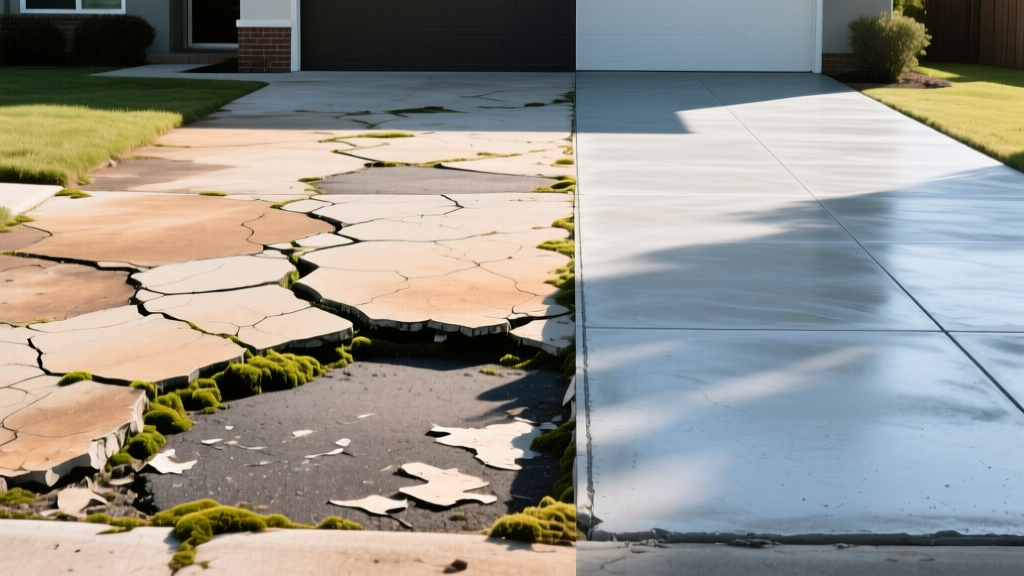
Leveling addresses vertical displacement; it does not fix structural degradation of the concrete matrix itself. Attempting to level a structurally failed slab is a sunk cost. Full replacement is strictly required when the following failure modes are present:
Fatal Concrete Failure Modes
- Alkali-Silica Reaction (ASR): Often termed "concrete cancer," ASR occurs when reactive silica in the aggregates reacts with alkali hydroxides in the Portland cement, forming a swelling gel that expands and fractures the slab from within. The Portland Cement Association notes that ASR damage is irreversible and requires total slab replacement with low-alkali cements or supplementary cementitious materials (SCMs) like fly ash or slag.
- D-Cracking: A series of fine cracks parallel to and near the joints and edges, caused by the freeze-thaw deterioration of susceptible coarse aggregates (like certain limestones or cherts). Once D-cracking breaches the surface, the slab's structural integrity is compromised.
- Severe Rebar Corrosion and Spalling: If chloride ingress (from de-icing salts) has caused the internal steel reinforcement to oxidize, the expanding rust will spall the concrete cover. If spalling exceeds 2 inches in depth or covers more than 15% of the slab surface, leveling will only result in the foam or slurry escaping through the delaminated areas.
- Map Cracking with Subgrade Washout: Interconnected shallow cracking combined with large voids beneath the slab indicates total subgrade failure, often requiring excavation and soil stabilization before any new concrete can be poured.
Hidden Variables: The True Cost of Tear-Out and Replacement
When comparing concrete leveling vs replacement, the sticker price of a new pour rarely tells the full financial story. Facility managers and homeowners must account for the "invisible" costs associated with demolition and site preparation.
The Tipping Fee and Hauling Factor
Concrete is exceptionally heavy. A standard 400-square-foot slab poured at a 4-inch thickness weighs approximately 19.7 tons (assuming 145 lbs/ft³ for reinforced concrete). In 2026, municipal and private recycling centers charge concrete tipping fees ranging from $40 to $85 per ton.
Disposal Math: 19.7 tons × $65/ton average = $1,280 solely in dumping fees. Add the cost of heavy equipment mobilization (skid steers, excavators) and flatbed hauling, and the demolition phase alone can consume 20% to 30% of the total replacement budget before a single cubic yard of fresh concrete is ordered.
Subgrade Remediation and Permitting
If a slab failed due to poor initial compaction, simply pouring a new slab over the same unprepared dirt guarantees future settlement. Proper replacement requires excavating 4 to 6 inches of native soil, importing a granular base course (like crushed limestone or recycled concrete aggregate), and compacting it to 95% Standard Proctor density. This adds $1.50 to $3.00 per square foot to the project. Furthermore, municipal permits for full curb cuts or driveway replacements can add $200 to $800 in administrative fees and inspection delays, whereas leveling rarely triggers building code permit requirements.
Decision Matrix: Level or Replace?
Use this rapid diagnostic guide to determine the most financially and structurally sound pathway for your concrete project.
- IF the slab is structurally sound (no ASR, minimal surface spalling) AND has sunk uniformly due to minor soil consolidation ➔ CHOOSE Polyurethane Leveling.
- IF the slab is heavily cracked into small pieces (alligator cracking) OR exhibits severe freeze-thaw degradation (D-cracking) ➔ CHOOSE Full Replacement.
- IF the slab is adjacent to a sensitive structure (historic masonry, delicate landscaping) where heavy demolition equipment cannot reach ➔ CHOOSE Polyurethane Leveling (requires only hand-carried pumps and minimal footprint).
- IF the underlying soil is highly expansive clay that undergoes severe seasonal heave ➔ CHOOSE Full Replacement with deep soil stabilization (lime treatment or helical piers), as leveling materials cannot resist active soil expansion forces.
- IF the project is a massive municipal highway approach or thick industrial apron where aesthetics are secondary and budget is the primary constraint ➔ CHOOSE Mudjacking.
Long-Term ROI and Lifespan Projections
The ultimate metric in the concrete leveling vs replacement debate is the cost-per-year of service life.
A full concrete replacement, assuming a proper 4000 PSI mix with a 0.45 water-to-cement ratio and adequate control joints, carries an expected lifespan of 30 to 50 years. Amortizing a $6,000 replacement over 40 years equates to $150 annually.
Polyurethane leveling typically carries a lifespan of 10 to 20+ years, provided the subgrade moisture dynamics are stabilized. Amortizing a $3,400 polyjacking job over 15 years equates to $226 annually.
While replacement offers a lower annualized cost over a half-century, the immediate capital outlay, environmental impact of demolition, and operational downtime (often 7 to 14 days for curing and heavy equipment access) make high-density polyurethane leveling the superior ROI for slabs that retain structural integrity but suffer from geotechnical settlement.
Written by
Sarah WhitfieldSarah Whitfield is a chartered quantity surveyor (MRICS) and construction cost analyst with 15 years of experience in material pricing, procurement strategy, and project budgeting. She earned her degree in Construction Management from the University of Reading (UK) and has worked on projects ranging from $2M custom homes to $180M mixed-use developments across North America and Europe. Sarah currently leads cost estimating for BuildMat Insight, maintaining a proprietary database of 4,000+ material price points updated quarterly. She is a frequent contributor to RSMeans cost data panels and has presented at the International Cost Engineering Council (ICEC) congress. Based in Denver, CO, Sarah is an avid trail runner and volunteer mentor for Women in Construction.
More from Sarah Whitfield
View all
Wood & Lumber
What Are the Different Types of Wood? A Builder's Guide
Compare structural softwoods, finish hardwoods, and engineered lumber. Analyze Janka ratings, MOE values, and 2026 pricing for construction.
Aug 4, 2026

Walls & Panels
Steel Framing vs Wood Framing: Corrosion and Moisture Defense
Compare steel framing vs wood framing for moisture resistance. Learn about galvanized coatings, condensation risks, and corrosion protection strategies.
Jul 21, 2026

Stone & Masonry
How to Cut Stone Veneer: Wet Saw vs Grinder Comparison
Compare the best tools for cutting stone veneer. We review wet saws, angle grinders, and chop saws to help you achieve clean, chip-free cuts.
Jul 21, 2026