Hardie Fiber Cement Siding Taxonomy: Profiles and Selection Guide
Navigate the Hardie fiber cement siding taxonomy. Compare HardiePlank, HardiePanel, and HardieShingle profiles, climate zones, and costs.
The Anatomy of Fiber Cement: Why Hardie Dominates the Category
Fiber cement is a composite material engineered from Portland cement, cellulose wood fibers, sand, and water. This specific matrix yields a siding product that is impervious to rot, non-combustible (achieving a Class A fire rating), and highly resistant to impact. James Hardie pioneered the autoclave curing process for fiber cement in the 1980s, effectively eliminating the asbestos used in early iterations and securing roughly 90% of the North American fiber cement market share. When builders and architects specify fiber cement, they are almost invariably specifying Hardie fiber cement siding products. However, treating the brand as a monolith is a critical error in material selection. The product line is highly segmented by profile, climate formulation, and finish technology.
Hardie Product Taxonomy: Lap, Vertical, and Shingle Profiles
Selecting the correct profile dictates not only the architectural aesthetic but also the installation methodology, waste factor, and structural load. The taxonomy is divided into three primary form factors.
HardiePlank Lap Siding
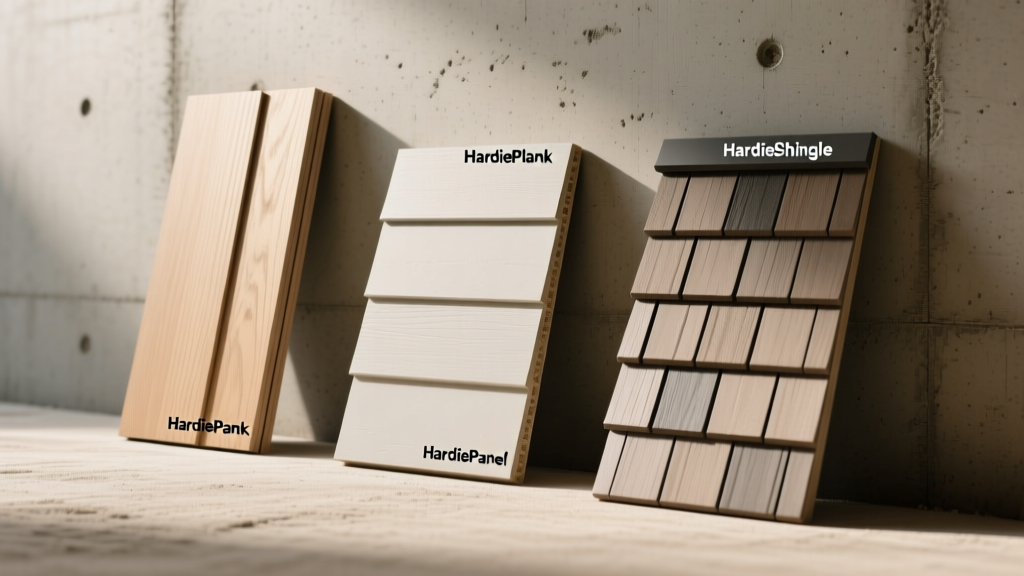
HardiePlank is the traditional horizontal lap siding and the highest-volume product in the portfolio. It is manufactured at a standard thickness of 5/16-inch and is available in 8.25-inch and 9.25-inch widths. The critical metric for lap siding is the exposure—the visible portion of the board after the 1.25-inch top overlap. An 8.25-inch board yields a 7-inch exposure. HardiePlank is offered in two primary textures: Select Cedarmill (which mimics real wood grain) and Smooth (for modern or traditional painted aesthetics). Because of its length (12 feet), it requires staggered vertical joints, which must be sealed or flashed.
HardiePanel Vertical Siding
HardiePanel is engineered for vertical applications, most commonly utilized to achieve the board-and-batten or vertical ribbed aesthetic. It is manufactured in 5/16-inch thick sheets, typically in 4x8, 4x9, and 4x10-foot dimensions. The stucco and smooth textures are the most prevalent. Unlike lap siding, vertical panels require joint treatment using either H-profile aluminum trim, color-matched caulk, or wood battens. Building Science Corporation heavily advocates for ventilated rain screens behind vertical panels to manage bulk water drainage, as the vertical seams are more vulnerable to wind-driven rain than overlapping horizontal laps.
HardieShingle Siding
Designed to replicate cedar shakes without the susceptibility to moisture and insect damage, HardieShingle is available in two configurations: Individual Shingles (for authentic, staggered shadow lines) and Continuous Panels (which feature a straight or staggered bottom edge but are installed as large sheets to reduce labor). The continuous panels are 5/16-inch thick and come in 48-inch lengths, dramatically reducing the install time compared to individual shakes.
| Profile Line | Thickness | Standard Dimensions | Max Exposure | Architectural Application |
|---|---|---|---|---|
| HardiePlank Lap | 5/16" | 12' x 8.25" / 9.25" | 7" or 8" | Traditional, Farmhouse, Colonial |
| HardiePanel Vertical | 5/16" | 4' x 8', 9', 10' | N/A (Full Sheet) | Modern, Board-and-Batten, Ag |
| HardieShingle Individual | 5/16" | Various widths, 16" length | 7" | Cape Cod, Craftsman, Accents |
| HardieShingle Panel | 5/16" | 48" x 16" | 7" | High-volume shake applications |
Climate Engineering: The HardieZone System
Fiber cement is not a one-size-fits-all chemical formulation. James Hardie engineers its products using the proprietary HardieZone system, which alters the fiber-to-cement ratio and the specific additives based on regional environmental stressors. Ordering the wrong zone product is a frequent cause of premature warranty voidance.
HZ5 vs. HZ10 Formulations
HZone 5 (HZ5): Engineered for northern climates characterized by freezing temperatures, snow, and ice. HZ5 products feature a denser micro-fiber reinforcement matrix to resist freeze-thaw spalling and cracking. The bottom edge is specially contoured to drip water away from the board below, preventing ice damming at the overlaps.
HZone 10 (HZ10): Formulated for southern and coastal climates facing high UV radiation, intense humidity, and hurricane-force winds. HZ10 utilizes proprietary additives that minimize moisture absorption (preventing swelling) and includes a specialized primer that resists blistering and peeling under extreme solar heat gain.
Finish Technology: ColorPlus vs. Primed
The finish selection drastically impacts both the upfront material budget and the long-term maintenance cycle. Hardie products are sold either factory-primed (requiring field painting) or with the ColorPlus Technology factory-applied finish.
- Primed: Features a single coat of factory-applied primer. The contractor must apply two topcoats of 100% acrylic exterior paint within 180 days of installation. While the material cost is lower, the field labor for scaffolding, spraying, and back-rolling adds significant expense.
- ColorPlus Technology: Features multiple coats of proprietary acrylic paint baked onto the board in a controlled factory environment. This ensures uniform mil-thickness and superior adhesion. The standard ColorPlus line carries a 15-year fade resistance warranty. For premium projects, the Dream Collection offers over 700 colors with a 30-year fade resistance warranty, utilizing advanced UV-blocking pigments.
2026 Cost Breakdown and Installation Realities
Pricing for Hardie fiber cement siding fluctuates based on regional supply chain dynamics, profile complexity, and finish selection. The data below reflects average national material and installed costs for 2026.
| Product Configuration | Material Only | Installed Cost (Labor + Mat) | Notes |
|---|---|---|---|
| HardiePlank Primed | $3.20 - $4.00 | $9.50 - $12.00 | Requires field painting ($2-$3/sq ft extra) |
| HardiePlank ColorPlus | $4.50 - $5.80 | $11.00 - $14.50 | No field painting required; faster install |
| HardiePanel Vertical | $2.80 - $3.50 | $8.50 - $11.00 | Lower waste factor; requires batten trim |
| HardieShingle Panel | $5.00 - $6.50 | $13.00 - $16.50 | Premium profile; complex flashing details |
Common Failure Modes and Edge Cases
Despite its durability, fiber cement is unforgiving of improper installation. The vast majority of field failures are not material defects, but rather violations of the manufacturer's installation instructions. According to James Hardie warranty documentation, the following edge cases will instantly void the product warranty:
- Insufficient Ground Clearance: Siding must terminate a minimum of 6 inches above the finished grade. Soil contact leads to capillary moisture uptake, causing the bottom courses to swell, delaminate, and crumble.
- Roof and Deck Clearance: A minimum 2-inch clearance must be maintained where siding intersects a roofline, deck, or step. Failing to flash and maintain this gap traps bulk water behind the siding plane.
- Fastener Blindness and Blowouts: Hardie requires corrosion-resistant hot-dipped galvanized or stainless steel nails (minimum 1.25-inch length). Nailing too close to the edge (less than 3/4-inch from the side edge or 1-inch from the bottom edge) causes the brittle cement matrix to fracture and blow out, compromising the wind-load holding capacity.
- Silica Dust Mismanagement: Cutting fiber cement generates respirable crystalline silica. OSHA standard 29 CFR 1926.1153 mandates strict dust control. Contractors must use specialized fiber cement shears (which produce zero dust) or score-and-snap tools. If using a circular saw, it must be equipped with a HEPA dust extraction system and a polycrystalline diamond (PCD) blade designed specifically for fiber cement.
Selection Framework: Matching Profile to Architecture
To finalize your material selection, apply this decision framework based on the architectural intent of the project:
- For Modern / Contemporary Builds: Select HardiePanel Vertical in Smooth texture, paired with matte black aluminum trim profiles. Alternatively, use HardiePlank Smooth with a 5-inch reveal for a tight, linear shadow line.
- For Traditional / Farmhouse Builds: HardiePlank Select Cedarmill is the definitive choice. Pair with PVC corner boards and a 7-inch exposure to replicate historical wood lap siding authentically.
- For High-Moisture / Coastal Zones: Prioritize HZ10 formulations. Avoid HardieShingle in direct splash zones, as the intricate shadow lines can trap wind-driven salt spray; opt for HardiePanel or tightly lapped HardiePlank instead, ensuring a ventilated rain screen cavity is detailed behind the cladding.