Pavers vs Stamped Concrete Cost: 2026 Installation Guide
Compare the pavers vs stamped concrete cost for 2026. This installation guide breaks down base prep, labor, materials, and long-term repair economics.

Executive Cost & Installation Summary
Stamped concrete averages $12 to $18 per square foot installed, while interlocking concrete pavers range from $16 to $25 per square foot. While pavers carry a 25-30% higher upfront premium, they require 20% more base material and eliminate the risk of catastrophic structural cracking. When evaluating the pavers vs stamped concrete cost over a 20-year lifecycle, pavers often yield a lower total cost of ownership in regions with severe freeze-thaw cycles or expansive clay soils due to near-zero structural repair costs.
Upfront Installation Costs: Pavers vs Stamped Concrete
Calculating the true pavers vs stamped concrete cost requires looking beyond the surface material. The pricing gap is primarily driven by labor intensity, base material volume, and the specialized tools required for each system. Stamped concrete is a rigid pavement system that relies on the tensile strength of the slab, whereas pavers form a flexible pavement system that distributes loads through interlocking friction and base confinement.
| Cost Component | Stamped Concrete (per sq. ft.) | Concrete Pavers (per sq. ft.) |
|---|---|---|
| Excavation & Base Material | $2.50 - $3.50 | $3.50 - $5.00 |
| Surface Materials (Concrete/Pavers) | $3.00 - $5.00 | $5.00 - $9.00 |
| Labor & Equipment | $5.50 - $8.00 | $7.00 - $11.00 |
| Sealing & Finishing | $1.00 - $1.50 | $0.50 - $1.00 (Polymeric Sand) |
| Total Average Installed Cost | $12.00 - $18.00 | $16.00 - $26.00 |
Subgrade and Base Preparation: The Hidden Cost Driver
The most frequent cause of premature failure in both systems is inadequate subgrade preparation. According to guidelines from the National Concrete Masonry Association (NCMA), flexible paver systems require a thicker, more rigorously compacted base than rigid concrete slabs to prevent differential settling.
Stamped Concrete Base Requirements
For a standard 4-inch stamped concrete slab, excavation must reach 8 to 10 inches below the finished grade. The subgrade requires 4 to 6 inches of compacted Class II road base (crushed aggregate). Because the concrete slab itself acts as a structural bridge over minor subgrade inconsistencies, the base compaction requirement is typically 95% Standard Proctor density. A 6-mil polyethylene vapor barrier is often placed over the base to prevent moisture from wicking out of the concrete during the curing process, which is critical for preventing plastic shrinkage cracks.
Paver Base Requirements
Pavers transfer loads directly to the base. Excavation must reach 9 to 12 inches deep. The American Concrete Institute (ACI) and ICPI standards mandate 6 to 8 inches of crushed angular aggregate, compacted in 2-inch lifts to achieve 98% Proctor density. In poorly draining soils, a non-woven geotextile fabric must be laid at the subgrade level to prevent clay migration into the aggregate base. This additional depth, material volume, and compaction labor is a primary reason the pavers vs stamped concrete cost skews higher during the earthwork phase.
If your site features highly expansive clay (e.g., in regions like Texas or Colorado), stamped concrete will almost certainly crack as the soil swells and shrinks, regardless of rebar reinforcement. In these scenarios, pavers are mandatory. The flexible joints accommodate soil movement without structural failure. Attempting to save money with stamped concrete on expansive soils will result in total slab replacement within 5 to 7 years.
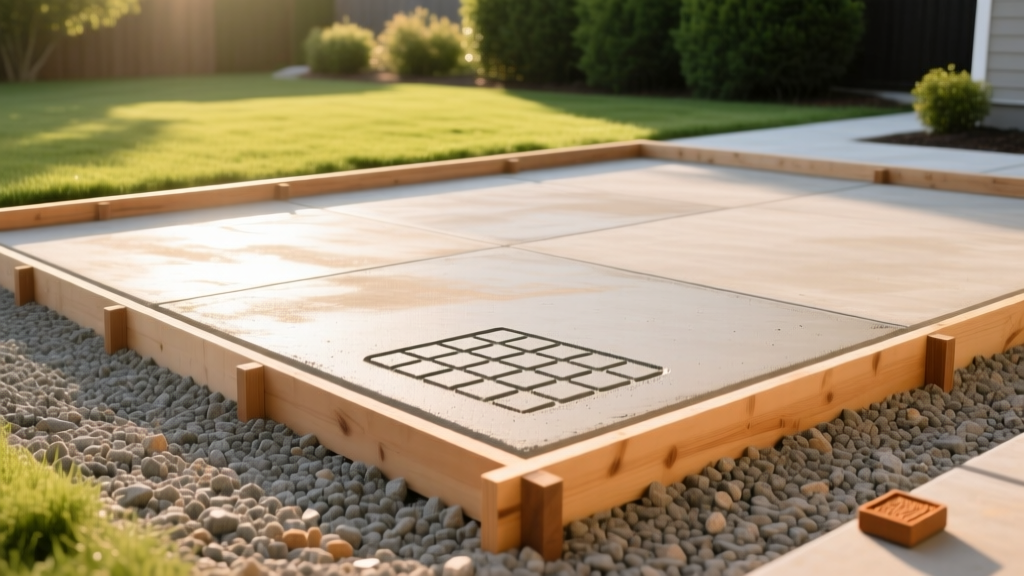
Installation Workflows: Forming and Pouring vs. Laying and Compacting
The labor dynamics of the two systems dictate the final installation price. Stamped concrete requires a highly coordinated, time-sensitive crew, while paver installation is methodical, physically demanding, and less bound by the clock.
Stamped Concrete: The Race Against the Clock
Once the 4000 PSI air-entrained concrete is poured, the crew has a strict window to strike off the surface, float it, and apply the stamping mats before initial set occurs. This requires a minimum crew of 3 to 4 experienced installers. The stamping process involves broadcasting a liquid or powdered release agent (which prevents the mats from sticking and adds secondary color) and pressing polyurethane stamping mats into the surface. If the concrete sets too fast due to high ambient temperatures or wind, the stamping will tear the surface, resulting in a costly tear-out. The slab must then cure for 28 days before a solvent-based acrylic sealer is applied to enhance the color and protect the release agent.
Pavers: Methodical Assembly and Confinement
Paver installation is not time-sensitive but is labor-intensive. After the base is compacted, a 1-inch layer of ASTM C33 concrete sand is screeded to create a perfectly level bedding. Pavers (which must meet ASTM C936 standards for compressive strength and freeze-thaw durability) are laid by hand. The critical cost factor here is the edge restraint. Without a rigid perimeter restraint—either poured-in-place concrete curbs or heavy-duty plastic restraints secured with 10-inch galvanized spikes—the pavers will creep outward and the joints will fail. Finally, a vibratory plate compactor (minimum 5,000 lbs of compaction force) is run over the surface to seat the pavers, and polymeric sand is swept into the joints and activated with water to lock the system together and prevent weed growth.
Long-Term Economics: Repair, Maintenance, and Lifespan
Evaluating the pavers vs stamped concrete cost requires a 20-year lifecycle analysis. Rigid and flexible pavements age very differently.
- Crack Repair: Stamped concrete will develop control joints, and despite saw-cutting and reinforcement, random cracking is a matter of 'when,' not 'if.' Repairing a cracked stamped slab requires epoxy injection or full-panel demolition and repouring, which rarely matches the original faded color. Pavers do not crack; if a section settles, you simply 'unzip' the pavers, re-grade the sand base, and relay them with zero visible repair lines.
- Sealing and Maintenance: Stamped concrete requires resealing every 2 to 3 years to prevent UV degradation and surface spalling, costing $1.50 to $2.50 per square foot per application. Pavers do not strictly require sealing, though a joint stabilizer can be applied every 4 to 5 years to replenish the polymeric sand.
- Utility Access: If a water line or irrigation pipe beneath the hardscape fails, accessing it through stamped concrete means jackhammering and patching. Pavers can be lifted and replaced seamlessly after the utility repair.
Climate and Soil Decision Matrix
Use this framework to determine which system provides the best return on investment for your specific site conditions.
| Site Condition | Stamped Concrete | Concrete Pavers | Verdict |
|---|---|---|---|
| Stable, well-draining soil | Excellent | Excellent | Stamped wins on upfront cost. |
| Expansive clay soils | Poor (High crack risk) | Excellent | Pavers are mandatory. |
| Severe freeze-thaw cycles | Good (if air-entrained) | Excellent | Pavers win on longevity. |
| Heavy tree root encroachment | Poor (Roots will shatter slab) | Good (Can be re-leveled) | Pavers offer repairability. |
| Complex curves and tight radii | Difficult (Forming is costly) | Excellent | Pavers are easier to shape. |
Authoritative References
For detailed engineering specifications regarding base compaction, paver manufacturing standards, and concrete mix designs, consult the following industry authorities:
- National Concrete Masonry Association (NCMA) - Technical notes on flexible pavement design and edge restraint requirements.
- American Concrete Institute (ACI) - Guidelines on slab-on-grade preparation, jointing, and curing protocols.
- National Ready Mixed Concrete Association (NRMCA) - Specifications for air-entrained decorative concrete mixes and aggregate sizing.
Written by
Sarah WhitfieldSarah Whitfield is a chartered quantity surveyor (MRICS) and construction cost analyst with 15 years of experience in material pricing, procurement strategy, and project budgeting. She earned her degree in Construction Management from the University of Reading (UK) and has worked on projects ranging from $2M custom homes to $180M mixed-use developments across North America and Europe. Sarah currently leads cost estimating for BuildMat Insight, maintaining a proprietary database of 4,000+ material price points updated quarterly. She is a frequent contributor to RSMeans cost data panels and has presented at the International Cost Engineering Council (ICEC) congress. Based in Denver, CO, Sarah is an avid trail runner and volunteer mentor for Women in Construction.
More from Sarah Whitfield
View all
Wood & Lumber
What Are the Different Types of Wood? A Builder's Guide
Compare structural softwoods, finish hardwoods, and engineered lumber. Analyze Janka ratings, MOE values, and 2026 pricing for construction.
Aug 4, 2026

Walls & Panels
Steel Framing vs Wood Framing: Corrosion and Moisture Defense
Compare steel framing vs wood framing for moisture resistance. Learn about galvanized coatings, condensation risks, and corrosion protection strategies.
Jul 21, 2026

Stone & Masonry
How to Cut Stone Veneer: Wet Saw vs Grinder Comparison
Compare the best tools for cutting stone veneer. We review wet saws, angle grinders, and chop saws to help you achieve clean, chip-free cuts.
Jul 21, 2026