Troubleshooting Common Types of Expansion Joints in Concrete
Learn how to diagnose and repair different types of expansion joints in concrete. Includes material specs, failure modes, and step-by-step fix protocols.
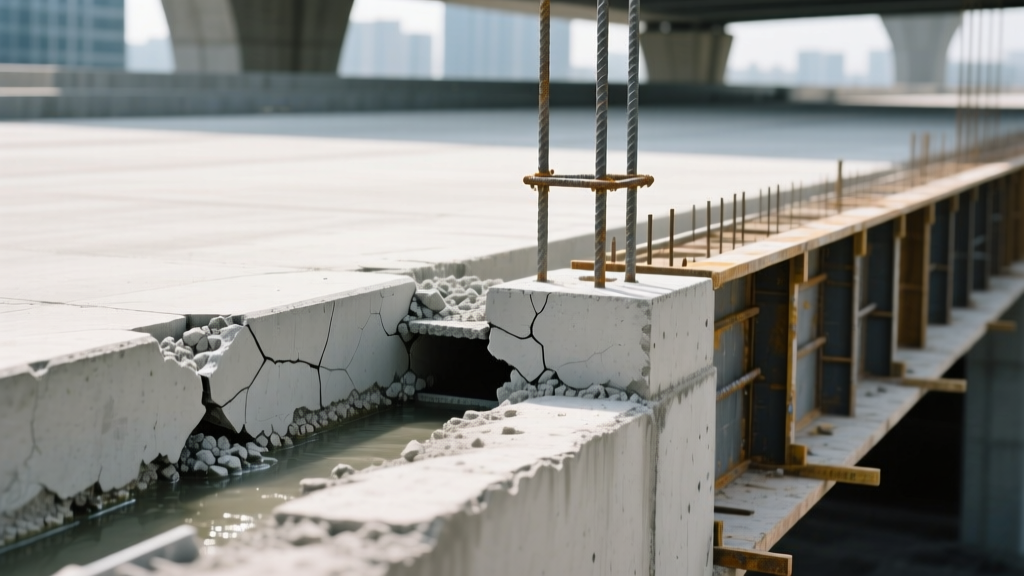
Diagnostic Matrix: Identifying Joint Failure Modes
Concrete slabs are dynamic structures. Thermal expansion, moisture fluctuations, and live loads induce continuous movement. When evaluating the various types of expansion joints in concrete, it is critical to recognize that joint failure is rarely a material defect; it is almost always a design, preparation, or installation error. According to the Portland Cement Association, uncontrolled cracking and joint spalling account for over 60% of premature concrete pavement distress.
| Observed Symptom | Probable Root Cause | Primary Joint Type Affected |
|---|---|---|
| Sealant tearing or cohesive failure | Improper width-to-depth ratio; lack of primer on porous concrete | Isolation / Perimeter Joints |
| Joint extrusion (sealant pushing up) | Joint width too narrow for thermal expansion range; 3-sided adhesion | True Expansion Joints |
| Edge spalling and raveling | Late saw-cutting; heavy hard-wheel traffic on soft sealants | Contraction / Control Joints |
| Subgrade washout and slab faulting | Water infiltration due to detached backer rod or sealant debonding | All Types |
Clarifying the Terminology: Expansion vs. Isolation vs. Contraction
Before initiating repairs, contractors must correctly identify the joint's intended function. Misidentifying the joint type leads to catastrophic material selection errors.
- True Expansion Joints: Designed with a preformed compressible filler (like closed-cell neoprene or asphalt-impregnated fiberboard) to accommodate significant thermal expansion without inducing compressive stress. Common in bridges, retaining walls, and long-run pavements.
- Isolation Joints: Separate the slab from rigid vertical structures (columns, foundations, curbs). They must accommodate both vertical and horizontal movement.
- Contraction (Control) Joints: Induced weaknesses created by saw-cutting to control where the concrete cracks as it shrinks during curing. Often mislabeled as expansion joints in field terminology.

Step-by-Step Repair Protocols by Joint Type
1. Repairing Isolation Joints (Perimeter & Structural)
The Failure: Sealant detaches from the concrete substrate, allowing water to pool against the building foundation or structural column.
The Fix:
- Route and Clean: Use a diamond-blade joint router (e.g., Husqvarna Soff-Cut) to widen the joint to a minimum of 1/2 inch and remove degraded sealant. Follow with high-pressure water blasting (minimum 3,000 PSI) and compressed air drying.
- Prime: Apply a specialized primer like Sika Primer-3 N to the concrete faces. This is non-negotiable for porous substrates to prevent outgassing and ensure chemical bonding.
- Install Backer Rod: Insert a closed-cell polyethylene backer rod that is 25% larger than the joint width. This ensures a tight friction fit and prevents 3-sided adhesion.
- Seal: Apply a high-movement polyurethane sealant (e.g., Sikaflex-1a or MasterSeal CR 195). Maintain a strict 2:1 width-to-depth ratio for horizontal joints (e.g., a 1-inch wide joint requires a 1/2-inch depth of sealant).
2. Repairing True Expansion Joints (Thermal Movement)
The Failure: The compressible filler board has disintegrated, or the pourable sealant has extruded upward due to extreme summer heat expansion.
The Fix:
- Excavate Filler: Use a hook knife and heat gun to extract the failed asphalt-impregnated fiberboard or degraded foam. Do not damage the concrete arris (edge).
- Install Preformed Neoprene: For joints experiencing movement exceeding 2 inches, transition from pourable sealants to preformed compression seals (e.g., Emseal SJ or Watson Bowman). These are installed using a specialized lubricant and roller tool, ensuring continuous compression against the joint walls.
- Alternative (Polysulfide): If using a pourable method for moderate movement, select a polysulfide sealant. Polysulfides offer superior resistance to fuel and chemical spills, making them the standard for airport aprons and gas station pads, as noted in FHWA pavement guidelines.
3. Repairing Contraction Joints (Spalling & Raveling)
The Failure: The edges of the saw-cut joint have chipped away under heavy forklift traffic, creating a bump hazard and accelerating joint deterioration.
The Fix:
- Saw-Cut New Arris: Cut a straight, clean line parallel to the damaged joint edge to remove the spalled concrete.
- Patch with Epoxy Mortar: Apply a high-modulus, rapid-setting epoxy mortar to rebuild the edge. Standard cementitious patching materials will fail under dynamic wheel loads.
- Fill with Polyurea: Fill the joint with a semi-rigid polyurea joint filler (e.g., Metzger/McGuire Spal-Pro RS 88). Unlike soft polyurethanes, semi-rigid polyurea supports the joint edges against hard-wheel traffic while still allowing for minor thermal contraction.
Material Selection Matrix for 2026 Repairs
Selecting the wrong sealant chemistry is the most common cause of repeat failures. Use this matrix to match the material to the specific environmental and mechanical demands of the joint.
| Sealant / Filler Type | Movement Capability | Cure Time | Best Application Scenario | Limitations |
|---|---|---|---|---|
| Polyurethane (e.g., Sikaflex-1a) | +/- 25% to 50% | 24-48 hours | Standard exterior slabs, pedestrian plazas, parking decks | Degrades under prolonged UV exposure without coating; poor fuel resistance |
| Polysulfide (e.g., MasterSeal M 860) | +/- 25% | 24 hours | Airport taxiways, fueling pads, chemical processing plants | Strong odor during application; requires strict mixing ratios |
| Semi-Rigid Polyurea (e.g., Spal-Pro) | Low (Thermal only) | 1-2 hours | Interior warehouse floors, distribution centers with heavy forklift traffic | Will tear if joint experiences significant vertical shear movement |
| Preformed Neoprene Foam | Up to 50% compression | N/A (Instant) | Bridge abutments, highway expansion joints, large structural gaps | Requires precise joint width tolerances; difficult to install in irregular gaps |
If sealant bonds to the bottom of the joint as well as the two side walls, it cannot stretch or compress. When the concrete expands, the sealant will tear itself apart internally (cohesive failure). Always use a backer rod or a bond-breaker tape on the joint floor to ensure the sealant only adheres to the two parallel vertical faces.
Critical Mistakes That Guarantee Repeat Failures
Ignoring the Width-to-Depth Ratio
Applying sealant too deep restricts its ability to elongate. For horizontal joints, the depth of the sealant should be exactly half the width (2:1 ratio), up to a maximum depth of 1/2 inch. For vertical joints, maintain a 1:1 ratio, capped at 3/8 inch deep. Exceeding these depths wastes material and induces internal shear stresses during thermal cycling.
Failing to Account for Installation Temperature
Joints are widest in the dead of winter and narrowest in peak summer. If you install a highly elastic sealant in mid-winter when the joint is fully open, the sealant will be subjected to extreme compression in the summer, leading to extrusion. The American Concrete Institute (ACI) recommends installing joint sealants during moderate temperatures (spring or fall) when the joint is near its median width, or adjusting the backer rod depth to compensate for seasonal extremes.
Using the Wrong Backer Rod
Open-cell backer rods act like sponges. If the sealant skin is punctured, water enters the open-cell foam, saturates it, and causes the sealant to blister and debond from the inside out. Always specify closed-cell polyethylene backer rods for exterior concrete applications to ensure a secondary moisture barrier.
FAQ: Joint Repair Edge Cases
Can I just rout out the old sealant and apply new sealant directly over the residue?
No. Polyurethane and polysulfide sealants will not chemically bond to cured versions of themselves or to silicone residues. You must rout the joint to expose fresh, clean concrete aggregate. If silicone was previously used, the joint must be aggressively ground or sandblasted, as silicone leaves an invisible film that prevents adhesion of any other chemistry.
How do I repair an expansion joint that has widened beyond 2 inches?
Standard pourable sealants will sag and fail in joints wider than 1.5 inches. For gaps exceeding 2 inches, transition to a preformed compression seal system or install a structural metal cover plate with a neoprene gland. Attempting to fill a 3-inch gap with liquid sealant and backer rod will result in massive material waste and inevitable failure.
What is the expected lifespan of a properly repaired concrete expansion joint?
With correct surface preparation, proper width-to-depth ratios, and high-quality materials, a polyurethane or polysulfide sealant repair should last 7 to 10 years. Preformed neoprene compression seals can last 15 to 20 years. Semi-rigid polyurea fillers in interior warehouse environments often last the lifetime of the floor slab (20+ years) unless subjected to extreme thermal shock.
Written by
David NakamuraDavid Nakamura is a licensed architect (AIA) and construction technology writer focused on sustainable building methods, mass timber engineering, and high-performance building envelopes. He holds a Master of Architecture from the University of Washington and is a certified Passive House Consultant (CPHC). David spent eight years at the Seattle firm Mithun, where he led the design of three LEED Platinum projects, before founding his own practice specializing in net-zero residential design. He serves on the editorial advisory board of GreenBuilder Magazine and has authored peer-reviewed papers on cross-laminated timber (CLT) connections for the Journal of Structural Engineering. In his spare time, David teaches woodworking at Pratt Fine Arts Center and kayaks the Puget Sound.
More from David Nakamura
View all
Construction Cost
Labor Cost to Build a Deck Per Sq Ft: 2026 Installation Guide
Discover the exact labor cost to build a deck per sq ft in 2026. This installation guide breaks down contractor rates, complexity factors, and hidden fees.
Aug 4, 2026

Construction Cost
How Much Does It Cost to Build a 3 Bedroom House? Financing Guide
Learn exactly how much it costs to build a 3 bedroom house and explore 2026 financing options, construction loan types, and budget frameworks for your build.
Aug 4, 2026

Construction Cost
Cost to Build a Tennis Court: 2026 Guide
How much does it cost to build a tennis court in 2026? Breakdowns for asphalt, concrete, and synthetic surfaces plus fencing and lighting.
Jul 30, 2026