Fiberglass vs Concrete Pool: Full Cost Breakdown 2026
Compare the true 2026 costs of fiberglass vs concrete pools. We break down installation, excavation, maintenance, and 10-year ownership expenses.
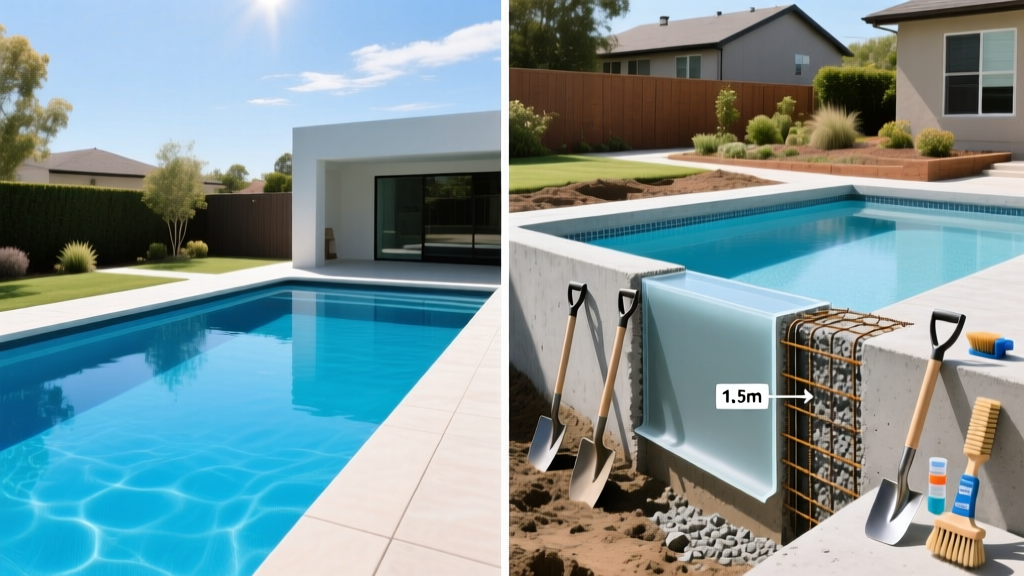
The Upfront Installation Cost Matrix
Choosing between a fiberglass and concrete (gunite/shotcrete) pool requires looking past the initial brochure price. In 2026, supply chain stabilization has normalized shell prices, but labor rates and site-specific engineering continue to drive significant variances. According to industry data tracked by Angi's home improvement network, the national average for an inground pool sits between $70,000 and $115,000, but the material you choose dictates where that money is actually spent.
| Cost Category | Fiberglass Pool (Avg. 14'x30') | Concrete Gunite Pool (Avg. 14'x30') |
|---|---|---|
| Shell Material | $22,000 - $38,000 | $28,000 - $45,000 (Rebar & Gunite) |
| Excavation & Hauling | $4,500 - $8,000 | $6,000 - $12,000 (Longer site time) |
| Crane / Heavy Equipment | $1,500 - $4,000 (Mandatory) | $800 - $1,500 (Pump trucks only) |
| Plumbing & Electrical | $7,000 - $11,000 | $8,500 - $14,000 |
| Coping & Decking (Basic) | $9,000 - $15,000 | $12,000 - $22,000 |
| Backfill & Engineering | $3,500 - $6,000 (Crushed stone) | $1,500 - $3,000 (Native soil) |
| Total Estimated Base | $55,000 - $90,000 | $75,000 - $125,000+ |
Hidden Site Preparation and Excavation Variables
The base prices above assume ideal conditions: flat terrain, standard loam soil, and clear overhead access. Real-world sites rarely comply. The physical properties of fiberglass and concrete dictate how they handle adverse site conditions, directly impacting your final invoice.
Fiberglass pools are manufactured off-site and delivered as a single, monolithic shell. If your property lacks a 50-foot clearance path from the street to the backyard, a standard crane cannot set the shell. You will either need to hire a specialized hydraulic boom crane ($4,000+) or, in extreme cases, a helicopter lift ($10,000+). Concrete pools are built entirely in situ, bypassing overhead access issues entirely.
Soil Mechanics and Backfill Requirements
Concrete pools rely on their massive structural weight and steel rebar grid (typically #4 or #5 rebar spaced at 10-inch centers) to resist hydrostatic pressure. Once the 4,000 PSI gunite cures for 28 days, the shell is self-supporting, allowing contractors to backfill with native excavated soil.
Fiberglass shells, conversely, are flexible. If backfilled with expansive clay or native dirt that retains water, the lateral pressure can cause the sidewalls to bow or the floor to "float" and crack. Fiberglass installations strictly require clean, angular crushed stone (usually 3/8-inch or 1/2-inch clean gravel) for backfill, which self-compacts and drains water away from the shell. This material requirement adds $2,000 to $4,000 to the project compared to using free native dirt.
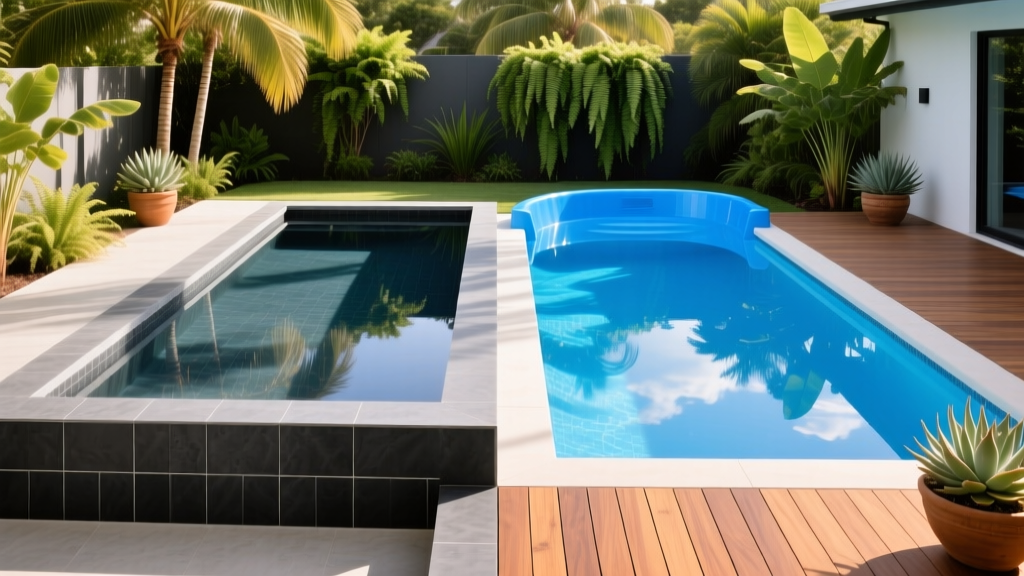
Long-Term Ownership: The 10-Year Maintenance Ledger
Installation is only the entry fee. The chemical and structural maintenance required over a decade reveals the true financial divergence between these materials. The Portland Cement Association notes that while concrete is exceptionally durable, its porous nature in submerged, chemically treated environments requires active surface management.
Chemical Consumption and Surface Care
- Concrete (Gunite): The rough, porous surface of plaster or pebble-tec finishes provides microscopic harbors for algae. Concrete pools require 30% to 40% more chlorine and algaecide annually than fiberglass. Expect to spend $1,100 to $1,500 per year on chemicals. Additionally, the surface must be acid-washed every 3 to 5 years ($300-$450) to remove calcium scaling and mineral stains.
- Fiberglass: The non-porous gel coat finish resists algae adhesion and does not alter water chemistry. Chemical costs typically range from $600 to $850 annually. The surface requires zero acid washing.
The Resurfacing Reality Check
Around year 12 to 15, a concrete pool's interior plaster or pebble finish will degrade, spall, or stain beyond chemical correction. Replastering a standard 14'x30' pool costs between $8,500 and $14,000 in 2026. Fiberglass pools do not require resurfacing. However, if a fiberglass shell suffers a structural impact crack or severe osmotic blistering (due to cheap orthophthalic resins used by discount manufacturers), structural gel coat repair costs $2,500 to $5,000 per incident.
Energy Efficiency and Heating Economics
If you plan to heat your pool, the thermal properties of the shell material will dictate your monthly utility bills. According to the U.S. Department of Energy, pool heating accounts for the vast majority of a pool's ongoing energy footprint.
Concrete's Thermal Mass: Concrete and the surrounding earth act as a massive heat sink. When you fire up a gas heater or heat pump, the concrete shell absorbs a significant portion of the thermal energy before the water temperature rises. It takes longer to heat a concrete pool from scratch, but it also retains heat longer once the heater is turned off.
Fiberglass Insulation: Fiberglass resin and the surrounding gravel backfill act as mild insulators. A fiberglass pool will heat up roughly 20% faster than a concrete pool of the same volume, reducing the runtime required on your heat pump or gas heater. Over a 6-month swim season, this thermal efficiency can save $150 to $300 annually in heating costs.
Decision Framework: Which Material Fits Your Scenario?
Use this diagnostic framework to align your site conditions and financial priorities with the correct material.
Choose Fiberglass If:
- You have a strict timeline (fiberglass pools are typically completed in 3 to 6 weeks, compared to 3 to 4 months for concrete).
- Your property has wide, unobstructed overhead access for a 70-ton crane.
- You want to minimize weekly chemical balancing and avoid a $10,000+ resurfacing bill in year 15.
- You are installing a standard geometric shape (rectangle, kidney, or Roman end) and do not require custom vanishing edges or integrated structural spas.
Choose Concrete (Gunite) If:
- Your site has tight access, steep slopes, or overhead power lines that prevent crane operation.
- You demand a highly customized footprint, specific depth profiles (like a deep diving well combined with a shallow sun shelf), or complex infinity edge engineering.
- You plan to stay in the home for 20+ years and view the pool as a permanent architectural feature that can be completely remodeled and reshaped in the future.
- You have a high water table and need the sheer mass of a reinforced concrete shell to resist hydrostatic uplift without relying on complex gravel drainage systems.
Frequently Asked Questions
Does a fiberglass pool add less resale value than a concrete pool?
No. In 2026, real estate appraisers generally value both types of inground pools similarly, provided they are well-maintained. However, in luxury markets where custom architectural integration is expected, concrete pools may yield a slightly higher return on investment due to their bespoke nature.
Can fiberglass pools be installed in cold climates with frost heave?
Yes, but the engineering must be precise. The clean gravel backfill must extend below the local frost line, and the plumbing lines must be pitched perfectly to drain completely for winterization. Concrete pools in frost zones require specialized expansion joints and thicker shotcrete applications to prevent frost-induced cracking.
Which pool type is more resistant to ground shifting and earthquakes?
Fiberglass pools possess high tensile flexibility, allowing them to absorb minor ground shifting and seismic vibrations without cracking. Concrete pools are rigid; significant soil subsidence or seismic activity will cause structural fractures in the gunite shell that require expensive epoxy injection and stapling repairs.
Written by
Elena RodriguezElena Rodriguez is a civil engineer and technical writer specializing in concrete technology, masonry systems, and ASTM/ACI compliance. She earned her B.S. in Civil Engineering from Texas A&M University and spent a decade at a materials testing laboratory, performing over 2,000 concrete compressive strength tests and masonry prism evaluations. Elena is an ACI-certified Field Testing Technician (Grade I) and a member of ASTM Committee C12 on Natural Building Stone. She currently consults on forensic engineering cases involving concrete failures and moisture intrusion. Based in San Antonio, TX, Elena is a proud member of the Society of Women Engineers (SWE) and coaches her daughter's FIRST Robotics team.
More from Elena Rodriguez
View all
Walls & Panels
Cost Analysis: Light Gauge Steel Framing Advantages and Disadvantages
Evaluate light gauge steel framing advantages and disadvantages through a strict cost analysis lens, comparing material, labor, and lifecycle expenses.
Aug 4, 2026

Walls & Panels
Gypsum Board Types: Exact Specifications, Thickness & Dimensions
Compare standard, Type X, and moisture-resistant gypsum board types. Get exact specifications, thicknesses, dimensions, and ASTM standards for your project.
Aug 4, 2026

Fire Resistance
Best Fire-Resistant Outdoor Decking Materials: 2026 Buyer Guide
Discover the best fire-resistant outdoor decking materials for 2026. Compare Class A PVC, aluminum, and hardwood options for WUI compliance and safety.
Aug 4, 2026