HardieBacker Concrete Board: Application-Fit & Scenario Guide
Match HardieBacker concrete board to your exact tile project. Compare 1/4-inch vs 1/2-inch specs, wet-area limits, and competitor alternatives.
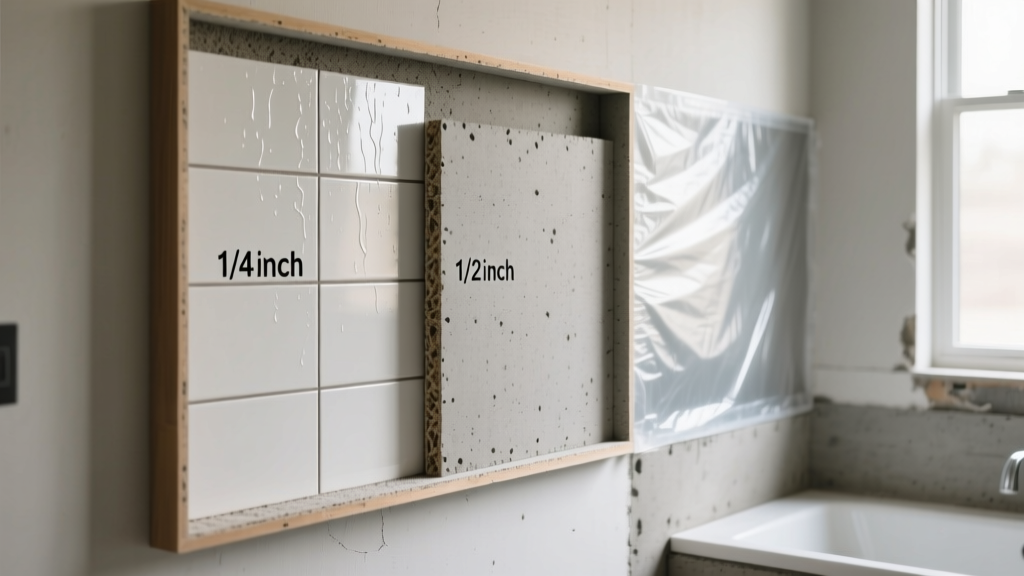
While widely searched as hardiebacker concrete board, James Hardie’s flagship tile backer is technically a fiber-cement product. True concrete boards contain coarse aggregates and are significantly heavier, whereas fiber-cement boards like HardieBacker use a cellulose fiber and Portland cement matrix. This distinction is not just semantic; it dictates how the material handles moisture, how it must be cut, and where it structurally belongs in your assembly. Misapplying this material remains one of the most common causes of tile delamination and grout cracking in residential and light-commercial builds.
Material Taxonomy: The Nomenclature Clarification
According to the Tile Council of North America (TCNA) Handbook, cementitious backer units (CBUs) must meet ANSI A118.9 standards. HardieBacker meets this standard, but its application-fit depends entirely on whether you are managing vertical wall loads, horizontal floor deflection, or continuous water exposure.
Scenario Decision Matrix: Where It Excels and Fails
Before purchasing, map your specific project scenario against this performance matrix to determine if fiber-cement is the correct substrate.
| Application Scenario | HardieBacker Suitability | Required Specification | Primary Failure Risk |
|---|---|---|---|
| Interior Shower Walls | Excellent | 1/2" (500) + Liquid Membrane | Unsealed seams wicking moisture to studs |
| Bathroom Floors (Over Plywood) | Good | 1/4" + Modified Thinset Bond | Omitting thinset under board causing flex |
| Steam Showers / Continuous Steam | Poor | Not Recommended | Vapor drive penetrating cement matrix |
| Exterior Cladding Substrate | Moderate | 1/2" + Weather Barrier | Freeze-thaw spalling if unsealed |
| Kitchen Countertops | Excellent | 1/4" or 1/2" over 3/4" plywood | Unsupported overhangs cracking at seams |
Product Line Breakdown: Matching Thickness to Assembly
HardieBacker 1/4-Inch (Floor and Countertop Underlayment)
The 1/4-inch board (typically 3' x 5') weighs approximately 27 pounds. It is engineered strictly as an underlayment to provide a dimensionally stable, water-resistant surface for thinset adhesion. It adds zero structural rigidity to the floor. The National Tile Contractors Association (NTCA) mandates that the structural subfloor beneath it must already meet an L/360 deflection rating for stone, or L/720 for natural stone. The 1/4-inch board must be embedded in a layer of modified thinset (ANSI A118.4) over the plywood subfloor to eliminate vertical movement, then screwed every 8 inches.
HardieBacker 500 (1/2-Inch Wall Board)
Weighing roughly 56 pounds per 3' x 5' sheet, the 1/2-inch board is designed for wall applications. It bridges studs spaced a maximum of 16 inches on-center. Because of its weight and brittleness, carrying and cutting 1/2-inch fiber-cement requires specialized scoring tools or diamond-blade grinders equipped with dust shrouds to prevent silica dust inhalation.
HardieBacker with HydroDefense Technology
Introduced to compete with integrated waterproof boards like GoBoard, the HydroDefense line features a water-resistant core and coated edges. While it resists water penetration far better than standard fiber-cement, industry best practices for 2026 still dictate treating seams and fastener holes with a liquid-applied waterproofing membrane in wet areas. Do not assume the board is a standalone waterproofing assembly in a shower pan environment.
Fastener and Mortar Chemistry: The Most Common Failure Points
"The majority of backer board failures we inspect are not material defects, but chemical incompatibilities between the fasteners, the thinset, and the alkaline nature of Portland cement." — Forensic Tile Consultant Report
Fiber-cement is highly alkaline. When exposed to moisture, this alkalinity accelerates the corrosion of standard metals. If you use standard drywall screws or uncoated galvanized fasteners, they will rust, expand, and telegraph brown stains through your grout lines or cause the board to detach from the framing.
- Fasteners: You must use alkali-resistant, corrosion-coated cement board screws (e.g., Buildex Rock-On or Backer-On). For walls, use 1-1/4" or 1-5/8" screws. For floors, use 1-1/4" screws to avoid penetrating PEX plumbing or radiant heat tubes below the subfloor.
- Thinset Mortar: Standard unmodified thinset (ANSI A118.1) lacks the bond strength and flexibility required for fiber-cement. Always use a polymer-modified thinset (ANSI A118.4 or ANSI A118.15) to bond the board to the subfloor and to bond the tile to the board.
- Seam Treatment: All joints must be taped with 2-inch alkali-resistant fiberglass mesh tape and filled with thinset. Standard drywall paper tape will dissolve in the alkaline thinset environment.
Competitor Scenario Matching: When to Choose Alternatives
While HardieBacker is a legacy standard, modern assemblies sometimes demand different material properties. Use this framework to decide when to pivot to an alternative.
Choose Schluter Kerdi-Board When:
You are building a steam shower or require a fully integrated, lightweight waterproofing system. Foam boards eliminate the need for secondary liquid membranes and cut with a standard utility knife, saving hours of labor and eliminating silica dust.
Choose Johns Manville GoBoard When:
You need a lightweight, inherently waterproof fiberglass-faced polyiso board for standard shower walls. It is significantly lighter than 1/2" HardieBacker, reducing installer fatigue, and features a built-in sealant system for fastener holes.
Choose GP DensShield When:
You are tiling high-volume commercial restrooms or laundry rooms where budget and speed are paramount. Glass-mat gypsum is cheaper and faster to install, though it cannot handle the continuous hydrostatic pressure of a residential shower pan.
2026 Cost and Yield Analysis
Material pricing has stabilized following the supply chain disruptions of the early 2020s. Below is the current builder-tier pricing and labor yield for standard HardieBacker products.
| Product SKU / Type | Dimensions | Avg. Sheet Cost | Cost per Sq. Ft. | Labor Yield (per 8hr day) |
|---|---|---|---|---|
| HardieBacker 1/4" (Standard) | 1/4" x 3' x 5' (15 sq ft) | $11.50 - $13.00 | $0.76 - $0.86 | 450 - 550 sq ft |
| HardieBacker 500 (1/2") | 1/2" x 3' x 5' (15 sq ft) | $13.50 - $15.50 | $0.90 - $1.03 | 300 - 400 sq ft |
| HardieBacker HydroDefense | 1/2" x 3' x 5' (15 sq ft) | $16.00 - $18.50 | $1.06 - $1.23 | 300 - 400 sq ft |
| Alkali-Resistant Screws (1-5/8") | 1 lb box (~130 screws) | $8.50 - $10.00 | N/A | N/A |
Note: Labor yields assume a two-person crew with pre-cut materials and do not include the time required for taping seams, applying liquid waterproofing membranes, or mixing thinset.
Final Assembly Verification
Specifying the correct backer board is only half the battle; executing the assembly correctly ensures the longevity of the tile installation. Always verify that your floor joist deflection meets the L/360 minimum before laying 1/4-inch underlayment, and never rely on the cement board itself as your primary waterproofing barrier in wet zones. By matching the specific thickness and coating of the board to your exact environmental and structural scenario, you eliminate the primary vectors for tile assembly failure.