Acid Stain vs Water Based Concrete Stain: A Mix Design Guide
Discover how concrete mix design impacts acid stain vs water based concrete stain. Compare chemistry, costs, and SCM limits for flawless decorative floors.
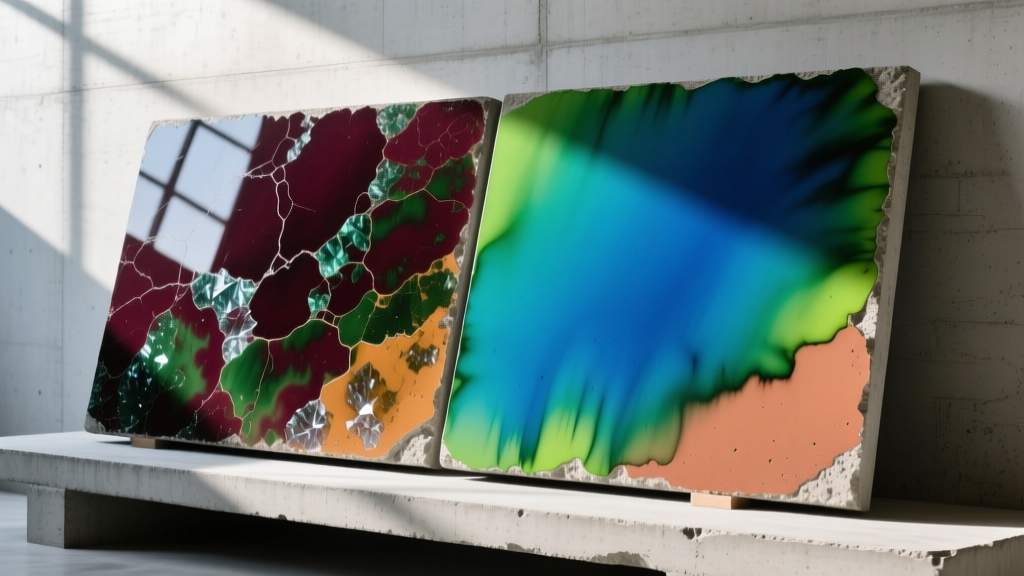
The Chemical Mechanics: Reactive vs. Penetrating
Choosing between an acid stain vs water based concrete stain is not merely an aesthetic decision; it is a chemical compatibility test against your specific concrete mix design. To achieve durable, vibrant decorative floors, contractors and architects must understand how each stain type interacts with the hydrated cement paste at a microscopic level.
Acid stains are reactive. They consist of water, hydrochloric acid, and acid-soluble metallic salts (typically iron, copper, or chromium). When applied, the acid lightly etches the surface, allowing the metallic salts to react with the free calcium hydroxide (portlandite) present in the hydrated cement matrix. This chemical reaction forms insoluble metallic oxides that permanently alter the concrete's color. Because it relies on a specific chemical compound within the concrete, acid staining is highly dependent on the original mix design.
Water-based stains, conversely, are non-reactive. They utilize acrylic polymers and organic or inorganic pigments suspended in a water carrier. Instead of a chemical reaction, these stains rely on capillary action to penetrate the concrete's pore structure. The pigments lodge within the microscopic voids, and the acrylic binder locks them in place. Therefore, water-based stains are dictated by the physical porosity and surface profile of the concrete rather than its chemical composition.
How Mix Design and SCMs Alter Stain Receptivity
The most critical factor in the acid stain vs water based concrete stain debate is how supplementary cementitious materials (SCMs) and mix proportions affect the slab. According to guidelines on concrete mix design from the Portland Cement Association, modern structural mixes frequently incorporate SCMs to improve workability and long-term durability, but these additions can severely compromise decorative staining.
Fly Ash and Slag Cement (The Portlandite Problem)
Acid stains require calcium hydroxide to react. When SCMs like Class F fly ash or ground granulated blast-furnace slag (GGBFS) are added to a mix, they undergo a pozzolanic reaction that consumes free calcium hydroxide to form additional calcium silicate hydrate (C-S-H) gel.
- Class F Fly Ash: If a mix replaces more than 15% to 20% of the Portland cement with Class F fly ash, the slab will lack sufficient free lime. Acid stains will yield pale, washed-out, or entirely non-reactive results. Water-based stains are the mandatory alternative here.
- Class C Fly Ash: Contains higher inherent calcium levels and is slightly more forgiving for acid stains, but results can still be inconsistent compared to a pure Type I/II Portland cement mix.
- Silica Fume: While it doesn't consume as much lime as fly ash, silica fume drastically densifies the concrete matrix. This extreme densification blocks the capillary penetration required for water-based stains unless the surface is aggressively mechanically profiled.
Water-to-Cement (w/c) Ratio and Porosity
A low w/c ratio (e.g., 0.35 to 0.40) produces high-strength, low-permeability concrete. While structurally superior, this dense paste restricts the penetration of water-based acrylic stains. If a low w/c mix is specified, acid stains are generally more effective, as the chemical reaction can occur on the surface without requiring deep capillary penetration. However, dwell times for the acid stain must be extended to allow the metallic salts to react fully with the dense matrix.
Never apply membrane-forming curing compounds to slabs intended for staining. These compounds seal the pores and block both chemical reactions and pigment penetration. If a curing compound was used, it must be completely removed via shot blasting or chemical stripping before any stain can be applied.
Head-to-Head Comparison Matrix
The following table breaks down the practical differences when evaluating an acid stain vs water based concrete stain for commercial and residential projects.
| Feature | Acid Stain (Reactive) | Water-Based Stain (Penetrating) |
|---|---|---|
| Color Palette | Limited (earth tones: browns, tans, terra-cottas, soft blues/greens) | Unlimited (full spectrum, including bright reds, yellows, and whites) |
| Visual Effect | Variegated, mottled, natural stone look; highlights surface imperfections | Uniform, consistent, opaque; can mimic painted or dyed surfaces |
| Mix Design Sensitivity | High (fails on high fly ash/slag mixes) | Moderate (requires adequate porosity/pore structure) |
| Neutralization Required | Yes (must wash with baking soda/ammonia to halt acid and raise pH) | No (simply allow to dry) |
| UV Stability | Excellent (metallic oxides do not fade in sunlight) | Good to Excellent (depends on specific acrylic polymer and pigment quality) |
Surface Preparation and Finishing Constraints
The physical finishing of the concrete slab directly dictates stain performance. According to decorative concrete specialists at the Concrete Network, a hard-troweled finish—while ideal for structural durability—burnishes the surface and closes the capillary pores.
For water-based stains, a hard-troweled surface acts as a barrier. The acrylic pigments will sit on the surface, leading to poor adhesion and rapid wear. To remedy this, the slab must be mechanically profiled using a planetary grinder with 40- to 80-grit metal-bonded diamonds, or treated with a mild etching solution to open the pores without altering the overall flatness (F-number) of the floor.
For acid stains, hard troweling is less detrimental to the chemical reaction itself, but it slows the penetration of the acid. Contractors must increase the dwell time from the standard 2 hours up to 8 hours, or apply multiple light coats to achieve the desired depth of color. Broom-finished or exposed aggregate finishes, which are highly porous, will react rapidly and aggressively to acid stains, often requiring dilution with water to prevent the color from becoming too dark.
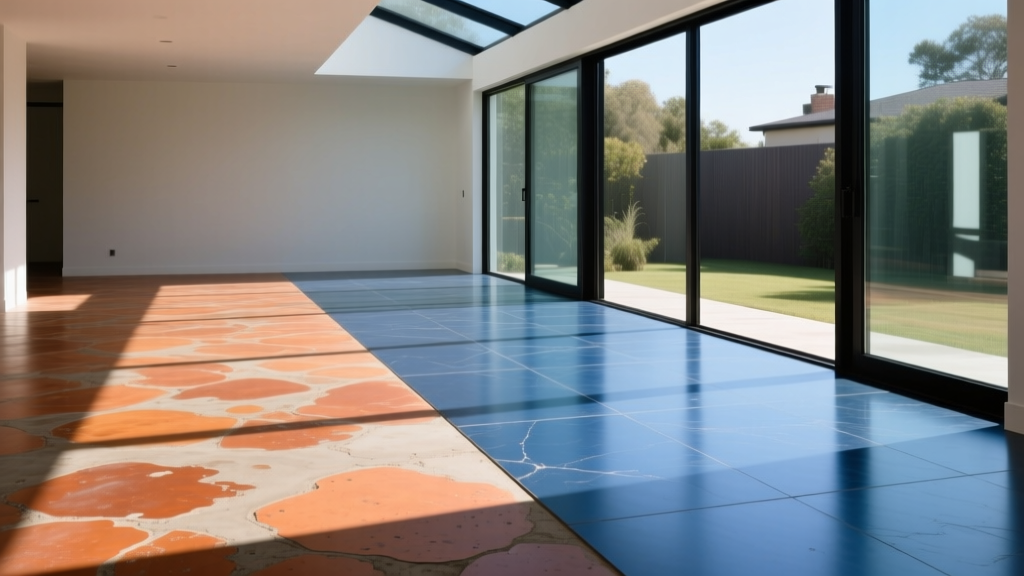
Cost Analysis and Project Timelines
Budgeting for decorative concrete requires looking beyond the material cost of the stain itself. Labor, preparation, and sealing dominate the financial profile.
The stain provides the color, but the sealer provides the wear resistance. For acid stains, a solvent-based acrylic sealer enhances the mottled depth and provides a wet-look finish. For water-based stains, a water-based polyurethane or polyaspartic topcoat prevents yellowing and maintains the true, uniform color of the pigment.
- Acid Stain Total Installed Cost: Typically ranges from $3.00 to $6.50 per square foot. The higher end accounts for the extensive labor required for neutralization, multiple water washes, and the 24-to-48-hour drying period required between neutralization and sealing.
- Water-Based Stain Total Installed Cost: Generally ranges from $2.50 to $5.00 per square foot. The faster timeline (no neutralization, rapid drying) reduces labor hours, though mechanical profiling of dense mixes can add $0.50 to $1.00 per square foot in equipment and labor costs.
Troubleshooting Mix-Related Stain Failures
Even with meticulous application, the underlying mix design can cause unexpected failures. Here is how to diagnose and correct the most common issues related to the acid stain vs water based concrete stain selection.
1. Saponification and Sealer Delamination (Acid Stains)
Symptom: The acrylic sealer turns chalky white and peels away from the concrete within weeks of application.
Cause: Incomplete neutralization. If the acid stain residue is not fully neutralized with sodium bicarbonate (baking soda) and rinsed, the residual acid reacts with the alkaline acrylic sealer in a process called saponification, creating a soap-like substance that destroys the bond.
Fix: Strip the failed sealer using a chemical stripper, re-neutralize the slab, test the pH with litmus paper to ensure it reads between 7 and 9, and reapply the sealer.
2. Patchy, Uneven Color Penetration (Water-Based Stains)
Symptom: The water-based stain appears blotchy, with some areas deeply colored and others barely tinted.
Cause: Inconsistent surface porosity, often caused by localized over-troweling during the finishing process or uneven distribution of a liquid densifier.
Fix: Apply a penetrating concrete conditioner or a light acrylic primer before re-staining. This creates a uniform absorption rate across the slab, ensuring the water-based pigments penetrate evenly.
3. The "Ghosting" Effect (Both Types)
Symptom: Faint lines or geometric patterns appear through the stain, mirroring the underlying subgrade or formwork.
Cause: Variations in the concrete's moisture content during the curing process, or differential absorption caused by plastic vapor barriers beneath the slab. This is a mix and placement issue, not a stain defect.
Fix: For acid stains, apply a secondary, lighter contrasting stain to blend the ghosting into a deliberate variegated pattern. For water-based stains, use a solid-color concrete dye or an opaque micro-topping to completely mask the underlying variations.
Written by
Marcus ChenMarcus Chen is a licensed structural engineer (PE) and building materials analyst with over 12 years of experience across residential, commercial, and industrial construction. He holds a Master of Science in Civil Engineering from UC Berkeley and spent six years at Thornton Tomasetti before transitioning to independent consulting and technical writing. Marcus specializes in material selection for seismic-prone regions, concrete reinforcement strategies, and lifecycle cost analysis. His work has been cited by the American Concrete Institute (ACI) and the Structural Engineers Association of California (SEAOC). When he is not on a job site or at his desk, you will find him hiking the Sierra Nevada or restoring a 1920s craftsman bungalow in Oakland, CA.
More from Marcus Chen
View all
Construction Cost
How Much Did the Eiffel Tower Cost to Build?
How much did the Eiffel Tower cost to build in 1889? We adjust for inflation and compare its budget to modern skyscraper construction.
Aug 4, 2026

Fire Resistance
What Is a Fire Resistant Material? Testing & Certification Guide
Discover what is a fire resistant material through ASTM and UL testing. Learn how fire ratings, certifications, and assemblies work in construction.
Aug 4, 2026

Construction Cost
How Much Did the Burj Khalifa Cost to Build?
How much did the Burj Khalifa cost to build? We break down the $1.5B project and extract 5 money-saving strategies for your next build.
Jul 30, 2026