Insulated Concrete Form Durability: Lifespan and Aging Analysis
Discover the true lifespan of insulated concrete form construction. We analyze EPS degradation, concrete curing, and long-term durability metrics.
The Core Metrics: Concrete Curing and EPS Inertia
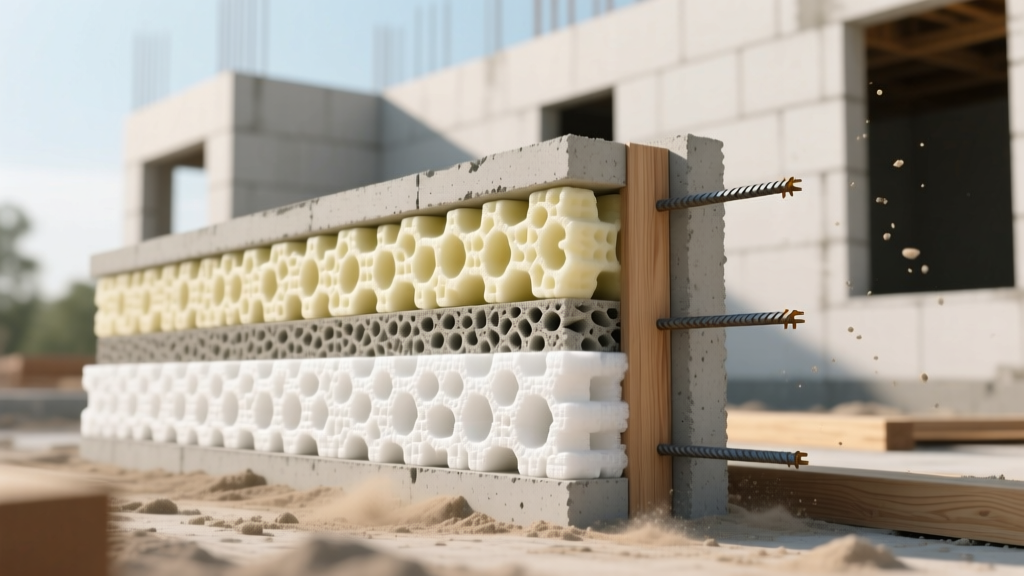
Insulated concrete form (ICF) construction merges the thermal mass of solid concrete with the continuous insulation of rigid foam. While industry professionals frequently cite a "100-year lifespan" for an insulated concrete form envelope, this figure requires structural qualification. The durability of the system depends entirely on the interplay between the Portland cement matrix, the steel reinforcement, and the expanded polystyrene (EPS) stay-in-place forms. Unlike traditional wood framing, which is subject to biological decay, or structural insulated panels (SIPs), which can suffer from oriented strand board (OSB) rot, ICF walls utilize inorganic and biologically inert materials.
The Concrete Core: 100+ Year Baseline
The structural core of an ICF wall typically utilizes a 3,000 to 4,000 psi concrete mix design. Because the EPS forms act as a curing blanket, the concrete retains moisture significantly longer than conventional formed pours. This extended hydration process results in a denser, higher-strength final product with reduced micro-cracking. According to the American Concrete Institute (ACI 318) standards, properly proportioned and placed concrete continues to gain compressive strength for decades. The primary threat to the concrete core is carbonation—a process where atmospheric CO2 penetrates the concrete and lowers its alkalinity, potentially leading to rebar corrosion. However, the continuous EPS layer drastically slows moisture and gas ingress, effectively pushing the carbonation front timeline well beyond a century.
The EPS Foam: Zero Biological Degradation
The expanded polystyrene used in modern ICF blocks (such as those manufactured by Fox Blocks, Nudura, or BuildBlock) is a closed-cell, petroleum-based polymer. It contains no organic nutrients, meaning it will not rot, mold, or support fungal growth. Furthermore, EPS does not off-gas or degrade chemically over time when kept at standard ambient temperatures. The R-value of the EPS forms (typically R-22 to R-24 for standard 2.5-inch + 2.5-inch configurations) remains stable indefinitely, unlike some polyisocyanurate foams that experience thermal drift as blowing agents dissipate.
While EPS is biologically inert, it is highly susceptible to ultraviolet (UV) radiation. If left exposed to direct sunlight during construction delays, the surface of the EPS will begin to chalk, yellow, and degrade within 30 to 60 days. This creates a dusty, compromised surface that will fail to bond with exterior parge coats or stucco. Always specify UV-resistant tarps for site storage and mandate that exposed ICF walls be covered with a protective weather-resistive barrier (WRB) or parging within 30 days of stacking.
Primary Degradation Vectors and Failure Modes
When an insulated concrete form system fails prematurely, the failure rarely originates in the materials themselves. Instead, it stems from execution errors during the pouring phase or improper exterior cladding attachment.
- Cold Joint Water Ingress: If a concrete pour is halted and the initial lift cures before the next lift is placed, a "cold joint" is formed. If this joint is not properly scarified and treated with a waterstop or bonding agent, it becomes a primary vector for hydrostatic water intrusion. Over decades, cyclical freeze-thaw action at this joint can cause localized spalling.
- Rebar Placement Tolerances: The EPS webbing inside the forms dictates rebar placement. If installers force rebar out of the designated chairs, the steel may end up too close to the interior or exterior face. A concrete cover of less than 1.5 inches over the rebar drastically increases the risk of oxidation and subsequent rust-jacking, which can crack the concrete core from the inside out.
- Improper Fastener Pull-Out: Attaching heavy exterior cladding (like brick veneer or fiber cement siding) directly into the EPS foam rather than penetrating the concrete core is a critical failure mode. Installers must use specialized ICF fasteners (e.g., Simpson Strong-Tie ICF screws) that penetrate at least 1.5 inches into the solid concrete to achieve the required pull-out strength for high-wind zones.
Material Lifespan and Resilience Matrix
To contextualize the longevity of an insulated concrete form envelope, it is necessary to compare it against other prevalent structural systems under the 2024/2026 International Residential Code (IRC) standards.
| Material System | Expected Structural Lifespan | Wind Load Capacity | Fire Rating (ASTM E119) | Moisture Susceptibility |
|---|---|---|---|---|
| Insulated Concrete Form (6" Core) | 100 - 200+ Years | 200+ mph (EF4/EF5) | 4 Hours | Extremely Low |
| Wood Framing (2x6) | 50 - 80 Years | 110 - 130 mph | 1 Hour (with Type X Gypsum) | High (Rot/Mold Risk) |
| Concrete Masonry Unit (CMU) | 100+ Years | 150 - 180 mph | 2 - 4 Hours | Moderate (Efflorescence) |
| Structural Insulated Panels (SIPs) | 60 - 90 Years | 140 - 160 mph | 1 Hour | High (OSB Skin Rot) |
Extreme Event Survivability
The durability of an insulated concrete form is most rigorously tested during extreme environmental events. The monolithic nature of the poured concrete core provides unparalleled resilience.
Wind and Impact Resistance
According to data from the Insulating Concrete Form Manufacturers Association (ICFMA), ICF walls can withstand wind loads exceeding 200 mph, making them compliant for FEMA P-361 safe room construction in tornado-prone regions. In missile-impact testing (simulating debris traveling at 100 mph), a standard 6-inch ICF wall prevents penetration, whereas wood-framed walls with standard OSB sheathing are easily breached by a 2x4 traveling at just 50 mph.
Thermal and Fire Endurance
While the EPS foam is combustible, it is manufactured with flame-retardant additives that prevent it from sustaining an independent flame. When covered with standard interior gypsum board and exterior parge or stucco, an 8-inch ICF wall achieves a 4-hour fire rating under ASTM E119 standards. During a structural fire, the concrete core remains intact, often allowing the structure to be salvaged and rebuilt upon the existing foundation and walls, drastically reducing post-disaster recovery costs.
Lifecycle Maintenance: Protecting the Envelope
To ensure an ICF structure reaches its maximum lifespan, specific maintenance protocols must be followed. The U.S. Department of Energy notes that while the structural components are virtually maintenance-free, the exterior cladding and water-management systems require standard oversight.
- Annual Weep Hole Inspection: If the ICF wall utilizes a brick veneer exterior, ensure that weep holes at the base of the wall remain clear of mortar droppings and debris. The air gap between the ICF EPS and the brick must remain ventilated to allow incidental moisture to drain.
- Sealant Joint Maintenance: Inspect the sealant joints around window and door buck perimeters every 5 to 7 years. Because ICF walls have minimal thermal expansion and contraction compared to wood or steel, sealant joints experience less mechanical fatigue, but UV degradation of the polyurethane sealants still necessitates periodic replacement.
- Below-Grade Waterproofing: For below-grade ICF foundation walls, the exterior EPS must be protected by a dimpled drainage mat and a fluid-applied or peel-and-stick waterproofing membrane. Never rely on the EPS foam alone as a waterproofing barrier in hydrostatic soil conditions.
Long-Term ROI and Insurance Implications
The initial capital expenditure for an insulated concrete form envelope is typically 5% to 10% higher than conventional wood framing. However, the lifecycle cost analysis heavily favors ICF. The continuous thermal barrier eliminates thermal bridging, reducing HVAC energy consumption by 40% to 60%. Furthermore, because of the documented durability and extreme-weather resilience, many major property insurance carriers offer premium discounts ranging from 15% to 25% for ICF-constructed homes in high-wind and wildfire-prone zones. When factoring in the elimination of future structural repairs, pest remediation, and energy savings, the true return on investment for an ICF envelope is realized well within the first 15 years of its 100-year lifespan.