What Type of Paint for Concrete? Cost Breakdown Analysis
Discover what type of paint for concrete suits your project. We break down material and labor costs per square foot for epoxy, acrylic, and silicate paints.

The Alkaline Challenge: Why Standard Paints Fail on Concrete
Concrete is not merely a hard, static surface; it is a dynamic, porous, and highly alkaline substrate. Freshly cured concrete typically registers a pH level between 12 and 13. When standard oil-based alkyd paints are applied to this environment, the alkalinity reacts with the fatty acids in the paint binder, a chemical process known as saponification. This literally turns the paint into a water-soluble soap, resulting in immediate peeling, blistering, and adhesion failure.
Therefore, answering the question of what type of paint for concrete is best requires looking beyond basic color choices and focusing on alkali-resistant chemistries, moisture vapor transmission rates, and mechanical bonding profiles. This cost breakdown analysis evaluates the three dominant concrete coating systems available in 2026, providing exact material costs, labor expectations, and environmental use-cases for residential and commercial projects.
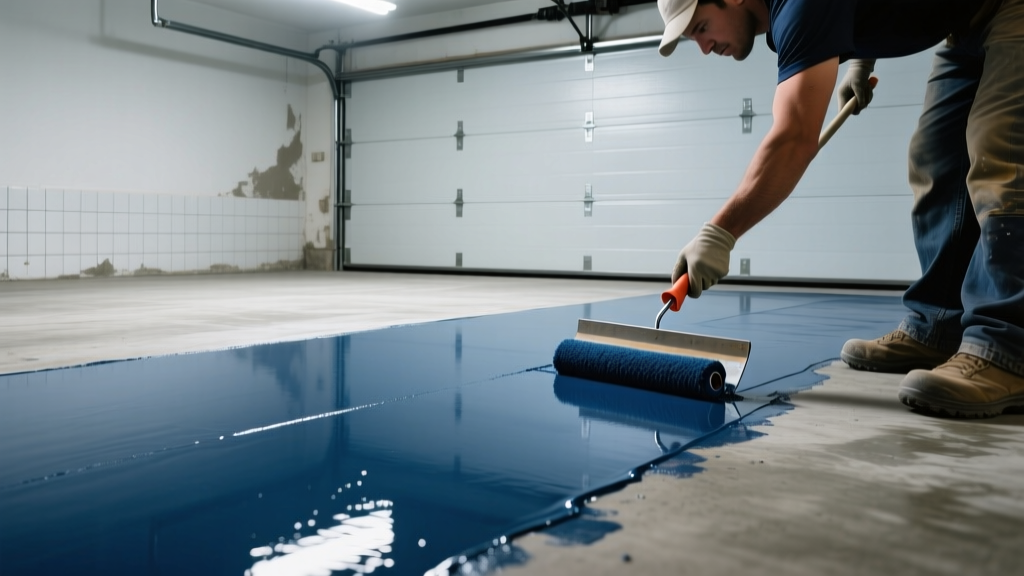
Cost Breakdown Matrix: Concrete Paint Systems
The following table outlines the average 2026 market rates for material and professional labor. Note that these costs assume a properly prepared, bare concrete substrate.
| Coating System | Material Cost (per sq ft) | Professional Labor (per sq ft) | Total Installed Cost | Expected Lifespan |
|---|---|---|---|---|
| 100% Acrylic Elastomeric | $0.45 - $0.85 | $1.20 - $1.80 | $1.65 - $2.65 | 5 - 8 Years |
| Two-Part Polyamine Epoxy | $0.90 - $1.60 | $2.50 - $4.00 | $3.40 - $5.60 | 10 - 15 Years |
| Silicate Mineral Paint | $1.30 - $2.20 | $2.00 - $3.50 | $3.30 - $5.70 | 15 - 20+ Years |
Deep Dive: Top 3 Concrete Paint Systems Analyzed
1. 100% Acrylic Elastomeric (e.g., Sherwin-Williams Loxon)
Acrylic elastomerics are thick, high-build coatings designed to stretch and bridge hairline cracks (up to 1/16th of an inch) as the concrete slab expands and contracts with thermal cycling. Because they are water-based and breathable, they allow trapped moisture to escape without blistering.
- Best Application: Exterior foundation walls, stucco, and above-grade masonry.
- Limitations: Not suitable for horizontal surfaces subjected to foot traffic or vehicular weight; the soft elastomeric film will tear under mechanical shear.
- Pro-Tip: Always apply an alkali-resistant primer if the concrete is less than 30 days old to prevent pH burn-through.
2. Two-Part Polyamine Epoxy (e.g., Rust-Oleum EpoxyShield, Sherwin-Williams Macropoxy)
Epoxies form a rigid, cross-linked polymer shield that is highly resistant to chemical spills, hot tire pickup, and heavy impact. Polyamine epoxies offer superior adhesion and moisture tolerance compared to cheaper polyamide alternatives found in big-box store kits.
- Best Application: Interior garage floors, basement slabs, and commercial warehouses.
- Limitations: Epoxies are inherently UV-unstable. If used outdoors, they will chalk and yellow within 6 months unless top-coated with an aliphatic polyurethane.
- Critical Requirement: Requires a strict Concrete Surface Profile (CSP) of 2 or higher to achieve mechanical interlock.
3. Silicate Mineral Paint (e.g., KEIM Concretal)
Silicate paints do not form a surface film. Instead, they undergo a process called silicification, where the potassium silicate binder chemically reacts with the free lime in the concrete to become a permanent, petrified part of the substrate itself. According to data from the Portland Cement Association, this chemical bond prevents delamination entirely.
- Best Application: Architectural concrete facades, historical restoration, and exterior retaining walls.
- Limitations: Limited color palette (only inorganic mineral pigments can be used) and cannot bridge existing cracks.
- Environmental Edge: Zero VOCs and completely inorganic, making it highly resistant to mold and algae growth.
The Hidden Cost: Surface Preparation & Profiling
The most common reason concrete paint fails is inadequate surface preparation. You cannot paint over a smooth, steel-troweled concrete finish; the coating requires microscopic valleys to grip onto. ASTM International standard D4259 outlines the requirements for abrasive blast cleaning and mechanical profiling of concrete.
Many DIY guides recommend muriatic acid etching. While cheap ($0.15/sq ft), acid etching is highly inconsistent, environmentally hazardous, and often leaves behind neutralizing salts that ruin epoxy adhesion. Professional contractors in 2026 overwhelmingly rely on mechanical diamond grinding.
Preparation Cost Comparison
- Acid Etching (DIY): $0.15 - $0.30 per sq ft. (High failure rate for epoxies).
- Diamond Grinding (Professional): $1.50 - $3.00 per sq ft. Opens the pores and guarantees a CSP 2-3 profile.
- Shot Blasting (Commercial): $2.00 - $4.50 per sq ft. Required for thick, heavy-duty industrial epoxy systems.
Moisture Vapor Transmission (MVT) & Failure Modes
Concrete slabs act like sponges, constantly drawing moisture from the soil below. When this moisture vapor attempts to escape through the surface, it creates hydrostatic pressure. If the pressure exceeds the tensile strength of the paint film, the coating will blister and delaminate.
Before selecting what type of paint for concrete floors, you must test the MVT. The Environmental Protection Agency and flooring manufacturers recommend testing via the Calcium Chloride test (ASTM F1869) or in-situ Relative Humidity probes (ASTM F2170).
If your MVT reading is under 3 lbs per 1,000 sq ft / 24 hours, standard two-part epoxies and acrylics are safe to use.
If your MVT reading is between 3 and 10 lbs, you MUST budget an additional $1.50 - $2.50 per sq ft for a moisture-mitigating epoxy primer (e.g., Sherwin-Williams Macropoxy 646) before applying your topcoat.
If your MVT reading is over 10 lbs, do not use any film-forming paint. Switch to a penetrating silicate densifier or a breathable mineral stain.
Decision Matrix: Matching Paint to Environmental Stressors
Use this framework to finalize your material selection based on your specific project parameters:
Scenario A: The Residential Garage Floor
Stressors: Hot tire pickup, road salts, oil drips, UV exposure from open doors.
Solution: Diamond grind the slab. Apply a 100% solids polyamine epoxy base coat, broadcast vinyl flakes for texture and slip resistance, and seal with a UV-stable polyaspartic topcoat.
Budget Expectation: $6.00 - $8.50 per sq ft fully installed.
Scenario B: Exterior Foundation & Retaining Walls
Stressors: Hydrostatic pressure, freeze-thaw cycling, soil alkalinity, UV exposure.
Solution: Pressure wash and apply a silicate mineral paint or a high-build acrylic elastomeric. These allow the wall to 'breathe' out moisture while blocking liquid water ingress.
Budget Expectation: $2.00 - $3.50 per sq ft.
Scenario C: Basement Storage Slab
Stressors: High humidity, potential MVT, low budget.
Solution: Acid etch or lightly grind, then apply a breathable, water-based acrylic concrete stain. Avoid epoxies entirely unless a moisture test confirms a dry slab, as basement slabs frequently lack proper vapor barriers.
Budget Expectation: $1.50 - $2.50 per sq ft.
Final Estimation Framework
When calculating your final budget to determine what type of paint for concrete fits your financial parameters, never look at material costs in isolation. A $50 gallon of premium epoxy will fail just as quickly as a $30 gallon of cheap paint if applied over an unprofiled, dusty slab. Always allocate at least 40% of your total project budget to surface preparation, moisture testing, and priming. By respecting the alkaline and porous nature of concrete, your chosen coating system will deliver decades of durable, aesthetic performance.
Written by
Marcus ChenMarcus Chen is a licensed structural engineer (PE) and building materials analyst with over 12 years of experience across residential, commercial, and industrial construction. He holds a Master of Science in Civil Engineering from UC Berkeley and spent six years at Thornton Tomasetti before transitioning to independent consulting and technical writing. Marcus specializes in material selection for seismic-prone regions, concrete reinforcement strategies, and lifecycle cost analysis. His work has been cited by the American Concrete Institute (ACI) and the Structural Engineers Association of California (SEAOC). When he is not on a job site or at his desk, you will find him hiking the Sierra Nevada or restoring a 1920s craftsman bungalow in Oakland, CA.
More from Marcus Chen
View all
Construction Cost
How Much Did the Eiffel Tower Cost to Build?
How much did the Eiffel Tower cost to build in 1889? We adjust for inflation and compare its budget to modern skyscraper construction.
Aug 4, 2026

Fire Resistance
What Is a Fire Resistant Material? Testing & Certification Guide
Discover what is a fire resistant material through ASTM and UL testing. Learn how fire ratings, certifications, and assemblies work in construction.
Aug 4, 2026

Construction Cost
How Much Did the Burj Khalifa Cost to Build?
How much did the Burj Khalifa cost to build? We break down the $1.5B project and extract 5 money-saving strategies for your next build.
Jul 30, 2026