Best Concrete Screed Brands & Product Lines for 2026
Compare top concrete screed brands like Mapei, ARDEX, and Sika. Analyze product specs, drying times, mix ratios, and 2026 pricing for commercial floors.
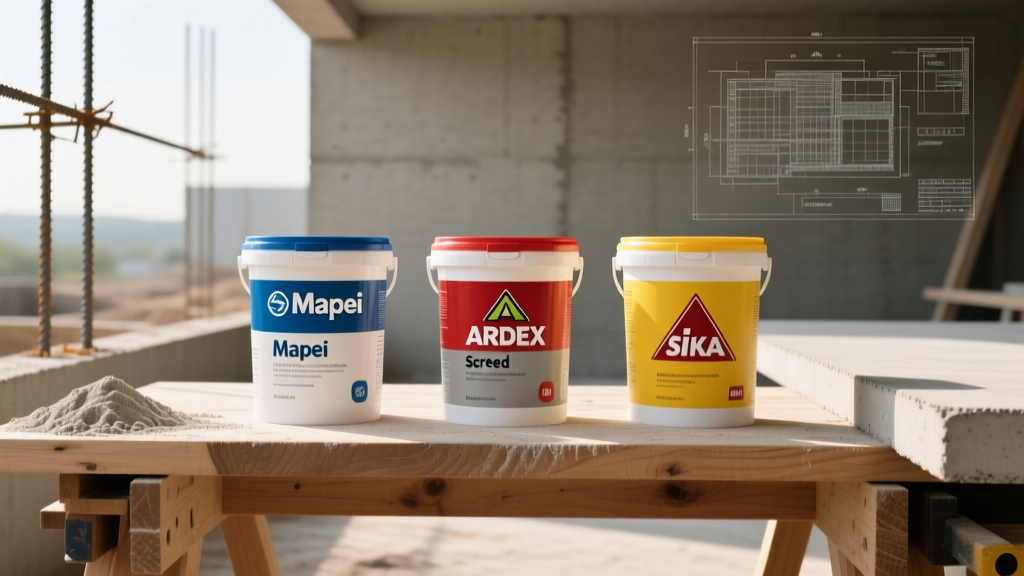
The Anatomy of a High-Performance Concrete Screed
A concrete screed is a specialized, thin-layer cementitious application designed to provide a level substrate for final floor finishes or serve as a direct-wearing surface. Unlike structural concrete slabs, screeds are engineered for precise flatness, rapid moisture dissipation, and surface hardness. According to guidelines published by the American Concrete Institute (ACI), the success of a screed relies heavily on the classification of the system: bonded, unbonded, or floating.
- Bonded Screeds (Minimum 20mm): Applied directly to a mechanically prepared, primed concrete base. Requires high-tensile strength to prevent delamination.
- Unbonded Screeds (Minimum 50mm): Separated from the structural slab by a polyethylene slip membrane. Relies on mass and thickness to resist curling.
- Floating Screeds (Minimum 65mm): Poured over acoustic or thermal insulation boards. Requires steel mesh or synthetic macro-fiber reinforcement to handle point loads.
Selecting the right chemical binder is where general contractors and flooring specialists diverge. Standard Portland cement (OPC) screeds require 28 days to cure and up to 90 days to dry sufficiently for moisture-sensitive floor coverings (like epoxy or solid wood). In 2026, fast-track commercial projects rely almost exclusively on specialized hydraulic binders and pre-blended rapid-dry mortars.
Brand Deep-Dive: Mapei’s Fast-Track Binders
Mapei Corporation dominates the fast-track screed market with two distinct product lines: Topcem (a hydraulic binder) and Mapecem (a pre-blended mortar). Understanding the difference is critical for yield and cost control.
Mapei Topcem vs. Mapecem Specifications
Topcem (Binder): Must be mixed on-site with washed, well-graded sand (0-8mm) and water.
Mix Ratio: 1 part Topcem to 4.5–5.5 parts sand (by weight).
Water Ratio: Strictly 16-18% of the Topcem weight. Excess water causes severe shrinkage.
Drying Time: 24 hours for ceramic tile; 4 days for moisture-sensitive wood/epoxy.
2026 Pricing: $48 - $55 per 50lb bag.
Mapecem (Pre-blended): Factory-mixed with graded aggregates; requires only water addition.
Water Ratio: Approx. 11-13% by weight (much lower water demand).
Walkable Time: 3 hours.
2026 Pricing: $62 - $68 per 55lb bag.
For large-scale commercial pours (over 5,000 sq ft), Topcem is the economically superior choice because buying bulk washed sand locally drastically reduces the cost per cubic foot compared to hauling pre-blended Mapecem bags. However, Topcem demands rigorous quality control; if the on-site mixing crew adds extra water to improve workability, the screed will inevitably curl at the joints.
ARDEX and the Rapid-Dry Standard: A 38 & K 15
While Mapei focuses on modified binders, ARDEX Americas engineered ARDEX A 38 to solve the fundamental flaw of traditional cement hydration: free water. Standard cement only uses about 30% of its mixing water for chemical hydration; the rest must evaporate, creating a moisture gradient that causes the top of the screed to shrink faster than the bottom, resulting in curling.
| Feature | ARDEX A 38 (Rapid Cement) | ARDEX K 15 (Self-Leveling) |
|---|---|---|
| Primary Use | Interior/Exterior thick screeds (bonded/unbonded) | Interior thin smoothing underlayment |
| Thickness Range | 15mm to 50mm+ | 1/4 inch to 1.5 inches |
| Mix Ratio | 1:5 to 1:8 (Cement to Sand) | Pre-blended (Just add water) |
| Compressive Strength | 4,000+ psi in 24 hours | 4,300 psi in 28 days |
| Moisture for Wood/Epoxy | Ready in 4 hours | Ready in 1-2 days (depending on thickness) |
| Est. Cost per 50lb Unit | $52 - $58 | $45 - $50 (per 50lb bag) |
ARDEX A 38 chemically binds almost all the mixing water during its rapid hydration process. Because there is virtually no 'free water' left to evaporate, the moisture gradient is eliminated, and the screed remains dimensionally stable. This makes A 38 the undisputed industry standard for exterior balconies, wet rooms, and fast-track interior floors where epoxy coatings must be applied the same day.
Sika & Quikrete: Heavy-Duty and Self-Leveling Solutions
For projects that require high-flow self-leveling properties or accessible big-box availability, Sika and Quikrete offer distinct product lines.
SikaScreed-100 & Sikafloor Systems
Sika’s approach bridges the gap between structural repair and floor leveling. SikaScreed-100 is a polymer-modified, fast-hardening binder designed for heavy industrial environments. Unlike standard screeds, SikaScreed-100 incorporates proprietary polymers that increase flexural strength, making it highly resistant to the micro-vibrations caused by heavy forklift traffic in warehouse environments.
- Pros: Exceptional impact resistance; integrates seamlessly with Sika’s industrial epoxy topcoats; high flexural strength reduces the need for welded wire mesh in floating applications.
- Cons: Limited availability in standard retail channels; requires specialized pumping equipment for large-scale pours; higher material cost ($70+ per equivalent yield unit).
Quikrete Commercial Grade Self-Leveling Underlayment (#1249-51)
Quikrete’s #1249-51 is a calcium aluminate cement-based self-leveling screed. It is widely available and designed for interior residential and light-commercial use to smooth out rough concrete before installing LVT (Luxury Vinyl Tile) or engineered hardwood.
- Pros: Ubiquitous availability; highly flowable (can be gauge-raked and smoothed with a spiked roller easily); forgiving mixing window for smaller crews.
- Cons: Not suitable for exterior use; lacks the rapid compressive strength gain of ARDEX A 38; maximum single-pour depth is limited to 1.5 inches without aggregate extension.
Decision Framework: Matching the Screed to the Subfloor
Choosing the correct product line requires evaluating the substrate condition, the final floor covering, and the project timeline. Use this framework to specify the right material:
IF the substrate is exterior, exposed to freeze-thaw cycles, or requires an epoxy coating within 24 hours...
THEN specify ARDEX A 38. Its low free-water content prevents freeze-thaw spalling and allows immediate moisture-sensitive coating application.
IF the project is a large interior commercial space (>5,000 sq ft) with a 4-day timeline for wood flooring installation...
THEN specify Mapei Topcem mixed with local washed sand. This provides the required 4-day drying profile while minimizing material transport costs.
IF the substrate is highly irregular interior concrete requiring a thin (1/2 inch) smoothing layer before LVT installation...
THEN specify Quikrete #1249-51 or ARDEX K 15. These self-leveling underlayments will seek their own plane without the need for manual straightedge screeding.
Common Application Failures & How Top Brands Mitigate Them
Even the most advanced chemical binders will fail if application protocols are ignored. The three most common failure modes in concrete screeds are curling, hollow spots (delamination), and plastic shrinkage cracking.
Failure Mode 1: Edge Curling
Cause: The top surface dries and shrinks faster than the bottom, which is trapped against a damp substrate or insulation board.
Mitigation: Use rapid-dry, low-water cements (ARDEX A 38). For standard OPC screeds, apply a liquid curing compound immediately after finishing to slow top-surface evaporation, or cut control joints at 15-foot intervals to force controlled cracking.
Failure Mode 2: Hollow Spots (Delamination in Bonded Screeds)
Cause: Failure to remove laitance (a weak layer of cement dust and fines) from the structural slab, or applying the screed to a dusty surface.
Mitigation: The substrate must be shot-blasted or scarified to expose open pores. Apply a slurry bond coat (e.g., Mapei Latex Plus mixed with the screed cement) immediately before pouring to ensure a monolithic chemical bond.
Cost Analysis & Yield Calculations for 2026
Estimating screed costs requires calculating the volumetric yield of the binder combined with aggregates. A standard 50lb bag of hydraulic screed binder, when mixed with the appropriate ratio of sand and water, yields approximately 0.45 cubic feet of compacted screed.
| Material System | Target Thickness | Bags per 100 Sq Ft | Est. Material Cost (per 100 Sq Ft) |
|---|---|---|---|
| Mapei Topcem + Local Sand | 50mm (2 inches) | ~37 bags (binder only) | $1,775 - $2,035 (plus sand cost) |
| ARDEX A 38 + Local Sand | 50mm (2 inches) | ~37 bags (binder only) | $1,924 - $2,146 (plus sand cost) |
| Mapei Mapecem (Pre-blended) | 50mm (2 inches) | ~75 bags (pre-blended) | $4,650 - $5,100 |
| Quikrete #1249-51 (Self-Level) | 12mm (1/2 inch) | ~20 bags | $900 - $1,000 |
When budgeting for 2026 commercial projects, general contractors must factor in the labor premium associated with traditional sand/cement screeds versus pre-blended or self-leveling alternatives. While Mapei Topcem and ARDEX A 38 have higher upfront binder costs than standard Portland cement, the reduction in floorcovering delays and the elimination of moisture-mitigation epoxy primers (which cost $4-$7 per sq ft) frequently result in a lower total project cost.