Foam vs Concrete for Fence Posts: Which Setting Material Actually Lasts?
Compare expanding polyurethane foam vs concrete for fence posts. Discover load limits, frost heave resistance, and exact product costs for your next build.

The Core Conflict: Polyurethane Foam vs. Portland Cement
The debate between expanding polyurethane foam and traditional Portland cement for setting fence posts centers on a fundamental misunderstanding of structural mechanics. Contractors and DIYers often assume that a fence post anchor must possess high compressive strength. In reality, a fence post primarily experiences lateral shear forces (wind load) and uplift forces (frost heave). The anchor material's job is not to bear vertical weight like a foundation pier, but to transfer lateral loads into the surrounding undisturbed soil via friction and adhesion.
Expanding two-part polyurethane foams (marketed under brands like Sika Post Mix) have disrupted the market by offering a lightweight, hydrophobic alternative to 50-pound bags of cement. However, treating foam as a universal replacement for concrete leads to catastrophic structural failures in high-load applications. Understanding the chemical and mechanical differences between these materials is critical for selecting the right anchor for your specific soil profile and fence design.
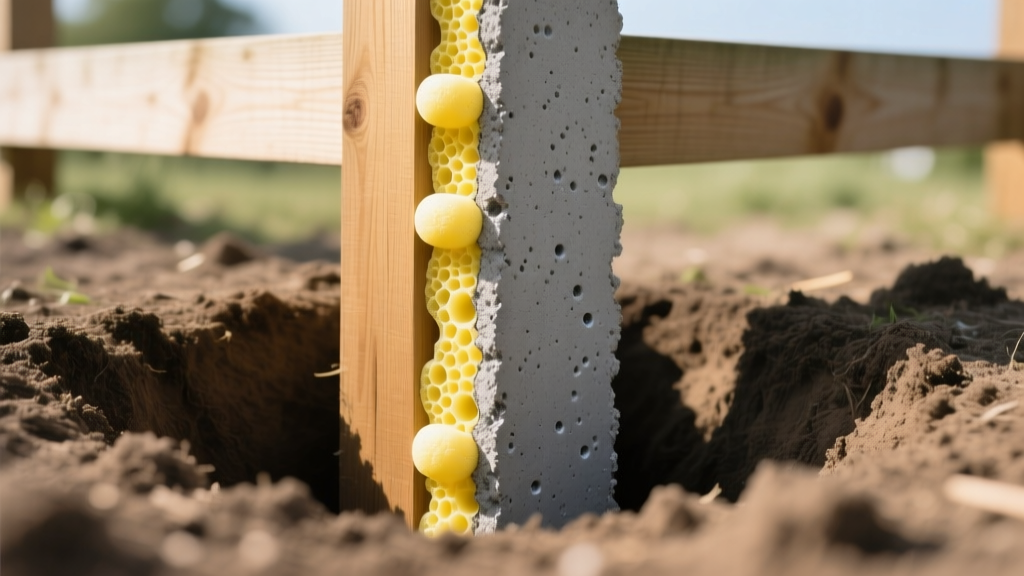
Material Deep Dive: Sika Post Mix vs. Quikrete Fast-Setting
To evaluate real-world performance, we must compare the industry standards for both categories: two-part polyurethane post foam and fast-setting red-bag concrete.
Expanding Polyurethane Foam (e.g., Sika Post Mix)
Polyurethane post foam is a two-part liquid resin that, when combined, undergoes an exothermic chemical reaction. It expands up to 20 times its liquid volume, aggressively filling irregular voids, rocky crevices, and root gaps that dry-set concrete often misses. It cures to a rigid, closed-cell foam in approximately 15 minutes.
- Compressive Strength: ~60 to 80 PSI (Rigid foam relies on soil friction, not compressive load-bearing).
- Weight per Hole: ~1.5 lbs (Liquid components).
- Cure Time: 15 minutes to handle; 1 hour for full lateral cure.
- Material Cost: $12.00 to $16.00 per standard 4x4 post hole.
Fast-Setting Concrete (e.g., Quikrete Fast-Setting Red Bag)
Quikrete Fast-Setting is a specialized blend of Portland cement, sand, and gravel designed to set in 20 to 40 minutes without pre-mixing in a wheelbarrow. For standard fence posts, it can be poured dry into the hole and hydrated in place. It achieves 4,000 PSI at 28 days, creating a massive, rigid collar around the post.
- Compressive Strength: 4,000 PSI at 28 days.
- Weight per Hole: 75 to 100 lbs (Requires 1.5 to 2 bags per hole).
- Cure Time: 20-40 minutes to set; 24-48 hours for full structural cure.
- Material Cost: $7.00 to $9.00 per bag ($10.50 to $18.00 per hole depending on depth).
Quick Decision Matrix
Choose Polyurethane Foam If: You are building a 4-foot picket or chain-link fence, working in rocky/sandy soil where concrete forms air pockets, working solo, or need to finish the project in a single afternoon.
Choose Fast-Setting Concrete If: You are setting 6-foot or taller privacy fence panels, anchoring heavy gate posts, securing corner/terminal posts, building in high-wind zones, or working in highly expansive clay soils.
Soil Dynamics and the Frost Heave Phenomenon
The most common cause of fence failure in northern climates is frost heave. According to University of Minnesota Extension guidelines, frost heave occurs when water in the soil freezes and expands, pushing the post upward. The interaction between the anchor material and the soil dictates how severe this movement will be.
The Concrete Collar Problem
When concrete cures, it forms a rough, rigid collar. If the top of the concrete collar is flat or concave, water pools between the wood post and the concrete. When this trapped water freezes, it expands, gripping the rough concrete surface and acting like a hydraulic piston to push the entire assembly out of the ground. Furthermore, in expansive clay soils, the clay grips the heavy concrete collar during freeze-thaw cycles, exacerbating the uplift.
The Hydrophobic Advantage (and Limitation) of Foam
Polyurethane foam is closed-cell and entirely hydrophobic. It does not absorb water, and it forms a seamless, waterproof seal between the wood and the soil, eliminating the internal water-trapping mechanism that plagues concrete. However, foam is not a magic bullet against frost heave. If the surrounding soil is highly expansive clay, the soil will freeze and grip the foam just as it grips concrete. The only true defense against frost heave is digging the hole below the local frost line and bell-shaping the bottom of the hole to create a mechanical deadman anchor.
Head-to-Head Specification Matrix
| Metric | Polyurethane Foam | Fast-Setting Concrete |
|---|---|---|
| Lateral Wind Load Capacity | Low to Moderate (Fails on 6ft+ privacy panels) | High (Excellent for tall, solid panels) |
| Water Absorption | 0% (Closed-cell, hydrophobic) | Moderate (Porous, requires sealing/capping) |
| Rocky Soil Adaptation | Excellent (Expands into crevices) | Poor (Gravel bridges, leaving air voids) |
| Wood Rot Prevention | Superior (Seals end-grain from moisture) | Poor (Traps moisture against end-grain) |
| UV Degradation | High (Turns to dust if exposed to sunlight) | None (UV stable) |
Application Showcase: Setting a 4x4 Post for a 6-Foot Privacy Fence
A 6-foot solid wood privacy fence acts as a massive sail in high winds. The leverage exerted on the base of the post is immense. For this application, Quikrete Fast-Setting Concrete is the mandatory choice. Polyurethane foam lacks the shear mass and lateral rigidity to prevent the post from leaning over time under dynamic wind loads.
Step-by-Step Concrete Application
- Excavation: Dig a hole 12 inches in diameter (3x the width of a 4x4 post) and 30 inches deep (assuming a 24-inch frost line, placing the base below the frost line).
- Bell-Shape the Base: Use a post-hole digger to flare the bottom 6 inches of the hole outward, creating a bell shape. This prevents frost heave from pulling the post up.
- Gravel Base: Add 3 inches of 3/4-inch crushed gravel to the bottom for drainage. Do not skip this; it prevents the wood end-grain from sitting in a water sump.
- Set and Plumb: Insert the pressure-treated 4x4 post. Use two levels on adjacent sides and brace the post with 2x4s staked into the ground.
- Pour and Hydrate: Pour 1.5 bags (75 lbs) of dry Fast-Setting Concrete into the hole, stopping 3 inches below grade. Slowly pour exactly 1.5 gallons of water over the dry mix. Do not stir; the water will percolate through the mix.
- Slope the Collar: As the concrete sets (around 20 minutes), use a trowel to slope the top 3 inches of the concrete away from the post. This sheds rainwater and prevents the freeze-thaw piston effect.
Common Failure Modes and How to Avoid Them
Failure Mode 1: UV Degradation of Exposed Foam
Polyurethane foam is highly susceptible to ultraviolet light. If you use foam to set a post and leave the yellow foam exposed above the soil line, UV radiation will break down the cellular structure within 4 to 6 months, turning it into a brittle dust. The Fix: Always backfill the top 2 inches of a foam-set hole with native soil, mulch, or a concrete cap to completely shield the foam from sunlight.
Failure Mode 2: Gate Post Sagging with Foam
A wooden gate introduces dynamic, uneven loads every time it is opened or closed. The repeated slamming and swinging create micro-fractures in the bond between the foam and the wood. Over a year, the gate post will lean, causing the gate to drag. The Fix: Never use expanding foam for gate hinge posts or latch posts. Always use fast-setting concrete, and consider upgrading gate posts to 6x6 lumber set 36 inches deep.
Failure Mode 3: Concrete Spalling in Freeze-Thaw Zones
If you use standard concrete mix (gray bag) instead of Fast-Setting (red bag) for fence posts, the mix may lack adequate air-entrainment. When water penetrates the porous concrete collar and freezes, the surface will spall, crack, and crumble within two winters. The Fix: Exclusively use air-entrained fast-setting mixes for above-grade collars, and apply a silane/siloxane concrete sealer to the collar after it fully cures to block water ingress.
Written by
Sarah WhitfieldSarah Whitfield is a chartered quantity surveyor (MRICS) and construction cost analyst with 15 years of experience in material pricing, procurement strategy, and project budgeting. She earned her degree in Construction Management from the University of Reading (UK) and has worked on projects ranging from $2M custom homes to $180M mixed-use developments across North America and Europe. Sarah currently leads cost estimating for BuildMat Insight, maintaining a proprietary database of 4,000+ material price points updated quarterly. She is a frequent contributor to RSMeans cost data panels and has presented at the International Cost Engineering Council (ICEC) congress. Based in Denver, CO, Sarah is an avid trail runner and volunteer mentor for Women in Construction.
More from Sarah Whitfield
View all
Wood & Lumber
What Are the Different Types of Wood? A Builder's Guide
Compare structural softwoods, finish hardwoods, and engineered lumber. Analyze Janka ratings, MOE values, and 2026 pricing for construction.
Aug 4, 2026

Walls & Panels
Steel Framing vs Wood Framing: Corrosion and Moisture Defense
Compare steel framing vs wood framing for moisture resistance. Learn about galvanized coatings, condensation risks, and corrosion protection strategies.
Jul 21, 2026

Stone & Masonry
How to Cut Stone Veneer: Wet Saw vs Grinder Comparison
Compare the best tools for cutting stone veneer. We review wet saws, angle grinders, and chop saws to help you achieve clean, chip-free cuts.
Jul 21, 2026