Pavers vs Concrete Price: 2026 Cost Breakdown and ROI Analysis
Compare the pavers vs concrete price with our 2026 cost breakdown. Analyze material, labor, maintenance, and long-term ROI for patios and driveways.

The Core Debate: Upfront Costs vs. Lifetime Value
When evaluating the pavers vs concrete price for hardscaping projects, homeowners and contractors often fixate on the initial installation quote. However, a true cost breakdown analysis requires examining material grades, labor intensity, long-term maintenance, and structural resilience. In 2026, supply chain stabilization has normalized material costs, but skilled labor rates for masonry and finishing continue to dictate the final price per square foot. This guide dissects the exact financial implications of poured concrete versus interlocking pavers for driveways, patios, and walkways.
Quick Cost Snapshot (Per Square Foot Installed)
- Standard Poured Concrete: $8.00 – $15.00
- Stamped/Decorative Concrete: $14.00 – $25.00
- Concrete Pavers: $15.00 – $25.00
- Clay/Brick Pavers: $20.00 – $35.00+
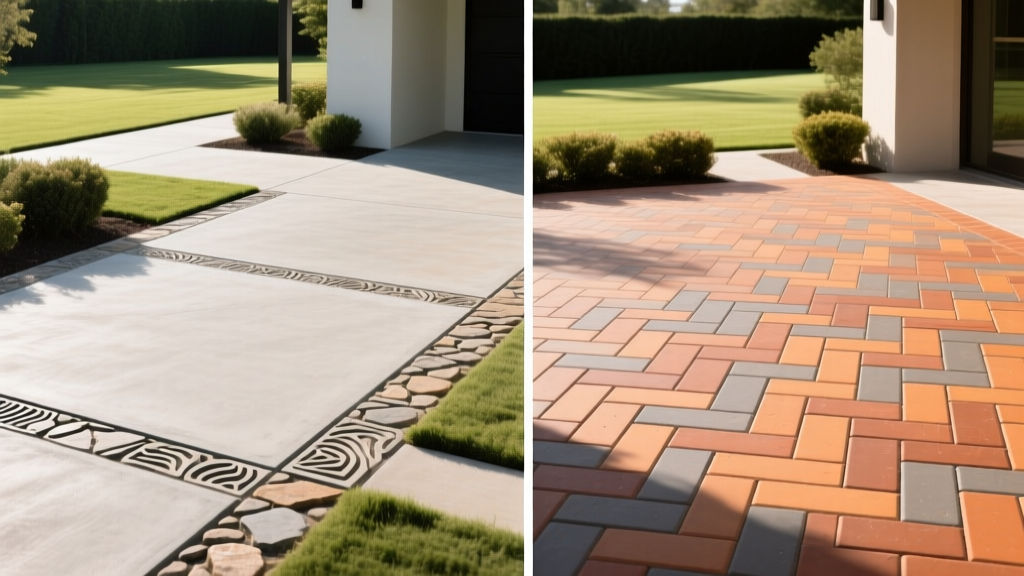
Material Costs: Pouring Slabs vs. Laying Pavers
The raw material cost is where poured concrete traditionally holds a significant advantage. A standard 4,000 PSI air-entrained concrete mix—necessary for freeze-thaw durability in northern climates—costs between $130 and $160 per cubic yard in 2026. When factoring in wire mesh or fiber reinforcement, the material cost translates to roughly $3.50 to $6.00 per square foot for a standard 4-inch thick slab.
Pavers, conversely, are priced by the unit. According to guidelines from the National Concrete Masonry Association (NCMA), interlocking concrete pavers must meet ASTM C936 standards, ensuring a minimum compressive strength of 8,000 PSI. This high density makes them incredibly durable but more expensive to manufacture and transport.
| Material Type | Material Cost (Per Sq Ft) | Key Characteristics |
|---|---|---|
| Standard Gray Concrete | $3.50 - $6.00 | Utilitarian, requires sealing, prone to surface cracking |
| Stamped/Colored Concrete | $7.00 - $12.00 | Aesthetic appeal, requires color hardeners and release agents |
| Tumbled Concrete Pavers | $4.00 - $8.00 | Vintage look, flexible joints, high PSI rating |
| Extruded Clay Pavers | $8.00 - $15.00+ | Colorfast, premium aesthetic, highest material cost |
Labor and Site Preparation Expenses
Site preparation is largely identical for both materials. Excavation, grading, and installing a 4-to-6-inch compacted aggregate base (usually crushed limestone or gravel) will cost between $2.00 and $4.00 per square foot regardless of the surface material. The divergence in pricing occurs during the actual installation phase.
Concrete Labor: Speed vs. Precision
Pouring concrete is a time-sensitive operation. A crew can form, pour, and finish a 500-square-foot patio in a single day. Labor rates for concrete finishing range from $4.00 to $8.00 per square foot. However, the American Concrete Institute (ACI) notes that improper curing or finishing in extreme temperatures can lead to plastic shrinkage cracking, necessitating costly tear-outs. Decorative finishes like stamping or exposed aggregate require specialized artisans, pushing labor costs up to $10.00 – $15.00 per square foot.
Paver Labor: The Masonry Premium
Laying pavers is meticulously labor-intensive. Installers must screed a 1-inch bedding sand layer, cut pavers to fit borders using diamond-blade wet saws, and compact the surface. Finally, polymeric sand must be swept into the joints and activated with water. This process typically costs $10.00 to $20.00 per square foot in labor alone. Complex patterns like herringbone or circular layouts increase cutting time and waste, driving labor costs toward the higher end of that spectrum.
The Hidden Costs: Maintenance, Repairs, and Sealants
The pavers vs concrete price debate shifts dramatically when analyzing a 20-year lifecycle. Concrete is a monolithic slab; when it fails, it fails visibly and permanently. Pavers are a flexible pavement system designed to move with the earth.
- Concrete Sealing: To prevent water intrusion and UV fading (especially on stamped concrete), a silane/siloxane penetrating sealer must be applied every 2 to 3 years. Cost: $1.50 – $3.00 per square foot if professionally applied.
- Concrete Crack Repair: Control joints mitigate cracking, but frost heave or tree root intrusion can cause structural fractures. Epoxy injection or slab jacking (mudjacking) costs $300 to $800 per incident, often leaving visible repair lines.
- Paver Joint Maintenance: Polymeric sand degrades over 5 to 8 years. Re-sanding a paver patio costs roughly $1.00 to $2.00 per square foot.
- Paver Settlement Repair: If a section of pavers settles or heaves, the affected stones are simply lifted, the base re-compacted, and the stones replaced. Material replacement cost is negligible; labor is typically billed at a minimum hourly rate ($150 – $250).
ROI and Resale Value Matrix
Hardscaping significantly impacts curb appeal and property valuation. Real estate appraisals generally favor the aesthetic permanence of high-end pavers over standard poured concrete, though stamped concrete bridges this gap.
Paver ROI Profile
Average ROI: 70% - 85%
Best Application: Front walkways, entry courtyards, high-visibility patios.
Market Perception: Premium, custom, high-end landscaping.
Concrete ROI Profile
Average ROI: 50% - 75% (Standard) / 65% - 80% (Stamped)
Best Application: Long driveways, utility pads, modern minimalist architecture.
Market Perception: Functional, durable, cost-effective.
Decision Framework: Which Should You Choose?
Use this practical framework to determine which material aligns with your specific site conditions and financial parameters.
Choose Poured Concrete If:
- Budget is the primary constraint: You need to cover a large area (e.g., a 1,200 sq ft driveway) and the $10,000+ premium for pavers is not justifiable.
- The design is modern/minimalist: Large expanses of smooth, lightly broomed concrete with crisp saw-cut control joints fit contemporary architectural styles perfectly.
- Heavy static loads are expected: For RV pads or areas where heavy machinery will sit for months, a 6-inch reinforced concrete slab offers superior load distribution without joint depression.
Choose Pavers If:
- The soil is highly expansive: Regions with heavy clay soils experience significant frost heave and seasonal swelling. A monolithic concrete slab will inevitably crack under this stress, whereas a flexible paver system will shift and can be easily releveled.
- Utility access is required: If the hardscape covers main sewer lines, water shutoffs, or irrigation manifolds, pavers can be unzipped and replaced after utility work is completed without leaving a scar.
- Maximum curb appeal ROI is the goal: For front-facing applications where first impressions dictate home valuation, the texture and color variation of clay or tumbled concrete pavers yield the highest return on investment.
Written by
Marcus ChenMarcus Chen is a licensed structural engineer (PE) and building materials analyst with over 12 years of experience across residential, commercial, and industrial construction. He holds a Master of Science in Civil Engineering from UC Berkeley and spent six years at Thornton Tomasetti before transitioning to independent consulting and technical writing. Marcus specializes in material selection for seismic-prone regions, concrete reinforcement strategies, and lifecycle cost analysis. His work has been cited by the American Concrete Institute (ACI) and the Structural Engineers Association of California (SEAOC). When he is not on a job site or at his desk, you will find him hiking the Sierra Nevada or restoring a 1920s craftsman bungalow in Oakland, CA.
More from Marcus Chen
View all
Construction Cost
How Much Did the Eiffel Tower Cost to Build?
How much did the Eiffel Tower cost to build in 1889? We adjust for inflation and compare its budget to modern skyscraper construction.
Aug 4, 2026

Fire Resistance
What Is a Fire Resistant Material? Testing & Certification Guide
Discover what is a fire resistant material through ASTM and UL testing. Learn how fire ratings, certifications, and assemblies work in construction.
Aug 4, 2026

Construction Cost
How Much Did the Burj Khalifa Cost to Build?
How much did the Burj Khalifa cost to build? We break down the $1.5B project and extract 5 money-saving strategies for your next build.
Jul 30, 2026