Price of Pavers vs Concrete: 2026 Cost Breakdown
Compare the 2026 price of pavers vs concrete. Detailed cost breakdown, installation variables, and long-term ROI for driveways and patios.

The Core Financial Divide: Rigid Slabs vs. Flexible Pavements
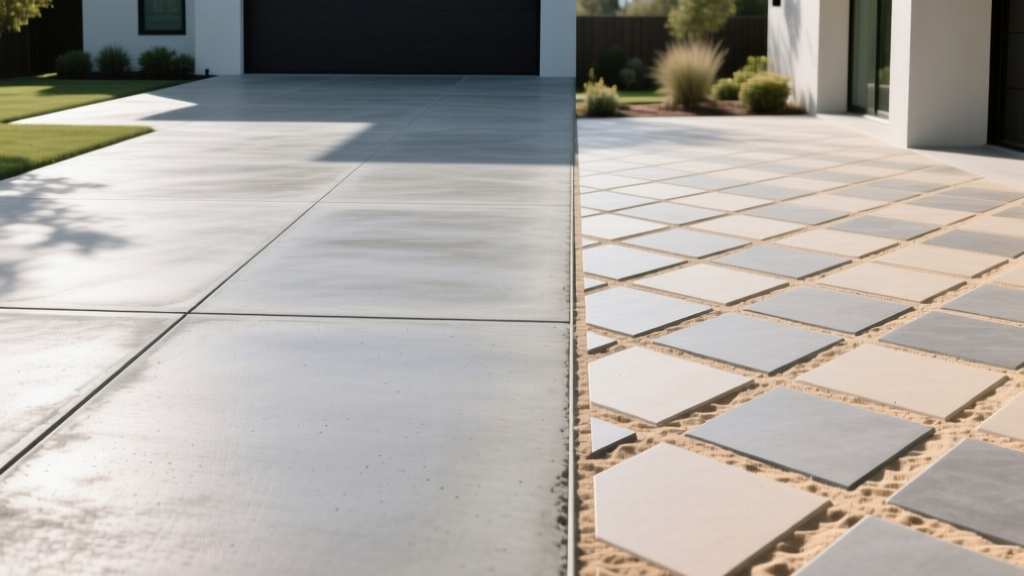
When evaluating the price of pavers vs concrete for exterior hardscaping, homeowners and contractors must look beyond the initial material quote. Poured concrete is a monolithic, rigid structure that relies on tensile strength and subgrade stability. Concrete pavers form a flexible, interlocking matrix that distributes loads laterally. This fundamental structural difference dictates not only the upfront installation costs but also the 20-year lifecycle expenses, repair methodologies, and site preparation requirements.
2026 National Average Installed Costs
Poured Concrete (Standard Broom Finish): $8.50 – $17.50 per sq. ft.
Concrete Pavers (Standard Pedestrian): $16.50 – $33.00 per sq. ft.
Note: Stamped or stained concrete bridges this gap, typically costing $14.00 – $24.00 per sq. ft., bringing it closer to mid-tier paver pricing.
Line-Item Cost Breakdown
To understand where the budget is allocated, we must deconstruct the installation process. The price of pavers vs concrete diverges most significantly in labor and base preparation.
| Cost Component | Poured Concrete (per sq. ft.) | Concrete Pavers (per sq. ft.) |
|---|---|---|
| Raw Material | $2.00 – $4.00 | $4.00 – $10.00 |
| Base & Subbase Aggregate | $1.50 – $2.50 | $2.50 – $4.50 |
| Labor & Equipment | $4.00 – $8.00 | $8.00 – $14.00 |
| Finishing, Sand & Sealing | $1.00 – $3.00 | $2.00 – $4.50 |
| Total Installed | $8.50 – $17.50 | $16.50 – $33.00 |
Hidden Costs: Subgrade Preparation and Edge Restraints
The most common cause of hardscape failure is inadequate base preparation. The Interlocking Concrete Pavement Institute (ICPI) mandates strict aggregate base depths that directly impact the final price.
Paver Base Requirements
- Pedestrian Patios/Walkways: Require 4 to 6 inches of compacted crushed angular aggregate (typically 3/4-inch minus gravel), topped with 1 inch of coarse, sharp concrete sand.
- Vehicular Driveways: Demand 8 to 12 inches of compacted aggregate to prevent lateral shifting under dynamic vehicle loads.
- Edge Restraints: Pavers require perimeter restraints to prevent spreading. Heavy-duty PVC or aluminum restraints, secured with 10-inch steel spikes every 12 inches, add $1.50 to $3.00 per linear foot. Mortar curbs are cheaper but prone to frost-heave cracking.
Poured Concrete Subbase Requirements
Poured concrete relies on the tensile strength of the slab itself. A standard 4-inch slab requires a 4-inch compacted gravel subbase. For driveways, the slab thickness increases to 5 or 6 inches, and the subbase remains 4 inches. While excavation costs are similar, the aggregate material cost for concrete is roughly 30% lower than for pavers because the bedding sand layer is eliminated.
Technical Specifications: PSI, Thickness, and Air Entrainment
When ordering materials, precise specifications dictate both durability and cost.
Concrete Mix Specifications
Patios: 3,000 PSI mix is standard. For regions with severe freeze-thaw cycles, specify 5% to 7% air-entrainment to create microscopic bubbles that allow water expansion without spalling.
Driveways: 4,000 PSI mix is mandatory to withstand point-loads from vehicle tires. Control joints must be saw-cut or tooled every 10 to 12 feet to predetermine cracking locations. The American Concrete Institute (ACI) provides exhaustive guidelines on joint spacing relative to slab thickness.
For pavers, thickness is the primary cost and structural variable. Standard 60mm (2 3/8-inch) pavers are sufficient for foot traffic. However, driveways require 80mm (3 1/8-inch) pavers. Upgrading to 80mm pavers increases material costs by 15% to 25% and requires deeper excavation.
Long-Term Maintenance and Repair Economics
The initial price of pavers vs concrete flips when analyzing a 20-year lifecycle. Rigid concrete slabs are highly susceptible to differential settlement, tree root intrusion, and freeze-thaw cracking.
Concrete Repair Costs
When a concrete slab cracks or settles, repairs are highly visible and expensive. Mudjacking (pumping a cementitious slurry beneath the slab to lift it) costs $3.00 to $6.00 per square foot. If the slab fractures beyond repair, demolition, hauling, and repouring a single panel costs $15.00 to $25.00 per square foot, and the new concrete will never perfectly match the weathered color of the existing slab.
Paver Repair Costs
Pavers offer a distinct economic advantage in repairability. Because they are modular, a settled or stained section can be 'unzipped.' A contractor removes the affected pavers, re-compacts the base aggregate, adds fresh bedding sand, and relays the original stones. The labor cost for localized paver repair is typically $75 to $150 per hour, with zero material waste. Furthermore, keeping 5% extra pavers from the original batch during installation ensures perfect color matching decades later.
Routine Maintenance
- Concrete Sealing: Acrylic or penetrating sealers must be reapplied every 2 to 3 years ($1.00 – $2.00 per sq. ft.).
- Paver Jointing: Polymeric sand, which binds the joints and prevents weed growth and ant mining, degrades over 5 to 7 years. Re-sanding and sealing a paver patio costs $2.50 to $4.00 per sq. ft.
Environmental Factors and Permeability
Municipal stormwater regulations are increasingly influencing hardscape costs. Traditional poured concrete is entirely impermeable, forcing runoff into municipal drains or requiring expensive dry wells and retention ponds.
The Environmental Protection Agency (EPA) highlights Permeable Interlocking Concrete Pavement (PICP) as a premier green infrastructure solution. PICP systems utilize open-graded aggregate bases and wider joints filled with clean, washed gravel to allow water to infiltrate the soil. While PICP installation costs 20% to 30% more than standard pavers, it can eliminate municipal stormwater tie-in fees or reduce the required footprint of retention basins, yielding significant net savings on large-scale commercial or high-end residential projects.
Decision Matrix: Which Material Should You Choose?
Use this framework to align your site conditions and budget with the correct material.
Choose Poured Concrete If:
- Your budget is strictly capped below $14 per sq. ft.
- You prefer a minimalist, modern aesthetic with large, unbroken planes.
- The soil is highly stable, well-draining bedrock or dense clay with no mature trees nearby.
- You are pouring a massive area (e.g., >1,000 sq. ft.) where concrete truck efficiency drastically lowers the per-square-foot labor cost.
Choose Concrete Pavers If:
- The site has expansive clay soils, heavy frost heave, or aggressive tree roots that will inevitably crack rigid slabs.
- You anticipate needing access to underground utilities (water lines, gas, irrigation) in the future.
- You are executing a DIY installation, as pavers eliminate the time-critical stress of screeding and finishing wet concrete before it sets.
- You require permeable drainage to comply with local lot-coverage or stormwater ordinances.
Final ROI Considerations
While the upfront price of pavers vs concrete heavily favors poured slabs, real estate appraisals often view high-quality paver installations as premium landscaping features rather than basic utility. A well-designed paver driveway or patio frequently yields a 70% to 80% return on investment at resale, compared to 50% to 60% for standard broom-finished concrete. Factor in your local climate, soil mechanics, and how long you intend to hold the property before making the final specification.
Written by
David NakamuraDavid Nakamura is a licensed architect (AIA) and construction technology writer focused on sustainable building methods, mass timber engineering, and high-performance building envelopes. He holds a Master of Architecture from the University of Washington and is a certified Passive House Consultant (CPHC). David spent eight years at the Seattle firm Mithun, where he led the design of three LEED Platinum projects, before founding his own practice specializing in net-zero residential design. He serves on the editorial advisory board of GreenBuilder Magazine and has authored peer-reviewed papers on cross-laminated timber (CLT) connections for the Journal of Structural Engineering. In his spare time, David teaches woodworking at Pratt Fine Arts Center and kayaks the Puget Sound.
More from David Nakamura
View all
Construction Cost
Labor Cost to Build a Deck Per Sq Ft: 2026 Installation Guide
Discover the exact labor cost to build a deck per sq ft in 2026. This installation guide breaks down contractor rates, complexity factors, and hidden fees.
Aug 4, 2026

Construction Cost
How Much Does It Cost to Build a 3 Bedroom House? Financing Guide
Learn exactly how much it costs to build a 3 bedroom house and explore 2026 financing options, construction loan types, and budget frameworks for your build.
Aug 4, 2026

Construction Cost
Cost to Build a Tennis Court: 2026 Guide
How much does it cost to build a tennis court in 2026? Breakdowns for asphalt, concrete, and synthetic surfaces plus fencing and lighting.
Jul 30, 2026