Portland Cement Types and Selection Guide for Concrete Mixes
Master Portland cement selection with our ASTM C150 taxonomy guide. Compare Type I through V and Type IL for optimal concrete mix design and durability.
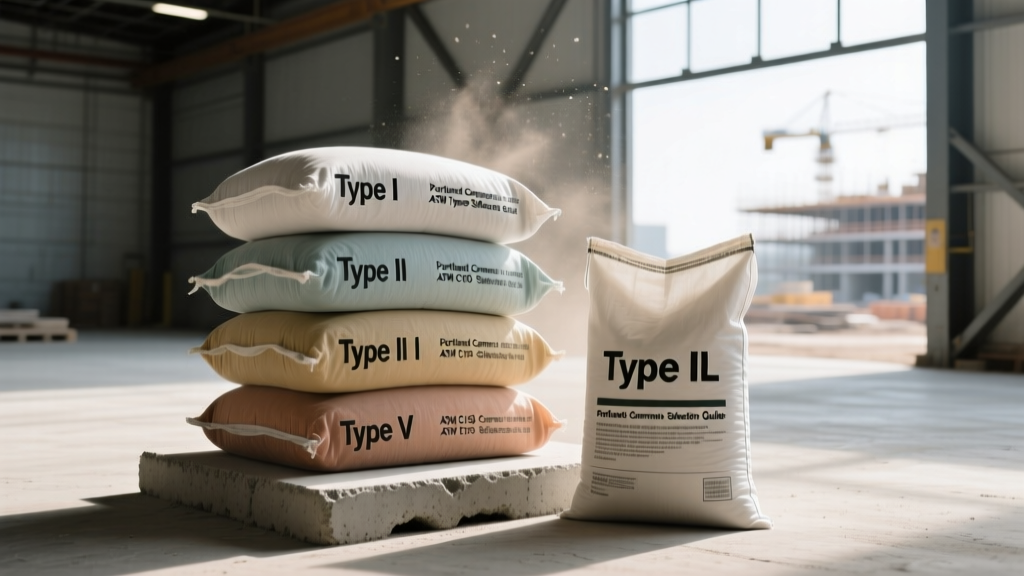
The ASTM C150 Taxonomy: Decoding Portland Cement Types
Specifying the correct portland cement is the foundational decision in concrete mix design. Under the American Concrete Institute (ACI) and ASTM C150 standards, portland cement is classified by its chemical composition and physical performance characteristics. These differences are driven by the proportions of four primary Bogue compounds: tricalcium silicate (C3S), dicalcium silicate (C2S), tricalcium aluminate (C3A), and tetracalcium aluminoferrite (C4AF). Selecting the wrong type leads to premature sulfate attack, thermal cracking in mass pours, or delayed form-stripping schedules.
Type I & IA: The General Purpose Standard
Type I is the baseline portland cement used when no special properties are required. It typically contains 50-70% C3S and up to 15% C3A. It provides standard strength gain and moderate heat of hydration. Type IA is the air-entraining variant, designed specifically for freeze-thaw environments where microscopic air bubbles are required to relieve internal osmotic pressure. Use Type I for standard residential slabs, interior columns, and non-exposed architectural precast.
Type II & IIA: Moderate Sulfate & Heat Control
Type II is engineered for environments with moderate sulfate exposure or where moderate heat of hydration is a concern. The critical specification here is the restriction of C3A to a maximum of 8%. Because C3A is the compound most vulnerable to sulfate attack (forming expansive ettringite), limiting it drastically improves durability in soils with water-soluble sulfate concentrations between 0.10% and 0.20%. Type II is the default choice for bridge piers, retaining walls, and drainage structures in mildly aggressive soils.
Type III: High Early Strength for Fast-Track Paving
Type III achieves high early strength through a finer grind and a higher C3S content (often exceeding 65%). This accelerates the hydration process, allowing concrete to reach structural loading thresholds in a fraction of the time.
Type IV: Low Heat for Mass Concrete
Type IV is formulated to generate heat at a very slow rate by minimizing C3S (20-40%) and C3A (<7%). It is strictly used in massive concrete elements like gravity dams and thick mat foundations where the heat of hydration could cause severe thermal differentials and subsequent cracking. Industry Note: As of 2026, Type IV is rarely manufactured in the US. Engineers now achieve low-heat profiles by substituting Type I/II with high volumes of supplementary cementitious materials (SCMs) like slag cement or fly ash, or by using chilled water and flaked ice in the mix.
Type V: Extreme Sulfate Resistance
Type V is the ultimate defense against severe sulfate exposure, restricting C3A to a maximum of 5%. It is mandated for foundations in soils or groundwater with water-soluble sulfate levels exceeding 0.20%, or in coastal tidal zones. Because the clinker requires specialized kiln runs to achieve such low aluminate levels, Type V carries a significant cost premium and longer lead times.
The 2026 Shift: Portland-Limestone Cement (Type IL)
The most significant evolution in cement taxonomy over the last five years is the widespread adoption of Portland-Limestone Cement (PLC), classified under ASTM C595 as Type IL. By intergrinding 5% to 15% uncalcined limestone with the clinker, Type IL reduces the carbon footprint of the cement by approximately 10% without sacrificing performance.
Selection Matrix: Matching Cement Type to Exposure
| Exposure Condition | Water-Soluble Sulfate (Soil) | Recommended ASTM Type | Max w/cm Ratio |
|---|---|---|---|
| Negligible / Interior | < 0.10% | Type I, IA, or IL | 0.50 |
| Moderate Sulfate | 0.10% - 0.20% | Type II or IIA | 0.45 |
| Severe Sulfate | 0.20% - 2.00% | Type V | 0.40 |
| Fast-Track / Cold Weather | N/A | Type III | 0.45 |
Real-World Failure Modes & Edge Cases
Even with the correct ASTM type specified, field errors can compromise the matrix. Understanding these edge cases prevents costly remediation:
- Delayed Ettringite Formation (DEF): If Type III concrete is cured at internal temperatures exceeding 158°F (70°C) during the first 24 hours, the C3A hydration products break down and reform later as expansive ettringite, causing severe map-cracking. Always monitor internal core temperatures in thick Type III pours.
- False Set in Type I: High alkali content combined with certain polycarboxylate ether (PCE) superplasticizers can cause a rapid loss of slump (false set) within 15 minutes of batching. Run preliminary mock-batches when pairing Type I cement with new generation high-range water reducers.
- Over-reliance on Type V: Specifying Type V in moderate sulfate soils 'just to be safe' is a procurement error. Type V has lower early strength and is highly susceptible to carbonation. If the soil report shows <0.20% sulfate, Type II is structurally and economically superior.
Procurement & Cost Considerations
Pricing for portland cement fluctuates based on regional clinker capacity, energy costs, and freight. Below are the baseline bulk pricing estimates (per short ton, FOB plant) for the current market:
- Type I / II / IL: $140 - $170 per ton. (Type IL is often at the lower end of this spectrum due to the limestone substitution).
- Type III: $160 - $195 per ton. The premium reflects the additional energy required for finer grinding and higher C3S clinker production.
- Type V: $190 - $240 per ton. Low production volume and specialized raw material blending dictate this premium. Lead times can exceed 3 weeks in non-coastal regions.
For comprehensive mix design protocols and updated durability tables, consult the latest guidelines published by the Portland Cement Association (PCA). Always require a certified mill test report (CMTR) from your batch plant to verify the exact C3A and C3S percentages of the delivered cement against your structural specifications.