Pouring Concrete on Slab: Top Overlay Brands Compared
Compare top polymer-modified products for pouring concrete on slab overlays. Deep-dive into Ardex, Mapei, and Quikrete specs, costs, and prep.
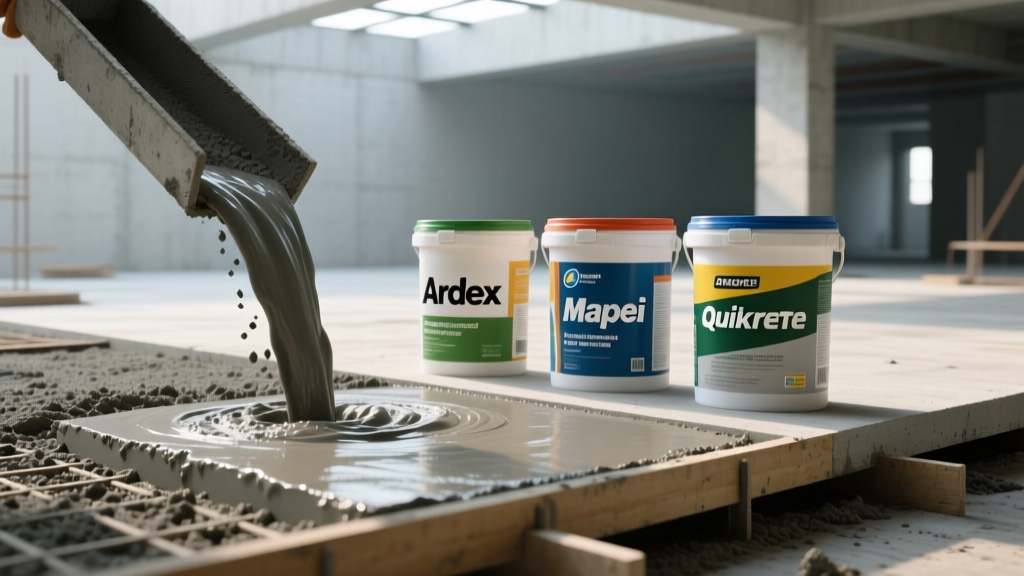
The Physics of Bonding: Why Standard Mixes Fail
Pouring concrete on slab substrates presents a unique chemical and mechanical challenge. Standard Portland cement mixes undergo significant volumetric shrinkage as they cure. When poured over an existing, fully cured concrete slab, the new overlay shrinks while the old slab remains dimensionally stable. This differential movement creates immense shear stress at the bond line, inevitably leading to delamination, hollow spots, and curling at the edges.
To successfully apply concrete on slab applications, contractors and DIYers must use polymer-modified overlays or self-leveling underlayments (SLUs). These products incorporate acrylic, vinyl, or redispersible polymer powders that drastically reduce shrinkage, increase flexural strength, and create a chemical bond with the existing substrate. According to guidelines published by the American Concrete Institute (ACI), successful overlay adhesion requires both mechanical interlock and chemical compatibility, which standard bagged concrete mixes simply cannot provide without specialized bonding agents.
Brand Deep-Dive: Ardex Engineered Cements
Ardex dominates the commercial and high-end residential market for concrete on slab overlays. Their product lines are engineered for specific thickness ranges and traffic requirements, utilizing advanced calcium aluminate chemistry to accelerate curing and minimize shrinkage.
Ardex K-500 and Ardex CD
Ardex K-500 is a heavy-duty, self-leveling concrete topping designed for thicknesses ranging from 1/4 inch up to 2 inches in a single pour. It boasts a compressive strength of 5,800 psi at 28 days and a flexural strength of 1,000 psi, making it suitable for forklift traffic in warehouse environments. Material cost averages $55 to $65 per 50 lb bag, covering approximately 12 square feet at 1/2 inch thick.
For feather-edge applications, Ardex CD (Concrete Dressing) is a trowel-applied overlay that can be applied down to 1/16 inch. It requires the Ardex P-51 primer (diluted 1:1 with water) to seal the substrate pores and prevent the old slab from rapidly stealing moisture from the new overlay, which would cause plastic shrinkage cracking.
Brand Deep-Dive: Mapei Concrete Restoration
Mapei’s UltraCare and Concrete Restoration Systems (CRS) offer robust solutions for pouring concrete on slab surfaces, particularly in environments requiring high chemical resistance or rapid return-to-service.
Ultratop and Planitop 330
Mapei Ultratop is a premium, rapid-setting self-leveling topping. Its defining characteristic is its exceptional flowability and abrasion resistance. At 28 days, Ultratop achieves 6,000 psi compressive strength. It is frequently used in retail spaces and showrooms as a polished concrete overlay. The critical companion product is Mapei Primer T, a multi-purpose primer that must be applied in two coats and broadcast with silica sand to create a mechanical grip.
Planitop 330 is Mapei’s fast-setting, polymer-modified resurfacer designed for interior horizontal surfaces. It cures to a walkable state in just 2 hours and accepts foot traffic rapidly. At roughly $45 per 50 lb bag, it sits at a mid-tier price point but offers commercial-grade reliability. According to the International Concrete Repair Institute (ICRI), pairing these overlays with proper surface profiling is mandatory to achieve the specified tensile bond strength of 200 psi.
Retail & DIY Lines: Quikrete and Custom Building Products
For residential projects, garage floors, and patio resurfacing, big-box retail brands offer accessible, albeit more constrained, product lines.
- Quikrete Concrete Resurfacer (#1131): This is the most widely available polymer-modified overlay for DIYers. It contains portland cement, sand, and proprietary polymer additives. It can be applied from 1/2 inch down to a featheredge. However, it has a strict maximum thickness limit of 1/2 inch per lift. Cost is highly competitive at $22 to $28 per 40 lb box. Compressive strength is 4,500 psi at 28 days.
- Custom Building Products LevelQuik RS: Primarily marketed as an underlayment for tile, LevelQuik RS (Rapid Setting) is frequently used to level severely sloped or pitted concrete slabs before installing floor coverings. It is not designed as a wear surface and must be covered. It flows exceptionally well but requires strict adherence to the 6-quart water-per-bag ratio; adding extra water to increase flow will destroy the cement matrix and cause dusting.
Product Comparison Matrix
| Brand / Product | Min / Max Thickness | 28-Day Compressive Strength | Pot Life (at 70°F) | Approx. Material Cost (per sq ft at 1/4") |
|---|---|---|---|---|
| Ardex K-500 | 1/4" to 2" | 5,800 psi | 30 minutes | $1.15 - $1.35 |
| Ardex CD | 1/16" to 1/4" | 4,400 psi | 15 minutes | $0.90 - $1.10 |
| Mapei Ultratop | 1/4" to 2" | 6,000 psi | 20 minutes | $1.20 - $1.45 |
| Mapei Planitop 330 | 1/8" to 1/2" | 4,500 psi | 30 minutes | $0.85 - $1.05 |
| Quikrete #1131 | Featheredge to 1/2" | 4,500 psi | 20 minutes | $0.45 - $0.60 |
Substrate Preparation and Failure Mode Prevention
The highest-performing overlay will fail if poured over an improperly prepared slab. The two most common failure modes in concrete on slab applications are bond failure due to poor profiling and osmotic blistering due to moisture vapor.
Achieving the Correct Concrete Surface Profile (CSP)
Acid etching is obsolete and unreliable for modern polymer-modified overlays. The ASTM International and ICRI mandate mechanical preparation. You must achieve a CSP 3 to CSP 5 profile.
- Diamond Grinding: Use a planetary grinder with 30-grit to 40-grit metal-bond diamonds to remove laitance, curing compounds, and old adhesives. This opens the pores of the concrete.
- Shotblasting: For thicker overlays (like Ardex K-500), shotblasting is preferred as it creates a deeper, more aggressive profile (CSP 4-5) that allows the thick slurry to lock into the substrate.
- Vacuuming: After profiling, the slab must be HEPA-vacuumed. Any residual dust acts as a slip plane, completely negating the chemical bond of the primer.
Moisture Vapor Transmission Limits
Pouring an impermeable concrete overlay over a slab with high Moisture Vapor Emission Rate (MVER) will trap hydrostatic pressure. As the moisture attempts to escape, it pushes against the overlay, causing osmotic blistering and adhesive failure.
Testing Standard: Before pouring any overlay, conduct a Calcium Chloride test per ASTM F1869 or an in-situ Relative Humidity (RH) probe test per ASTM F2170. Most polymer-modified overlays require an MVER of less than 3 lbs per 1,000 square feet per 24 hours. If your slab exceeds this, you must apply an epoxy moisture mitigation barrier (such as Mapei Primer ER or Ardex MC RAPID) before the overlay.
By selecting the correct polymer-modified product for your specific thickness requirement and rigorously adhering to mechanical profiling and moisture testing protocols, you can ensure a monolithic, long-lasting bond when pouring concrete on slab surfaces.