Concrete Fiber Mesh vs Wire: Slab Reinforcement Guide
Compare concrete fiber mesh vs wire reinforcement. Analyze ASTM specs, true installed costs, dosage rates, and structural limits for slab pours.

The Core Mechanics: 2D Plane vs. 3D Matrix
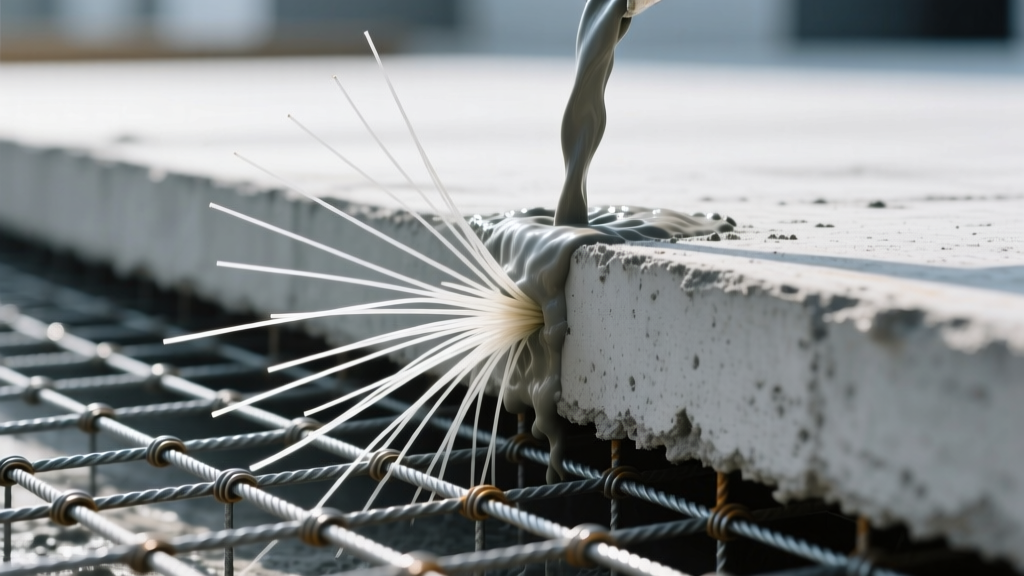
The debate between concrete fiber mesh vs wire reinforcement centers on how tensile forces are distributed within a curing slab. Welded Wire Reinforcement (WWR) provides a continuous 2D plane of high-tensile steel, designed to hold together macro-cracks that occur due to drying shrinkage and thermal contraction. Fiber reinforcement, conversely, creates a 3D matrix throughout the entire volume of the concrete. While fibers intercept micro-cracks at their inception before they propagate, they do not behave identically to steel under heavy structural loads. Understanding this distinction is critical for specifying the correct mix design for driveways, industrial floors, and patios.
Welded Wire Reinforcement (WWR): Specifications and Failure Modes
Wire mesh is governed by ASTM A1064 standards and is specified using a "W" designation that indicates the cross-sectional area of the wire in hundredths of a square inch.
Common WWR Specifications
- 6x6 W1.4 x W1.4 (10-Gauge): The standard for residential driveways and sidewalks. Provides 0.014 sq. in. of steel per foot of width.
- 6x6 W2.9 x W2.9 (6-Gauge): Used for commercial slabs, RV pads, and areas subject to heavy point loads. Provides nearly double the tensile capacity of W1.4.
Fiber Reinforcement: Decoding Dosage and Material Types
Fiber mesh is governed by ASTM C1116. The biggest mistake specifiers make is assuming all fibers provide structural reinforcement. Micro-synthetic fibers only control plastic shrinkage; they will not hold a slab together under structural loading. To replace wire mesh, you must specify macro-synthetic or steel fibers at precise dosage rates.
| Fiber Type | Material | Dosage Rate (per CY) | Primary Function | Can it Replace Wire? |
|---|---|---|---|---|
| Micro-Synthetic | Polypropylene | 0.5 – 1.5 lbs | Plastic shrinkage crack prevention | No |
| Macro-Synthetic | Polyolefin / Copolymer | 3.0 – 7.0 lbs | Secondary structural, drying shrinkage | Yes (Replaces W1.4 only) |
| Steel Fibers | Carbon Steel (ASTM A820) | 30 – 90 lbs | Primary structural, heavy impact | Yes (Replaces W2.9 and rebar) |
| Alkali-Resistant Glass | AR Glass | 1.0 – 3.0 lbs | Surface micro-cracking, GFRC | No |
Head-to-Head Comparison Matrix
When evaluating concrete fiber mesh vs wire for a standard 4-inch residential driveway, the choice impacts labor, finish quality, and long-term durability.
| Criteria | Welded Wire Mesh (W1.4) | Macro-Synthetic Fiber (4.0 lbs/cy) |
|---|---|---|
| Crack Control Mechanism | Post-crack macro-bridging (holds large cracks tight) | Pre-crack micro-interception (stops cracks from forming) |
| Placement Labor | High (requires tying, overlapping, and setting on chairs) | Zero (batched at the plant or added to the truck chute) |
| Risk of Installation Error | High (mesh pushed to bottom of slab by foot traffic) | Low (uniform 3D distribution guaranteed by mixing) |
| Surface Finishing Impact | None, unless wire is too close to surface (causes rust spots) | High (fibers can cause a "hairy" surface if not troweled correctly) |
| Corrosion Resistance | Poor (exposed edges or shallow cover will rust and spall) | Excellent (synthetic polymers are completely inert) |
True Installed Cost Analysis (1,000 Sq. Ft. Driveway)
Pricing fluctuates based on regional steel markets and batch plant surcharges. The following breakdown reflects 2026 average installed costs for a 1,000 sq. ft. slab (approx. 12.5 cubic yards).
Wire Mesh Route
- Material: 10 sheets (5'x15' W1.4) @ $40/sheet = $400
- Chairs & Tie Wire: $50
- Labor (Placement): 4 hours @ $65/hr = $260
- Total Reinforcement Cost: $710 ($0.71 / sq. ft.)
Macro-Fiber Route
- Material: 12.5 cy @ $28/cy batch plant surcharge = $350
- Chairs & Tie Wire: $0
- Labor (Placement): $0
- Total Reinforcement Cost: $350 ($0.35 / sq. ft.)
Note: While macro-fiber is significantly cheaper on a pure material and labor basis, engineers may still require WWR in regions with highly expansive soils where ultimate post-crack tensile strength is mandated by local building codes.
The Finishing Reality: Surface Defects and Remediation
Contractors often resist fiber mesh due to finishing challenges. Understanding the chemistry and mechanics of the surface paste is required to mitigate these issues.
The "Hairy Slab" Phenomenon
When using synthetic fibers, the troweling action pulls microscopic filaments to the surface, creating a fuzzy or "hairy" appearance. The Fix: Do not attempt to steel trowel while bleed water is present. Wait for the surface to stiffen slightly, then use a sharp steel trowel held at a high angle to shear the fibers. For exterior broom finishes, use a stiff-bristled broom and pull in a single direction. Alternatively, a light pass with a propane torch (held 18 inches from the surface) will instantly melt synthetic fibers without damaging the concrete paste.
Wire Mesh "Ghosting" and Puncture
If wire mesh is pulled too close to the surface during screeding, the concrete cover becomes too thin. This leads to "ghosting" (visible grid lines on the surface due to differential curing temperatures) and eventual rust jacking, where oxidizing steel expands and spalls the concrete above it. The Fix: Mandate the use of 2-inch concrete dobies (chairs) and strictly prohibit crew members from walking directly on the mesh without support boards during the pour.
The Engineer's Decision Framework
Use this practical framework to specify the correct reinforcement based on the project parameters. For comprehensive mix design guidelines, refer to resources from the Euclid Chemical technical library and local ACI chapters.
- Scenario A: Residential Sidewalks & Patios (Light Duty)
Specification: Micro-synthetic fibers (1.0 lb/cy). Wire mesh is unnecessary and adds unjustified cost. - Scenario B: Standard Residential Driveways (Medium Duty)
Specification: Macro-synthetic fibers (4.0 lbs/cy) OR 6x6 W1.4 wire mesh. Choose fiber for speed and cost savings; choose wire if local soil is highly expansive clay. - Scenario C: RV Pads & Commercial Loading Docks (Heavy Point Loads)
Specification: 6x6 W2.9 wire mesh, or a dual-system (W1.4 wire + micro-synthetic fibers for comprehensive plastic and drying shrinkage control). - Scenario D: Industrial Warehouse Slabs (High Traffic, Forklifts)
Specification: Steel fibers (50-75 lbs/cy) combined with a dry-shake metallic aggregate hardener. WWR is generally insufficient for joint-armoring in these environments.
Written by
Marcus ChenMarcus Chen is a licensed structural engineer (PE) and building materials analyst with over 12 years of experience across residential, commercial, and industrial construction. He holds a Master of Science in Civil Engineering from UC Berkeley and spent six years at Thornton Tomasetti before transitioning to independent consulting and technical writing. Marcus specializes in material selection for seismic-prone regions, concrete reinforcement strategies, and lifecycle cost analysis. His work has been cited by the American Concrete Institute (ACI) and the Structural Engineers Association of California (SEAOC). When he is not on a job site or at his desk, you will find him hiking the Sierra Nevada or restoring a 1920s craftsman bungalow in Oakland, CA.
More from Marcus Chen
View all
Construction Cost
How Much Did the Eiffel Tower Cost to Build?
How much did the Eiffel Tower cost to build in 1889? We adjust for inflation and compare its budget to modern skyscraper construction.
Aug 4, 2026

Fire Resistance
What Is a Fire Resistant Material? Testing & Certification Guide
Discover what is a fire resistant material through ASTM and UL testing. Learn how fire ratings, certifications, and assemblies work in construction.
Aug 4, 2026

Construction Cost
How Much Did the Burj Khalifa Cost to Build?
How much did the Burj Khalifa cost to build? We break down the $1.5B project and extract 5 money-saving strategies for your next build.
Jul 30, 2026