Stamped Concrete vs Pavers Cost: 2026 Installation & ROI Guide
Compare stamped concrete vs pavers cost in 2026. Get exact pricing per square foot, installation labor rates, maintenance expenses, and long-term ROI data.

The Core Economic Divide: Upfront Price vs. Lifetime Value
Evaluating stamped concrete vs pavers cost requires looking beyond the initial contractor quote. While stamped concrete generally presents a lower upfront material cost, interlocking concrete pavers offer superior structural flexibility and drastically lower long-term repair expenses. In 2026, supply chain stabilization has normalized concrete pricing, but regional labor shortages continue to drive installation premiums for complex masonry work. This analysis breaks down the exact material, labor, and lifecycle costs to determine which hardscape material delivers the highest return on investment for your specific site conditions.
2026 Quick Cost Snapshot (Per Square Foot)
- Stamped Concrete (Installed): $12.50 – $22.00 / sq. ft.
- Concrete Pavers (Installed): $16.00 – $28.50 / sq. ft.
- Clay Brick Pavers (Installed): $24.00 – $38.00 / sq. ft.
- 20-Year Maintenance Cost: Stamped ($4.50/sq ft) vs. Pavers ($1.80/sq ft)
Stamped Concrete: Detailed Cost Breakdown
Stamped concrete mimics natural stone, slate, or brick by pressing textured polyurethane mats into freshly poured, colored concrete. The final price is heavily dictated by the complexity of the stamp pattern, the number of colors used, and the required compressive strength of the mix.
Material & Labor Rates
| Component | Budget Tier | Premium Tier |
|---|---|---|
| Concrete Mix (4000 PSI, Air-Entrained) | $2.50 / sq. ft. | $3.80 / sq. ft. |
| Color Hardener & Release Agent | $1.20 / sq. ft. | $2.50 / sq. ft. (Antiquing) |
| Stamping Labor & Formwork | $5.00 / sq. ft. | $9.50 / sq. ft. |
| Acrylic Sealer (Non-Slip Additive) | $1.00 / sq. ft. | $1.80 / sq. ft. (Polyurethane) |
Hidden Costs & Structural Edge Cases
The most frequent failure point in stamped concrete is improper joint planning. Concrete will inevitably crack; control joints must be saw-cut every 10 to 12 feet to dictate where those cracks occur. Saw cuts will intersect your stamp pattern, creating visual breaks that cannot be hidden. Furthermore, in freeze-thaw climates, contractors must use a 4000 PSI air-entrained mix (4% to 6% air content). According to the Portland Cement Association, omitting air-entrainment to save $0.40 per square foot guarantees surface spalling within two winters when de-icing salts are applied.
Paving Stones: Detailed Cost Breakdown
Interlocking concrete pavers (ICPI standards) or clay brick pavers rely on a flexible, unbound base system. The cost of pavers is less about the surface material and more about the extensive sub-grade excavation and base preparation required to prevent settling.
Base Preparation & Material Tiers
A compliant paver installation requires excavating 9 to 11 inches of topsoil, followed by a 6-to-8-inch base of 3/4-inch minus crushed aggregate (ASTM D2940), compacted to 98% Proctor density. Using rounded river gravel instead of crushed angular stone is a critical error that leads to lateral movement and joint failure.
| Component | Standard Concrete Pavers | Tumbled / Natural Stone Pavers |
|---|---|---|
| Excavation & Geotextile Fabric | $2.50 / sq. ft. | $2.50 / sq. ft. |
| Crushed Aggregate Base & Bedding Sand | $3.80 / sq. ft. | $4.20 / sq. ft. |
| Paver Material (ASTM C936 Compliant) | $4.00 / sq. ft. | $12.50 / sq. ft. |
| Installation, Edge Restraint & Polymeric Sand | $6.50 / sq. ft. | $11.00 / sq. ft. |
The Edge Restraint Imperative
Pavers require a rigid perimeter to lock the system together. A hidden poured concrete beam (bond beam) costs roughly $14 to $18 per linear foot but provides permanent stability. Plastic or aluminum spike-in restraints cost only $4 to $7 per linear foot but are prone to heaving in expansive clay soils, eventually causing the outer rows of pavers to separate and the bedding sand to wash out.
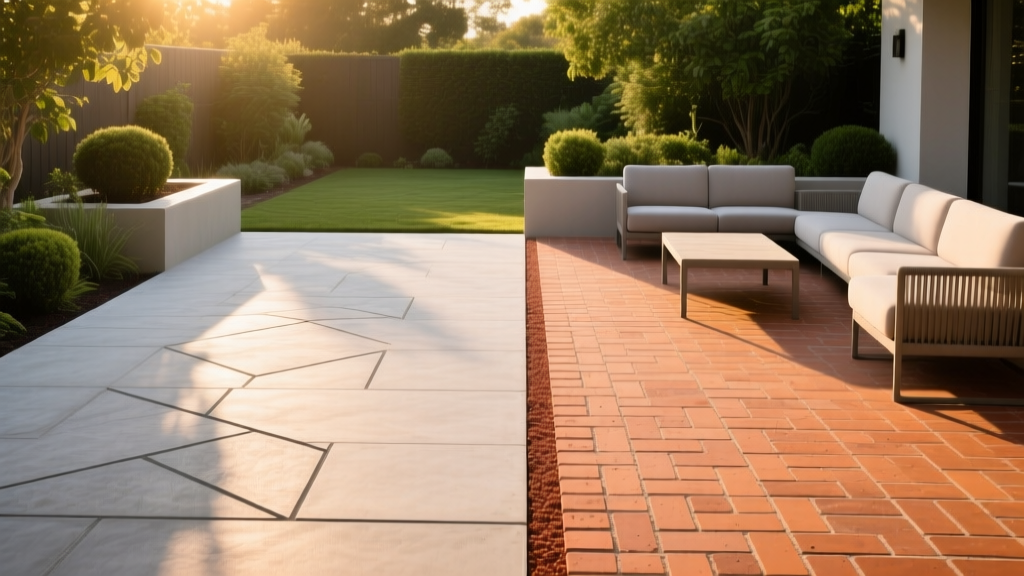
Head-to-Head Comparison Matrix
This matrix evaluates the physical and economic realities of both materials across critical hardscape performance metrics.
| Metric | Stamped Concrete | Interlocking Pavers |
|---|---|---|
| Initial Cost | Lower ($12 - $22 / sq ft) | Higher ($16 - $35 / sq ft) |
| Crack Repairability | Poor (Patches are highly visible) | Excellent (Unzip, fix base, replace) |
| Freeze-Thaw Durability | Moderate (Vulnerable to salt spalling) | Superior (Flexible system shifts with frost) |
| Utility Access | Destructive (Must jackhammer and repour) | Non-Destructive (Lift and relay pavers) |
| Surface Traction | Slippery when wet (Requires grip sealer) | High traction (Textured surface & joints) |
| Curing / Use Time | 5 to 7 days for full cure | Immediate use upon completion |
Long-Term Maintenance & Repair Economics
The true cost of hardscaping emerges in years 3 through 15. Stamped concrete requires a strict maintenance regimen to protect the color hardener and prevent moisture intrusion.
- Stamped Concrete Resealing: Acrylic sealers degrade under UV exposure and must be stripped and reapplied every 2 to 3 years. Professional resealing costs $1.50 to $2.50 per square foot. Over 15 years, a 500-square-foot patio will incur $1,500 to $2,500 in resealing costs.
- Paver Joint Maintenance: Polymeric sand can erode or wash out due to aggressive power washing or ant activity. Re-sanding joints costs $0.60 to $1.10 per square foot and is typically only required every 7 to 10 years.
- Settling Repairs: If a tree root lifts a section of stamped concrete, the only fix is saw-cutting the slab, demolishing the affected area, re-pouring, and attempting to color-match the new concrete to the faded old concrete—a nearly impossible aesthetic feat. With pavers, you simply pry up the affected stones, cut the root, re-compact the base, and relay the exact same stones.
Decision Framework: Which Should You Choose?
Select between stamped concrete and pavers based on your site's soil profile, local climate, and aesthetic tolerance for control joints.
Choose Stamped Concrete If:
- Your budget is strictly capped below $16 per square foot.
- You live in a mild climate with rare freeze-thaw cycles (e.g., Southern California, Central Florida).
- You prefer a continuous, monolithic look and can accept visible saw-cut control joints every 10 feet.
- Subsurface utility access is not anticipated in the future.
Choose Pavers If:
- Your property has expansive clay soils or significant tree root networks that cause ground heaving.
- You experience harsh winters requiring frequent use of de-icing salts.
- You require a zero-maintenance surface that never needs chemical resealing.
- You anticipate needing to access underground plumbing, gas, or electrical lines in the future.
For large, open commercial plazas or pool decks where slip resistance and immediate drainage are paramount, permeable pavers installed over an open-graded aggregate base provide superior functional value, despite the 25% installation premium over standard stamped concrete.
Written by
Elena RodriguezElena Rodriguez is a civil engineer and technical writer specializing in concrete technology, masonry systems, and ASTM/ACI compliance. She earned her B.S. in Civil Engineering from Texas A&M University and spent a decade at a materials testing laboratory, performing over 2,000 concrete compressive strength tests and masonry prism evaluations. Elena is an ACI-certified Field Testing Technician (Grade I) and a member of ASTM Committee C12 on Natural Building Stone. She currently consults on forensic engineering cases involving concrete failures and moisture intrusion. Based in San Antonio, TX, Elena is a proud member of the Society of Women Engineers (SWE) and coaches her daughter's FIRST Robotics team.
More from Elena Rodriguez
View all
Walls & Panels
Cost Analysis: Light Gauge Steel Framing Advantages and Disadvantages
Evaluate light gauge steel framing advantages and disadvantages through a strict cost analysis lens, comparing material, labor, and lifecycle expenses.
Aug 4, 2026

Walls & Panels
Gypsum Board Types: Exact Specifications, Thickness & Dimensions
Compare standard, Type X, and moisture-resistant gypsum board types. Get exact specifications, thicknesses, dimensions, and ASTM standards for your project.
Aug 4, 2026

Fire Resistance
Best Fire-Resistant Outdoor Decking Materials: 2026 Buyer Guide
Discover the best fire-resistant outdoor decking materials for 2026. Compare Class A PVC, aluminum, and hardwood options for WUI compliance and safety.
Aug 4, 2026