Prism Grout vs. Epoxy & Standard Cement: Tile Material Selection Guide
Compare prism grout, epoxy, and standard cement. Expert material taxonomy, ANSI standards, cost analysis, and selection frameworks for tile installations.
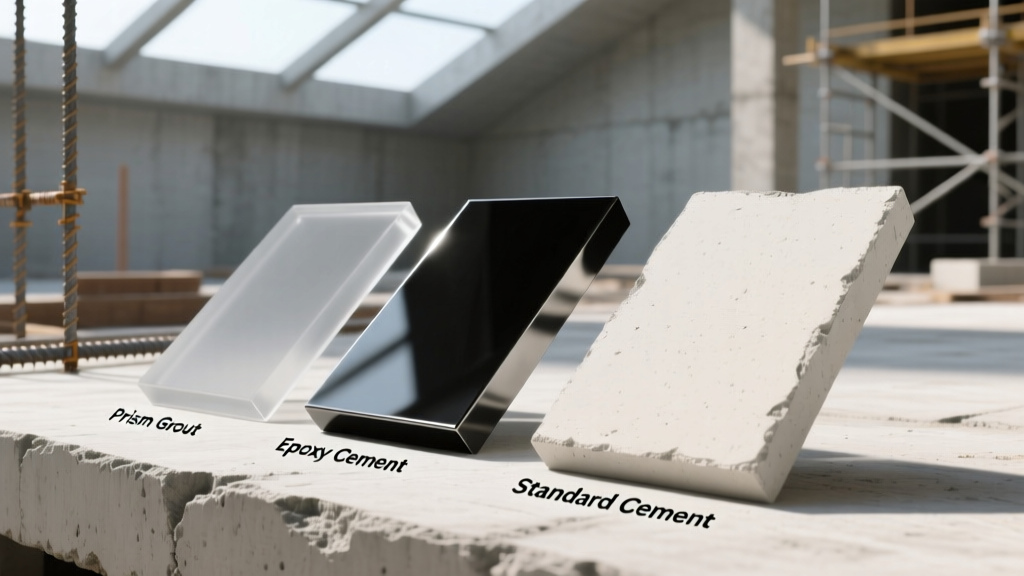
The Grout Taxonomy: Where Advanced Polymers Fit
Selecting the correct grout is a structural and aesthetic decision that dictates the longevity of a tile assembly. The modern grout market is divided into four primary chemical categories, each governed by specific ANSI (American National Standards Institute) specifications. Understanding this taxonomy is critical before evaluating specific products like Custom Building Products' PRISM SureColor Grout.
The Four Primary Grout Categories
- Standard Cementitious (ANSI A118.6): Traditional sanded and unsanded Portland cement grouts. Highly porous, prone to efflorescence, and requires post-installation sealing.
- High-Performance Modified Cementitious (ANSI A118.7): Cement-based grouts enhanced with advanced polymers and specialized aggregates. This is the category where prism grout resides. It bridges the workability of cement with the stain resistance of synthetic grouts.
- Epoxy (ANSI A118.3): A two-part system (resin and hardener) offering near-zero water absorption and extreme chemical resistance. Notoriously difficult to install and clean before curing.
- Urethane/Furan: Pre-mixed or specialized chemical grouts used for extreme flexibility or high-acid environments, respectively.
According to the Tile Council of North America (TCNA) Handbook, the shift toward large-format and rectified porcelain tiles has driven demand for ANSI A118.7 modified grouts. These tiles require narrower joints (often 1/16 inch), where standard cementitious grouts fail to achieve adequate compressive strength and are highly susceptible to shading and calcium leaching.
Deep Dive: The Chemistry and Mechanics of Prism Grout
Prism grout is a proprietary, rapid-setting, polymer-modified cementitious grout. Its formulation specifically targets the three most common failure modes of traditional cement grouts: efflorescence, color shading, and joint cracking.
Technical Specifications & Capabilities
- Joint Width Compatibility: 1/16 inch to 24 inches (eliminates the need to switch between sanded and unsanded variants).
- Compressive Strength: Exceeds 4,500 psi at 28 days (ANSI A118.7 requirement is 2,000 psi).
- Water Absorption: Less than 3% (compared to 7-10% in standard cement grouts).
- Cure Time: Foot traffic in 24 hours; full water submersion resistance in 7 days.
The Efflorescence Mechanism
Standard cement grouts contain Portland cement, which produces calcium hydroxide (free lime) as a byproduct of hydration. When water migrates through the porous grout joint to the surface and evaporates, it leaves behind white, crystalline salt deposits—efflorescence. Prism grout utilizes specialized calcium aluminate cements and proprietary polymer binders that drastically reduce the presence of free lime. Combined with its dense, low-absorption polymer matrix, water migration is halted at the micro-level, effectively eliminating efflorescence without the need for topical chemical sealers.
Material Selection Matrix: Prism vs. Epoxy vs. Standard Cement
When evaluating materials for a specific project, contractors and architects must weigh performance against installation labor and material costs. The following matrix compares high-performance modified cement (Prism), standard sanded cement, and 100% solids epoxy.
| Feature | Prism Grout (ANSI A118.7) | Standard Sanded (ANSI A118.6) | Epoxy (ANSI A118.3) |
|---|---|---|---|
| Stain Resistance | High (Inherent polymer matrix) | Low (Requires penetrating sealer) | Extreme (Non-porous resin) |
| Efflorescence Risk | Virtually None | High | None |
| Install Difficulty | Low-Medium (Similar to cement) | Low | High (Fast cure, sticky cleanup) |
| Shading/Color Consistency | Excellent (Uniform pigments) | Poor (Prone to water-ratio shading) | Excellent |
| Material Cost (per 17lb unit) | $35 - $45 | $15 - $20 | $75 - $95 (per 2-gallon kit) |
Critical Installation Edge Cases & Failure Modes
While polymer-modified grouts are highly forgiving, they are not immune to installer error. Misunderstanding the chemical requirements of these products leads to catastrophic aesthetic failures. Review these specific edge cases before specifying or installing prism grout.
1. Pigment Migration on Natural Stone
Prism grout contains highly concentrated, uniform color pigments. When applied to porous, unsealed natural stone (such as tumbled marble, limestone, or unsealed travertine), these pigments can migrate into the micro-fissures of the stone, causing permanent staining. Mandatory Protocol: All natural stone must be sealed with a high-quality, solvent-based impregnating sealer prior to grouting. Always conduct a mock-up test on a spare piece of stone.
2. The Water-Ratio Trap
Standard cement grouts allow for 'eyeballing' the water mixture. Prism grout does not. Adding excess water to improve workability breaks down the polymer chains, dilutes the pigment (causing light spots), and increases the water-to-cement ratio, leading to shrinkage cracks. You must measure the mixing water precisely according to the manufacturer's technical data sheet. If the grout begins to stiffen in the bucket (slake), it must be remixed without adding any additional water.
3. Glass Tile Scratching Concerns
Historically, unsanded grout was mandated for glass tile to prevent scratching the delicate surface. Prism grout utilizes a specialized, finely graded quartz aggregate that is engineered to be non-scratching. However, the hardness of the glass coating varies wildly between manufacturers. While Prism is generally safe for modern architectural glass tiles, a physical scratch test in an inconspicuous area or on a sample board is a non-negotiable prerequisite.
Although Prism is rapid-setting, the polymer matrix requires time to fully cross-link. Exposing the grout to continuous water (such as in a shower pan or pool) before the full 7-day cure cycle will result in pigment leaching and joint softening. Protect wet areas from moisture during the first week of curing.
Cost Analysis and ROI for Contractors
When evaluating material selection, looking solely at the bag price is a flawed metric. The true cost of grout includes material, labor, and long-term warranty liabilities.
Consider a 500-square-foot large-format porcelain tile installation with 1/8-inch joints:
- Standard Cement: Material costs roughly $60. However, the contractor must return after the 72-hour cure to apply a penetrating sealer (adding $100 in labor and materials). Furthermore, the risk of a callback for efflorescence or shading within the first year is statistically significant, potentially costing $500+ in remediation.
- Epoxy: Material costs roughly $350. More importantly, epoxy requires specialized, highly skilled labor. Installation and the mandatory chemical cleanup take roughly 2.5 times longer than cementitious grouts, adding $400+ in labor costs.
- Prism Grout: Material costs roughly $150. It installs at the same speed as standard cement and requires no sealing or secondary chemical cleanup. The net project cost is often lower than epoxy and highly competitive with standard cement when factoring in the eliminated sealer step and zero callback risk.
Final Selection Framework
Use this decision tree to determine if an advanced polymer-modified grout is the correct specification for your project:
- Is the environment subject to continuous chemical exposure or commercial kitchen grease?
If Yes: Specify 100% solids Epoxy or Furan.
If No: Proceed to step 2. - Are you installing large-format tile with narrow joints (1/16' to 1/8') where color consistency is critical?
If Yes: Polymer-modified (Prism) is the optimal choice to prevent shading and ensure joint strength.
If No: Proceed to step 3. - Is the project a budget-conscious residential flip using standard ceramic tile with wide joints (3/8' or larger)?
If Yes: Standard sanded cementitious grout with a post-application sealer is sufficient and cost-effective.
If No: Default to Polymer-modified for the best balance of durability, aesthetics, and labor efficiency.
By mapping the specific chemical properties of advanced modified grouts against the physical demands of the tile assembly, builders can eliminate the most common aesthetic failures in modern masonry and tile work. Selecting the correct material taxonomy ensures the installation performs structurally and visually for decades.