Grout Sealer Performance Ratings: Penetrating vs. Membrane Specs
Compare grout sealer performance ratings, water absorption specs, and VOC limits to choose the right penetrating or membrane sealer for your tile project.
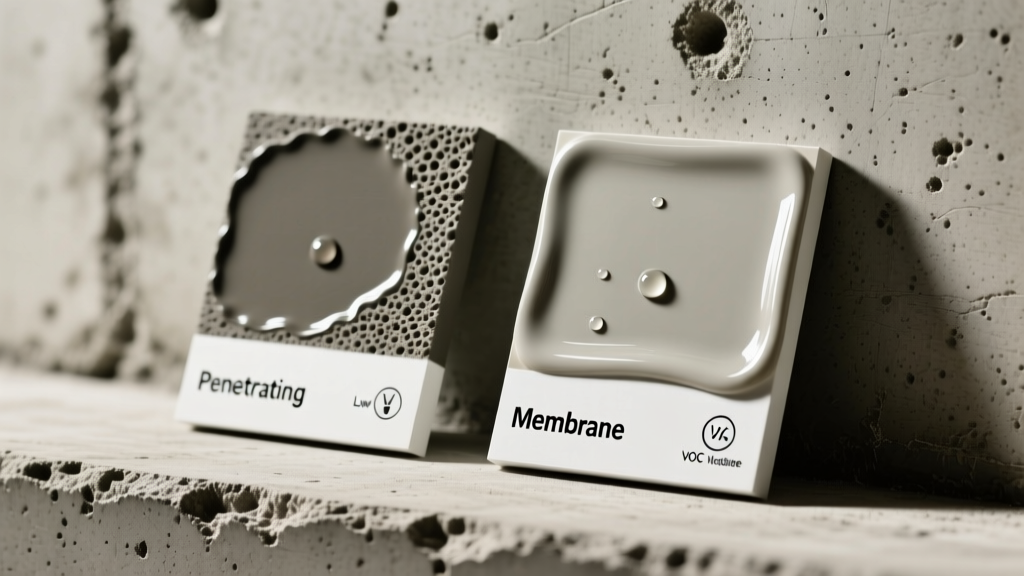
The Capillary Mechanics of Cementitious Grout
Cementitious grout, governed by ANSI A118.6 specifications, is inherently porous. During the hydration process, water evaporation leaves behind a microscopic capillary pore network. Unsealed sanded grout can absorb up to 12% to 15% of its weight in water, creating a direct pathway for moisture, chlorides, and staining agents to reach the substrate. Selecting the correct grout sealer requires analyzing chemical performance ratings, vapor transmission limits, and substrate compatibility rather than relying on generic marketing claims.
Penetrating Sealers: Siloxanes vs. Fluoropolymers
Penetrating sealers (impregnators) do not form a surface film. Instead, they utilize solvents or water carriers to transport active resins deep into the grout’s pore structure. Once the carrier evaporates, the resins bond to the pore walls, lowering the surface tension and creating a hydrophobic barrier. The two primary chemical families used in 2026 are siloxanes and fluoropolymers.
Siloxane Chemistry
Siloxanes and silanes are highly effective at water repellency. They form a cross-linked silicone resin network within the capillary pores. While they excel at preventing water intrusion and resist UV degradation, standard siloxanes lack oleophobic (oil-repelling) properties. They are specified for vertical, dry-area applications where oil staining is not a primary concern.
Fluoropolymer Chemistry
Fluoropolymers utilize carbon-fluorine bonds, which possess some of the lowest surface energies of any known chemical compound. This allows them to repel both water and oil-based stains. High-performance fluorochemical sealers are mandatory for kitchen backsplashes, commercial food service areas, and high-traffic entryways where grease and organic acids are present.
| Active Chemistry | Water Repellency | Oil Repellency | Vapor Transmission | Primary Use Case |
|---|---|---|---|---|
| Water-Based Siloxane | High | None | Excellent (100%) | Interior vertical walls, low-traffic floors |
| Solvent-Based Siloxane | Very High | Low | Excellent (95%+) | Exterior patios, pool decks |
| Water-Based Fluoropolymer | High | High | Very Good | Interior floors, commercial kitchens |
| Solvent-Based Fluoropolymer | Extreme | Extreme | Excellent | High-stain risk areas, natural stone |
Membrane (Topical) Sealers: Specifications and Limitations
Membrane sealers, typically composed of acrylic, polyurethane, or epoxy resins, form a continuous physical film over the grout joint and tile surface. While they provide an immediate, high-gloss aesthetic and robust initial stain resistance, their performance ratings in wet environments are critically flawed.
Never specify membrane sealers for shower pans, steam rooms, or exterior slabs-on-grade. Cementitious substrates require vapor transmission to release moisture. Topical films trap hydrostatic vapor pressure, leading to efflorescence, adhesive degradation, and eventual film delamination. The Tile Council of North America (TCNA) strictly advises against topical coatings in continuous wet areas.
Industry Standards: ASTM and TCNA Protocols
Evaluating grout sealer performance requires standardized testing. While sealers themselves lack a singular ANSI standard, their impact on the substrate is measured using concrete and masonry testing protocols.
ASTM C1585 Water Absorption Testing
The ASTM C1585 standard measures the rate of water absorption by hydraulic-cement concretes. In independent laboratory testing, unsealed standard sanded grout exhibits an initial absorption rate of roughly 150 grams per square meter per minute. A high-quality penetrating fluorochemical sealer reduces this absorption rate to less than 5 grams per square meter per minute, effectively rendering the joint hydrophobic without altering its dimensional stability.
VOC Limitations and Air Quality
Solvent-based sealers rely on volatile organic compounds (VOCs) like naphtha or xylene to carry resins into dense grout joints. Under current EPA and SCAQMD regulations, architectural coatings are heavily restricted. Solvent-based impregnators often push the legal limit of 600 g/L VOC, requiring specialized ventilation during application. Water-based microemulsions typically test below 50 g/L VOC, making them mandatory for occupied commercial renovations and LEED-certified projects.
2026 Premium Grout Sealer Specification Matrix
The following matrix outlines the technical specifications of three industry-leading penetrating sealers used by professional contractors. Pricing reflects 2026 commercial quart averages.
| Product | Active Chemistry | Coverage (sq ft / qt) | VOC (g/L) | Cure Time | Est. Cost |
|---|---|---|---|---|---|
| Miracle Sealants 511 Impregnator | Solvent Siloxane/Fluoro Blend | 500 - 1,000 | < 600 | 24 Hours | $28.00 |
| Aqua Mix Sealer's Choice Gold | Water-Based Fluoropolymer | 400 - 800 | < 100 | 48 Hours | $34.00 |
| StoneTech BulletProof | Water-Based Microemulsion | 600 - 1,200 | < 50 | 24 Hours | $42.00 |
Application Variables and Failure Modes
Even the highest-rated fluorochemical sealer will fail if application specifications are ignored. The following edge cases represent the most common field failures.
Blushing (Solvent Trapping and White Haze)
When applying solvent-based sealers in high-humidity environments (above 70% relative humidity) or at temperatures below 50°F (10°C), the solvent evaporation rate drops. Moisture from the air condenses into the cooling solvent, causing the resin to precipitate prematurely on the surface rather than penetrating the pore. This results in a stubborn white haze known as 'blushing.' Correction: Solvent-based sealers must be applied between 60°F and 80°F with active cross-ventilation.
Premature Application on Uncured Grout
Standard cementitious grout requires a minimum of 72 hours to cure sufficiently for sealing, but full structural hydration takes 28 days. Applying a penetrating sealer at the 48-hour mark traps unreacted water and alkaline salts inside the joint. As the grout continues to cure, the resulting vapor pressure pushes the sealer resin out of the pores, leading to spotty water repellency and localized efflorescence. Always verify grout moisture content with a digital moisture meter (reading below 4%) before application.
The Water Drop Verification Test
To verify sealer efficacy post-application, contractors should perform a water drop test. Place a 2-inch diameter bead of water on the grout joint. If the water maintains a high contact angle (beads up tightly) and does not darken the grout after 5 minutes, the pore network is adequately saturated. If the grout darkens, a second coat is required immediately before the first coat fully cross-links.