Concrete Driveway vs Asphalt: Technical Specs & Load Limits
Compare concrete driveway vs asphalt with technical specs, load ratings, PSI requirements, base depths, and 2026 installation costs.

Binder Chemistry and Material Composition
When evaluating a concrete driveway vs asphalt, the fundamental difference lies in the binder chemistry. Concrete relies on Portland cement (typically Type I or II) which undergoes a hydration reaction with water to form calcium silicate hydrate (C-S-H) gel. This rigid matrix binds the aggregate together. For residential driveways, the water-cement (w/c) ratio must be strictly capped at 0.45 or lower to minimize capillary porosity, reduce permeability, and maximize freeze-thaw durability.
Asphalt, conversely, utilizes bitumen (asphalt cement) as a viscoelastic binder. Modern hot mix asphalt (HMA) is engineered using the Superpave Performance Grade (PG) system. A standard residential driveway in a temperate climate typically specifies a PG 64-22 binder. This designation indicates the pavement is engineered to resist rutting at maximum temperatures up to 64°C (147°F) and resist thermal cracking at minimum temperatures down to -22°C (-7.6°F). In regions with extreme summer heat, polymer-modified binders (PMBs) are required to prevent surface deformation.
Structural Load Capacity and Thickness Specifications
Concrete is a rigid pavement that distributes loads over a wide area through slab action. Asphalt is a flexible pavement that relies on the structural support of its underlying base layers, distributing loads in a cone-shaped pattern downward. According to the American Concrete Institute (ACI), standard thickness and strength requirements vary significantly based on anticipated axle loads.
| Technical Parameter | Poured Concrete (Rigid) | Hot Mix Asphalt (Flexible) |
|---|---|---|
| Primary Strength Metric | Compressive Strength (PSI) | Stiffness Modulus / Tensile Strength |
| Standard Mix Design | 4,000 PSI at 28 days | PG 64-22 Binder, 9.5mm or 12.5mm Nominal Max Aggregate Size |
| Thickness (Passenger Vehicles) | 4 to 6 inches | 2 to 3 inches (Surface) + 3 to 4 inches (Base) |
| Thickness (Heavy RVs / Trucks) | 6 to 8 inches (Reinforced) | 3 to 4 inches (Surface) + 6 to 8 inches (Base) |
| Air Entrainment (Freeze-Thaw) | 5% to 8% air content required | Not applicable (relies on binder flexibility) |
Subgrade Preparation and Base Course Engineering
Failure in both pavement types is rarely due to the surface material itself; it is almost always a subgrade failure. However, the two materials react to subgrade deficiencies differently.
Concrete Subgrade Requirements
Because concrete is rigid, it can bridge minor soft spots in the subgrade. However, if the subgrade washes out or settles unevenly, the slab will experience tensile stress and crack catastrophically. Specifications require a 4 to 6-inch base course of compacted 3/4-inch minus crushed aggregate. The subgrade must achieve a minimum of 95% Standard Proctor Density. A vapor retarder (such as a 10-mil polyethylene sheet) is often specified beneath the base course to prevent moisture migration and slab curling.
Asphalt Subgrade Requirements
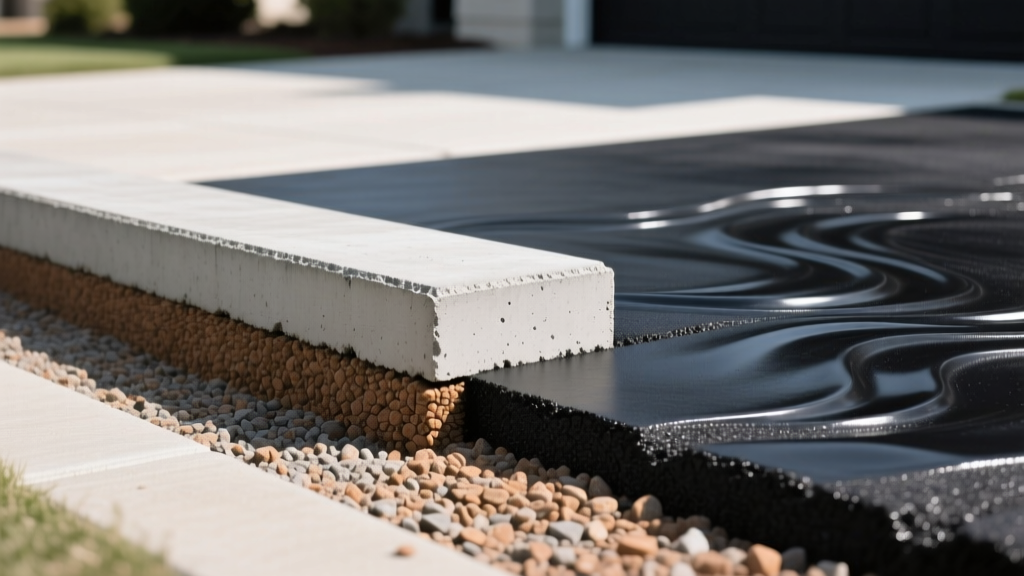
Asphalt is flexible and conforms to the subgrade. If the base shifts, the asphalt will deflect, leading to fatigue cracking (alligator cracking) or reflective cracking. The Asphalt Institute recommends a thicker aggregate base for HMA—typically 6 to 8 inches of well-draining crushed stone. Proper edge confinement is also critical; without concrete curbs or stabilized shoulders, asphalt edges will ravel and crumble under lateral tire forces.
Thermal Expansion, Jointing, and Surface Tolerances
Temperature fluctuations dictate the structural detailing of the driveway surface.
- Concrete Jointing: Concrete expands and contracts with temperature and moisture changes. To control cracking, control joints must be saw-cut or tooled into the surface. The standard rule of thumb is that joint spacing (in feet) should be 2 to 3 times the slab thickness (in inches). For a 6-inch slab, joints are placed every 12 to 18 feet. Joint depth must be exactly 25% of the slab thickness (1.5 inches for a 6-inch slab). Saw-cutting must occur within 12 to 24 hours of placement to prevent uncontrolled random cracking.
- Asphalt Thermal Response: Asphalt requires no jointing due to its viscoelastic nature. However, it is highly sensitive to temperature extremes. In high heat, unmodified asphalt can rut under stationary heavy loads (like RV stabilizer jacks). In extreme cold, it becomes brittle and susceptible to transverse thermal cracking.
Permeability, Drainage, and Surface Runoff
Standard concrete and standard asphalt are both virtually impermeable, requiring a minimum 1% to 2% cross-slope to shed water into storm drains or swales. However, sustainable drainage systems (SuDS) have introduced permeable variants for both materials.
Pervious Concrete: This 'no-fines' mix omits sand, creating a connected pore structure with 15% to 25% void space. It allows water to pass through at a rate of 3 to 5 gallons per minute per square foot. It requires a specialized underlying stone recharge bed and is highly susceptible to clogging if not vacuum-swept annually.
Porous Asphalt: Similar in concept, porous asphalt uses an open-graded aggregate structure. While highly effective for stormwater management, porous asphalt degrades faster than standard HMA and requires strict maintenance to prevent the binder from stripping away under high-velocity water flow.
Curing Timelines and Early-Stage Vulnerabilities
The timeline for opening a driveway to traffic differs drastically between the two materials, impacting construction scheduling.
- Concrete Hydration Cycle: Concrete reaches approximately 70% of its design strength at 7 days, which is the earliest passenger vehicles should be permitted on the slab. Full design strength (4,000 PSI) is achieved at 28 days. During the first 48 hours, the surface is highly vulnerable to plastic shrinkage cracking if evaporation rates exceed the bleed water rate. Curing blankets or liquid membrane-forming compounds are mandatory to retain moisture.
- Asphalt Cooling and Oxidation: HMA is placed at temperatures between 275°F and 325°F. It achieves structural stability simply by cooling to ambient temperatures, allowing traffic in 48 to 72 hours. However, the chemical curing (oxidation) process takes months. During the first 30 days, the surface is vulnerable to scuffing from sharp, stationary tire turns, which can tear the immature binder matrix.
Decision Matrix: Specifying the Right Material
Choosing between the two requires aligning material properties with site-specific constraints and budget parameters. Based on current Federal Highway Administration (FHWA) pavement design principles, apply the following framework:
- Specify Concrete When: The project demands a 30- to 50-year lifecycle, the driveway will support heavy static loads (boat trailers, motorhomes) that would rut asphalt, or the site features poor soil conditions where a rigid slab can bridge minor subgrade inconsistencies. Expect initial capital costs to range from $8 to $14 per square foot.
- Specify Asphalt When: The project has strict initial budget constraints ($4 to $8 per square foot), the driveway features complex curves or steep gradients where concrete jointing and forming are cost-prohibitive, or the site is heavily shaded by tree canopies (concrete is prone to moss and black algae in constant shade, while asphalt's dark color absorbs heat and inhibits biological growth).
Written by
Sarah WhitfieldSarah Whitfield is a chartered quantity surveyor (MRICS) and construction cost analyst with 15 years of experience in material pricing, procurement strategy, and project budgeting. She earned her degree in Construction Management from the University of Reading (UK) and has worked on projects ranging from $2M custom homes to $180M mixed-use developments across North America and Europe. Sarah currently leads cost estimating for BuildMat Insight, maintaining a proprietary database of 4,000+ material price points updated quarterly. She is a frequent contributor to RSMeans cost data panels and has presented at the International Cost Engineering Council (ICEC) congress. Based in Denver, CO, Sarah is an avid trail runner and volunteer mentor for Women in Construction.
More from Sarah Whitfield
View all
Wood & Lumber
What Are the Different Types of Wood? A Builder's Guide
Compare structural softwoods, finish hardwoods, and engineered lumber. Analyze Janka ratings, MOE values, and 2026 pricing for construction.
Aug 4, 2026

Walls & Panels
Steel Framing vs Wood Framing: Corrosion and Moisture Defense
Compare steel framing vs wood framing for moisture resistance. Learn about galvanized coatings, condensation risks, and corrosion protection strategies.
Jul 21, 2026

Stone & Masonry
How to Cut Stone Veneer: Wet Saw vs Grinder Comparison
Compare the best tools for cutting stone veneer. We review wet saws, angle grinders, and chop saws to help you achieve clean, chip-free cuts.
Jul 21, 2026