Calculate Rubber Cement Glue Costs for Concrete Subfloors
Estimate rubber cement glue costs for concrete subfloors. Calculate coverage, material pricing, and prep expenses for commercial flooring projects.
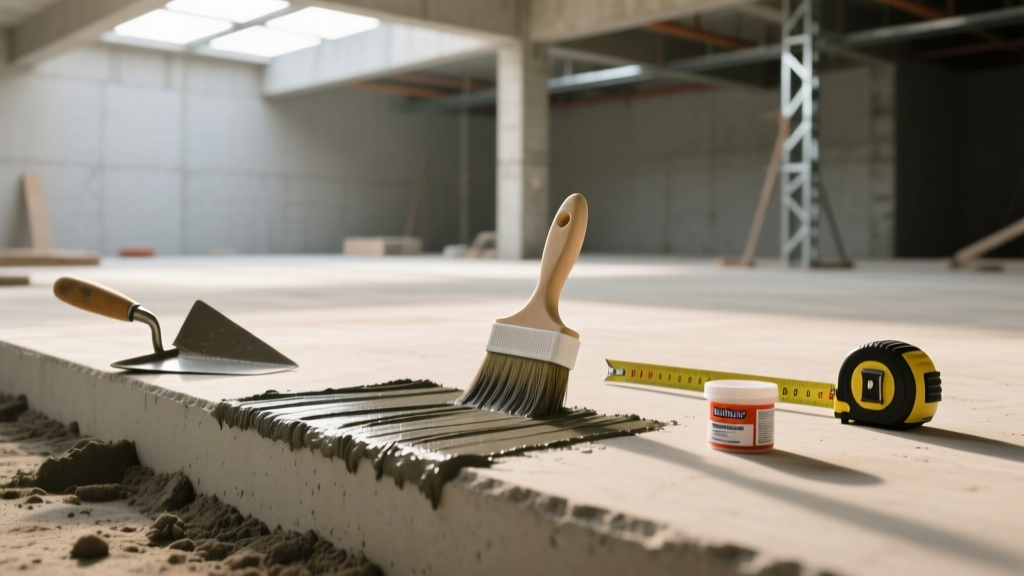
Terminology Clarification: Craft vs. Construction Adhesives
Before running any quantity calculations, it is critical to define what rubber cement glue means in a commercial construction context. In consumer markets, rubber cement refers to low-viscosity, non-destructive craft adhesives. However, when bonding resilient flooring, acoustic underlayments, or rubber tiles to concrete subfloors, 'rubber cement glue' refers to polychloroprene (neoprene) contact cements and synthetic rubber-based flooring mastics. These construction-grade adhesives are engineered to withstand high shear loads, resist alkaline degradation from concrete, and maintain flexibility under dynamic foot traffic.
Estimating the cost of these adhesives requires more than multiplying square footage by a generic coverage rate. Concrete porosity, ambient temperature, trowel notch geometry, and moisture vapor emission rates (MVER) drastically alter both material yield and total project costs.
2026 Material Pricing & Coverage Matrix
The following matrix outlines current market pricing and baseline coverage rates for the three primary categories of rubber-based adhesives used on concrete slabs. Note that coverage rates assume a perfectly smooth, steel-troweled concrete finish. Broom-finished or porous concrete will reduce yield by 20% to 40%.
| Adhesive Category | Base Chemistry | Avg Cost / Gallon (2026) | Coverage (Smooth Concrete) | Primary Application |
|---|---|---|---|---|
| Neoprene Contact Cement | Polychloroprene / Solvent | $45 - $65 | 100 - 125 sq ft/gal | Rubber stair treads, cove base, flash coving |
| Rubber-Based Mastic | SBR Latex / Synthetic Rubber | $55 - $85 | 80 - 110 sq ft/gal | Sheet vinyl, VCT, thin acoustic underlayment |
| Urethane-Modified Rubber | Polyurethane / Rubber Blend | $90 - $130 | 60 - 85 sq ft/gal | Heavy gym flooring, rolled rubber, shock pads |
Step-by-Step Coverage & Cost Calculator Framework
To generate an accurate material budget, follow this four-step calculation framework. This methodology accounts for the real-world variables that cause contractors to underestimate adhesive requirements by up to 30%.
- Determine Net Bondable Area: Measure the total square footage and subtract areas where flooring will not be installed (e.g., heavy equipment pads, drain grates). Example: 2,500 sq ft weight room minus 150 sq ft of equipment pads = 2,350 net sq ft.
- Apply the Porosity Multiplier: Assess the concrete finish. Steel-troweled = 1.0x multiplier. Light broom = 1.15x multiplier. Heavy broom or shot-blasted profile = 1.35x multiplier. Example: Light broom finish means 2,350 sq ft x 1.15 = 2,702 adjusted sq ft.
- Select Trowel and Base Coverage: Match the trowel to the flooring thickness. A 1/16' x 1/16' x 1/16' square notch yields ~110 sq ft/gal. A 1/8' x 1/8' x 1/8' U-notch yields ~75 sq ft/gal. Divide the adjusted area by the base coverage. Example: Using a U-notch for 3/8' gym tiles: 2,702 / 75 = 36.02 gallons.
- Add the Waste and Spillage Factor: Add 8% for standard trowel waste, or 12% if the crew is inexperienced or working around complex penetrations. Example: 36.02 gal x 1.08 = 38.9 gallons. Round up to 39 gallons.
Critical Warning: Moisture Vapor Emission Rate (MVER)
Rubber cement glue will chemically break down, emulsify, and lose bond strength if applied over damp concrete. According to ASTM International standards (specifically ASTM F1869), the MVER must not exceed 3 to 5 lbs per 1,000 sq ft per 24 hours, depending on the manufacturer's exact specification. Always perform calcium chloride tests or in-situ relative humidity (RH) probes per Resilient Floor Covering Institute (RFCI) guidelines before purchasing adhesive.
Hidden Cost Drivers: Concrete Surface Preparation
The adhesive itself is only one line item in your flooring budget. If the concrete slab fails moisture or flatness tolerances, surface preparation costs will quickly eclipse the cost of the rubber cement glue.
- Diamond Grinding (Profile Creation): $0.45 - $0.85 per sq ft. Required if the concrete is sealed, burnished, or contaminated with old adhesive residue to achieve a CSP 2 or CSP 3 profile.
- Shot Blasting: $0.60 - $1.10 per sq ft. More aggressive than grinding; used for removing thick mastic or leveling high spots.
- Epoxy Moisture Mitigation Barrier: $4.50 - $7.50 per sq ft. If MVER exceeds manufacturer limits, a two-part 100% solids epoxy vapor barrier must be rolled on before the rubber adhesive can be applied.
- Self-Leveling Underlayment (SLU): $3.00 - $5.50 per sq ft (installed). Required if the slab deviates more than 3/16' in a 10-foot radius, as rubber flooring will telegraph any subfloor imperfections.
Application Variables That Destroy Yield
Even with a perfect mathematical estimate, poor job-site practices will cause you to run out of rubber cement glue before the job is finished. Monitor these three yield-killers:
1. Open Time and Flash-Off: Solvent-based neoprene contact cements require a flash-off period (usually 10 to 30 minutes) until the surface is tacky but does not transfer to a knuckle. If the crew spreads too much adhesive at once, it will skin over and lose its bonding capability, forcing them to scrape it off and reapply.
2. Ambient Temperature: Adhesive viscosity drops in high heat and thickens in cold. If the concrete slab temperature is below 65°F (18°C), the rubber mastic will not flow properly into the concrete pores, requiring a heavier application rate to achieve a mechanical bond. Always condition the adhesive buckets in a 70°F room for 24 hours prior to use.
3. Trowel Degradation: The notches on a trowel wear down after approximately 1,500 to 2,000 sq ft of use on abrasive concrete. A worn 1/8' notch effectively becomes a 1/16' notch, resulting in insufficient adhesive transfer and eventual delamination. Mandate that crews replace trowel blades mid-project.
Frequently Asked Questions
Can I use standard craft rubber cement to glue down a rubber gym mat?
No. Craft rubber cement lacks the shear strength, alkali resistance, and structural integrity required for flooring. It will degrade upon contact with the alkaline environment of a concrete slab (which typically has a pH of 11 to 13) and will fail under dynamic loads.
Do I need to back-butter the rubber flooring?
For porous-backed rubber tiles or heavy rolled goods, back-buttering (applying a thin, flat coat of adhesive to the back of the flooring) is highly recommended. While this reduces your coverage yield by roughly 30%, it ensures 100% adhesive transfer and prevents air pockets that can lead to bubbling.
How long does rubber cement glue take to cure on concrete?
Initial set (walkable time) typically occurs in 12 to 24 hours. However, full structural cure and maximum shear strength take 72 hours. Heavy equipment or rolling loads should not be introduced to the floor until the 72-hour mark has passed.