Concrete vs Plastic Septic Tank: Mix Design, Durability & Cost Data
Compare concrete vs plastic septic tanks with 2026 mix design specs, structural load data, installation costs, and lifespan analysis for residential builds.

Structural Core: Concrete Mix Design for Septic Tanks
Specifying an onsite wastewater treatment system requires evaluating structural load capacity, chemical resistance, and hydrostatic buoyancy. The decision between a concrete vs plastic septic tank system centers on how each material handles subterranean compressive forces and the highly corrosive internal environment of anaerobic digestion. Precast concrete tanks remain the industry standard for heavy-load applications, but their longevity is entirely dependent on precise mix design and curing protocols.
ASTM C1227 Compliance and Mix Proportions
Precast concrete septic tanks manufactured for residential and commercial use must comply with ASTM C1227 standards. This specification mandates a minimum compressive strength of 4,000 psi at 28 days. To achieve this while maintaining workability, modern batch designs utilize a water-cementitious (w/c) ratio strictly between 0.40 and 0.45. Lowering the w/c ratio reduces capillary porosity, which is critical for preventing groundwater infiltration and internal effluent leakage.
Standard mix designs incorporate 15% to 25% fly ash or ground granulated blast-furnace slag (GGBFS) as supplementary cementitious materials (SCMs). These SCMs consume calcium hydroxide during the hydration process, densifying the concrete matrix and significantly improving resistance to sulfate attack.
Mitigating Crown Corrosion
The most common failure mode in concrete septic tanks is crown corrosion. Anaerobic bacteria in the septic environment produce hydrogen sulfide (H2S) gas, which accumulates in the vapor space above the liquid level. Thiobacillus bacteria then colonize the moist concrete ceiling, oxidizing the H2S into sulfuric acid. This acid reacts with calcium hydroxide in the cement paste to form expansive calcium sulfate (gypsum), causing the concrete cover to spall and expose the steel reinforcement.
Polyethylene (Plastic) Tank Engineering
Polyethylene septic tanks are manufactured via rotational molding using high-density polyethylene (HDPE) resins. Unlike concrete, which relies on mass and compressive strength, plastic tanks rely on geometric structural design to resist soil loads. The walls are engineered with deep, continuous external ribs that provide hoop strength and prevent radial deformation under lateral earth pressure.
HDPE is completely inert to the sulfuric acid and biological enzymes present in septic effluent, rendering plastic tanks immune to the internal chemical degradation that plagues uncoated concrete. However, the structural integrity of a plastic tank is entirely dependent on proper backfill procedures. If native expansive clay is used as backfill and compacted unevenly, the localized point loads can exceed the HDPE yield strength, causing permanent rib deflection or wall buckling. Manufacturer specifications universally require a uniform bedding of 3/4-inch crushed stone or pea gravel, compacted in 12-inch lifts to distribute loads evenly across the ribbed geometry.
Head-to-Head Comparison Matrix
| Feature | Precast Concrete (ASTM C1227) | HDPE Plastic (Ribbed) |
|---|---|---|
| Empty Weight (1,000 gal) | 4,500 - 6,000 lbs | 200 - 350 lbs |
| Compressive / Yield Strength | 4,000+ psi (Compressive) | 3,500 psi (Tensile Yield) |
| Internal Chemical Resistance | Moderate (Requires Epoxy Coating) | Excellent (Inert to H2S / Acids) |
| Buoyancy Risk (Empty) | Negligible | High (Requires Anchoring) |
| Expected Lifespan | 25 - 40+ Years | 20 - 30 Years |
Installation Variables: Buoyancy and Soil Load
The most critical differentiator in the concrete vs plastic septic tank debate is hydrostatic buoyancy. According to data published by the EPA regarding onsite wastewater systems, soil composition and water table depth dictate tank stability. A 1,000-gallon concrete tank weighs approximately 5,000 pounds, easily counteracting the upward hydrostatic force of saturated soil (which exerts roughly 62.4 pounds of buoyant force per cubic foot of displaced water).
Conversely, an empty 1,000-gallon HDPE tank weighs less than 300 pounds but displaces roughly 133 cubic feet of volume. If installed in a region with a seasonal high water table, and the tank is pumped out for maintenance during the wet season, the hydrostatic uplift force will exceed 8,000 pounds. Without mechanical anchoring, the plastic tank will literally float out of the ground, shearing the inlet and outlet PVC connections and causing catastrophic system failure.
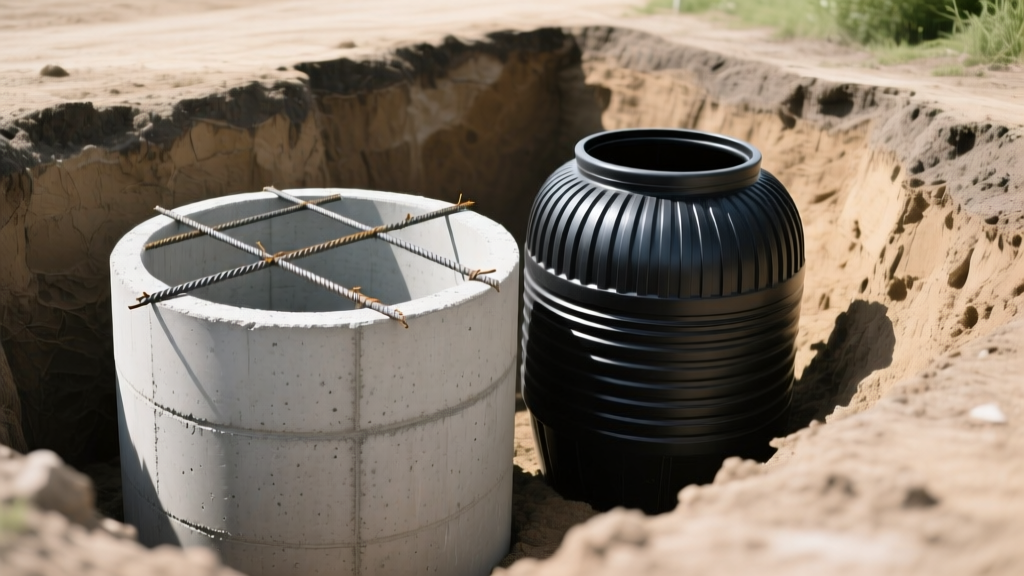
Cost Breakdown: Material vs. Total Installed Price
Evaluating costs requires separating the unit price from the total installed cost. Concrete tanks are heavier, requiring specialized rigging equipment (such as a crane or heavy-duty excavator) for placement, which increases labor and equipment rental fees. Plastic tanks can often be manually rolled into the excavation or lifted with a standard backhoe bucket.
- 1,000-Gallon Precast Concrete Tank (Material): $1,300 - $2,200
- 1,000-Gallon HDPE Plastic Tank (Material): $900 - $1,500
- Standard Excavation & Backfill (Both): $1,500 - $3,000
- Heavy Rigging / Crane Surcharge (Concrete): $300 - $600
- Concrete Anchor Pad & Tie-Downs (Plastic, High Water Table): $400 - $800
When factoring in regional labor rates and equipment, a standard concrete installation typically ranges from $3,500 to $5,500. A plastic installation in well-draining soil (no anchor required) ranges from $2,800 to $4,200. However, if soil conditions require an anchor pad and specialized gravel backfill for the plastic tank, the total installed costs converge, making the superior structural mass of concrete the more logical investment.
Final Verdict: Specifying the Right System
Specify a precast concrete septic tank (with a sulfate-resistant mix and interior epoxy coating) for sites with heavy vehicular traffic loads (e.g., tanks buried under driveways), high water tables, or expansive clay soils where point-load deflection is a risk. The sheer mass and compressive strength of ASTM C1227 compliant concrete provide unmatched structural stability with minimal backfill preparation.
Specify a ribbed HDPE plastic septic tank for sites with well-draining sandy or loamy soils, low seasonal water tables, and restricted site access where heavy cranes cannot reach the excavation zone. Ensure the contractor strictly adheres to the manufacturer's crushed-stone backfill specifications to prevent geometric deformation of the HDPE ribs under long-term soil loading.
Written by
Priya KapoorPriya Kapoor is a real estate market analyst and construction economics researcher with expertise in housing affordability, development feasibility, and infrastructure investment. She holds a Master of Regional Planning from Cornell University and previously worked as a senior analyst at CBRE's Investment Properties group, where she modeled returns for $4B in mixed-use development pipelines. Priya now runs an independent research practice advising developers, municipalities, and REITs on construction cost forecasting and market timing. She publishes the quarterly "BuildMat Market Pulse" report tracking material price indices across 12 commodity categories. Based in Austin, TX, Priya serves on the board of Habitat for Humanity Austin and is a marathon runner.
More from Priya Kapoor
View all
Construction Cost
Cost to Build a 1600 Sq Ft Home in 2026: Full Breakdown
Accurate 2026 cost to build a 1600 sq ft home—material, labor, and regional pricing breakdowns included. Plan your budget with real-time estimates.
Aug 11, 2026

Wood & Lumber
Name the Types of Wood for Pressure Treatment and Preservation
Learn how to name the types of wood best suited for pressure treatment. Compare species treatability, chemical retention levels, and 2026 preservation costs.
Aug 4, 2026

Stone & Masonry
Stone Veneer Suppliers Lindenhurst: 2026 Cost Analysis
Analyze 2026 stone veneer costs in Lindenhurst, NY. Compare local supplier pricing, delivery fees, and Suffolk County installation labor rates.
Aug 4, 2026