Concrete vs Gunite Pool: Technical Specs & Mix Designs
Compare wet-mix concrete and dry-mix gunite for pool construction. Explore technical specs, PSI strength, rebound rates, and mix designs.

The Core Distinction: Wet-Mix Shotcrete vs. Dry-Mix Gunite
In the swimming pool construction industry, the terms "concrete" and "gunite" are frequently used to differentiate between two distinct pneumatic application methods. According to the American Concrete Institute (ACI) Committee 506, both fall under the broader category of shotcrete. However, the mechanical delivery, hydration timing, and structural outcomes differ significantly.
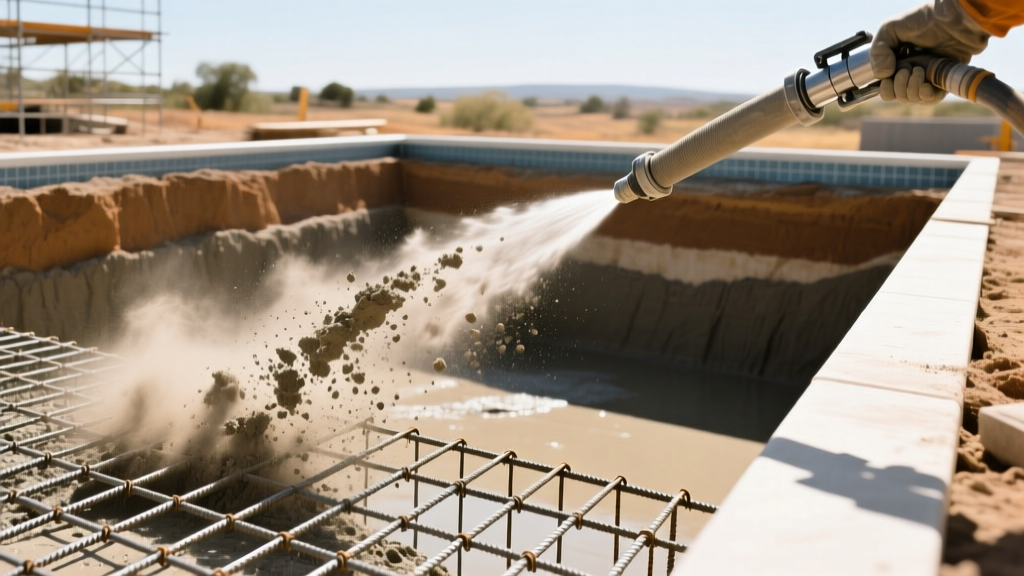
- Gunite (Dry-Mix Process): Pre-dampened sand and cement are blown through a hose via compressed air. Water is introduced only at the nozzle, where it mixes with the dry aggregate instantly upon impact.
- Concrete / Shotcrete (Wet-Mix Process): All ingredients, including water and admixtures, are batched at a plant or mixed on-site before entering the pump. The fully hydrated mixture is propelled through the hose and pneumatically projected onto the substrate.
Understanding the technical specifications of each method is critical for structural engineers, pool builders, and inspectors evaluating shell integrity, permeability, and long-term durability.
Compressive Strength and Water-Cement (W/C) Ratios
The compressive strength of pneumatically applied pool shells is primarily dictated by the water-cement ratio and the nozzleman's technique. The American Shotcrete Association (ASA) emphasizes that while wet-mix concrete offers highly predictable batch-to-batch consistency, dry-mix gunite strength is heavily dependent on real-time water adjustment at the nozzle.
| Specification Metric | Dry-Mix Gunite | Wet-Mix Concrete (Shotcrete) |
|---|---|---|
| Target 28-Day PSI | 4,500 - 7,500 psi | 4,000 - 6,000 psi |
| Ideal W/C Ratio | 0.35 - 0.45 (Nozzle controlled) | 0.40 - 0.45 (Batch controlled) |
| Slump Equivalent | N/A (Zero-slump upon impact) | 4 - 6 inches (Pre-pump) |
| Consistency Variance | High (Operator dependent) | Low (Plant batched) |
When a gunite nozzleman adds excess water to reduce dust or improve workability, the W/C ratio can spike above 0.55, causing a precipitous drop in 28-day compressive strength and increasing the risk of plastic shrinkage cracking. Wet-mix concrete eliminates this variable, as the water content is locked in at the batch plant.
Aggregate Grading and Mix Proportions
Aggregate size limits are strictly governed by the internal diameter of the delivery hose and the pneumatic velocity required to prevent line blockages.
Gunite (Dry Process) Aggregate Limits
Dry-mix gunite relies on a sand-cement blend. The maximum aggregate size is typically limited to 3/8 inch (9.5 mm), with a fine aggregate grading conforming to ASTM C33. The cement-to-sand ratio generally ranges from 1:3.5 to 1:4.5 by volume. Because the mixture must travel through a 2-inch or 2.5-inch hose suspended in a high-velocity air stream, larger aggregates would cause catastrophic hose blowouts or blockages.
Wet-Mix Concrete Aggregate Limits
Wet-mix shotcrete can accommodate larger coarse aggregates, up to 3/4 inch (19 mm) for a 3-inch hose, though pool builders frequently restrict the top size to 3/8 inch or 1/2 inch to ensure smooth flow around dense #3 and #4 steel rebar grids. The inclusion of larger aggregate reduces the overall cement paste volume, which inherently lowers the heat of hydration and minimizes thermal shrinkage cracking in thick pool bond beams.
Application Mechanics: Rebound and Structural Implications
Rebound—the aggregate and cement particles that bounce off the substrate upon impact—is the most critical technical differentiator between the two methods. Rebound is structurally deficient; it is high in aggregate and low in cement paste. If rebound is trapped behind rebar or troweled into the surface, it creates porous, weak planes that compromise the pool shell's watertight integrity.
- Dry-Mix Gunite Rebound Rates: Typically 15% to 30% on vertical walls and up to 50% on overhead surfaces (such as negative edge spillways or grottos).
- Wet-Mix Concrete Rebound Rates: Typically 5% to 10% on vertical walls, and 15% to 25% on overhead surfaces.
"The absolute prohibition of embedding rebound into the structural shell cannot be overstated. Inspectors must mandate the continuous removal of rebound from the pool floor during vertical wall application to prevent cold joint delamination." — ASA Technical Guidelines on Shotcrete Placement
Admixtures and Performance Enhancers
Modern pool construction frequently utilizes chemical admixtures to manipulate the rheology and setting time of the concrete. The Portland Cement Association outlines several critical additives used in pneumatic applications:
Silica Fume (Microsilica)
Added at 5-10% by weight of cement. Drastically reduces rebound in both wet and dry mixes by increasing the cohesiveness of the paste. Boosts 28-day PSI by up to 20% and significantly lowers chloride permeability, protecting steel reinforcement from pool water chemicals.
Accelerators (Non-Chloride)
Used primarily in wet-mix shotcrete to induce flash-setting at the nozzle, allowing for thicker single-pass lifts (up to 6 inches on walls) without sagging. Calcium nitrate or alkali-free liquid accelerators are injected directly at the nozzle head.
Curing Protocols and Shrinkage Mitigation
Pneumatically applied concrete has a high surface-area-to-volume ratio, making it highly susceptible to rapid moisture loss and plastic shrinkage. Proper curing is not optional; it is a structural requirement.
- Initial Set (0-24 Hours): The pool shell must be kept continuously moist. Fog spraying with a fine mist of water prevents surface crusting while allowing internal hydration. High-pressure hoses must be avoided, as they can erode the uncured cement paste.
- Wet Curing (Days 2-7): Continuous water curing is the gold standard. For gunite, which has a lower initial water content, external water is essential to complete the hydration process and achieve target PSI.
- Membrane Curing Compounds: If water curing is logistically impossible, ASTM C309-compliant membrane-forming compounds (typically wax or resin-based) can be sprayed on. However, these must be completely removed via sandblasting or high-pressure washing before applying the pool's interior plaster or pebble finish, otherwise, the finish will delaminate.
Failure Modes: When Pneumatic Application Fails
Even with perfect mix designs, improper execution leads to specific, identifiable failure modes in pool shells.
Warning: Common Structural Defects
- Shadowing: Occurs when the nozzleman fails to maintain a 90-degree angle to the substrate, or sprays from too far away. This leaves voids behind the rebar where the concrete failed to encapsulate the steel, leading to localized corrosion and spalling.
- Sand Pockets: Caused by excessive rebound being trapped in corners or behind plumbing penetrations. These pockets lack cement paste and will easily crumble when chipped with a hammer during inspection.
- Delamination: Often the result of applying a new layer of gunite over a dried, unprepared previous layer without a bonding agent or proper scoring, creating a structural cold joint that will separate under hydrostatic pressure.
Equipment and Cost Specifications
The capital expenditure and operational costs differ vastly between the two systems, influencing contractor selection and project budgeting.
| Factor | Gunite (Dry-Mix) | Shotcrete (Wet-Mix) |
|---|---|---|
| Primary Equipment | Volumetric gunite rig, 185 CFM+ air compressor | Ready-mix transit trucks, high-pressure concrete line pump |
| Material Sourcing | Bulk sand and cement silos on-site | Batch plant (requires strict 90-min discharge window) |
| Avg. Shell Cost (Residential) | $12,000 - $18,000 | $14,000 - $22,000 |
Ultimately, the choice between wet-mix concrete and dry-mix gunite hinges on site access, the complexity of the pool's geometry, and the availability of highly skilled nozzlemen. While wet-mix offers superior batch consistency and lower rebound, dry-mix gunite remains the preferred method for complex, tight-access residential builds where ready-mix trucks cannot stage effectively.
Written by
Marcus ChenMarcus Chen is a licensed structural engineer (PE) and building materials analyst with over 12 years of experience across residential, commercial, and industrial construction. He holds a Master of Science in Civil Engineering from UC Berkeley and spent six years at Thornton Tomasetti before transitioning to independent consulting and technical writing. Marcus specializes in material selection for seismic-prone regions, concrete reinforcement strategies, and lifecycle cost analysis. His work has been cited by the American Concrete Institute (ACI) and the Structural Engineers Association of California (SEAOC). When he is not on a job site or at his desk, you will find him hiking the Sierra Nevada or restoring a 1920s craftsman bungalow in Oakland, CA.
More from Marcus Chen
View all
Construction Cost
How Much Did the Eiffel Tower Cost to Build?
How much did the Eiffel Tower cost to build in 1889? We adjust for inflation and compare its budget to modern skyscraper construction.
Aug 4, 2026

Fire Resistance
What Is a Fire Resistant Material? Testing & Certification Guide
Discover what is a fire resistant material through ASTM and UL testing. Learn how fire ratings, certifications, and assemblies work in construction.
Aug 4, 2026

Construction Cost
How Much Did the Burj Khalifa Cost to Build?
How much did the Burj Khalifa cost to build? We break down the $1.5B project and extract 5 money-saving strategies for your next build.
Jul 30, 2026