Types of Anchor Bolts for Concrete: Technical Load Specs
Engineering guide to types of anchor bolts for concrete. Compare cast-in-place, mechanical, and adhesive anchors with ACI 318-19 load specs and failure modes.

Structural integrity in concrete construction hinges on the precise selection and specification of anchoring systems. The types of anchor bolts for concrete are broadly classified by their installation timing and load-transfer mechanisms. Under ACI 318-19 Chapter 17 (formerly Appendix D), anchor design requires rigorous evaluation of steel strength, concrete breakout, pullout, and pryout capacities. This technical guide dissects the engineering specifications, installation parameters, and failure modes of cast-in-place and post-installed anchor systems to ensure optimal load transfer in both cracked and uncracked concrete environments.
System Classification and Load Transfer Matrix
Anchor systems transfer tensile and shear loads into the concrete substrate through mechanical interlock, friction, or chemical bond. Selecting the correct system requires analyzing the concrete compressive strength ($f'_c$), edge distances, and environmental exposure. The following matrix outlines the primary technical distinctions between anchor classifications.
| Anchor Classification | Load Transfer Mechanism | Ideal Substrate Condition | Typical Tensile Capacity (1/2" dia) | Cracked Concrete Approved |
|---|---|---|---|---|
| Cast-in-Place (Headed) | Bearing at the bolt head | Uncracked (Pre-pour) | 8,000 - 12,000 lbs | Yes (with supplementary rebar) |
| Torque-Controlled Mechanical | Expansion friction & interlock | Uncracked / Cracked | 4,500 - 6,500 lbs | Yes (if ACI 355.2 qualified) |
| Displacement-Controlled | Expansion via driven plug | Uncracked | 3,500 - 5,000 lbs | Rarely / Restricted |
| Adhesive (Epoxy) | Chemical bond to concrete pore | Uncracked / Cracked | 7,000 - 10,000 lbs | Yes (with specific reduction factors) |
| Grout / Cementitious | Bond and micro-interlock | Uncracked (Large holes) | Variable (depends on grout) | No |
Mechanical Expansion Anchors: Torque and Displacement Specs
Mechanical anchors are post-installed systems that rely on expansion against the concrete walls of the drilled hole. They are subdivided into torque-controlled (e.g., wedge and sleeve anchors) and displacement-controlled (e.g., drop-in anchors) categories.
Torque-Controlled Systems (Wedge and Sleeve)
Wedge anchors feature a clip that expands when the nut is tightened, generating a high clamping force. Sleeve anchors use a cylindrical sleeve that compresses and expands against the hole wall. For structural applications, wedge anchors are preferred due to their higher load capacities and predictable failure modes.
- Installation Torque Specifications: Proper expansion requires precise torque application. For a standard 1/2-inch diameter wedge anchor in 4,000 psi concrete, the required installation torque is typically 45 to 55 ft-lbs. A 3/4-inch anchor requires 110 to 120 ft-lbs, while a 3/8-inch anchor requires 20 to 25 ft-lbs.
- Embedment Depth: Minimum embedment for a 1/2-inch wedge anchor is 2-1/4 inches, but structural engineers typically specify 4 to 6 inches to mitigate concrete cone breakout failures.
- Edge Distance ($c_{min}$): To prevent concrete edge spalling during expansion, the minimum edge distance for mechanical anchors is generally $5d$ to $7d$ (where $d$ is the anchor diameter). For a 1/2-inch anchor, maintain at least 3.5 inches from any free edge.
Displacement-Controlled Systems (Drop-In Anchors)
Drop-in anchors require a setting tool and hammer to drive an internal plug, expanding the anchor body. These are strictly limited to uncracked concrete and flush-mounted applications. They exhibit lower tensile capacities and are highly sensitive to improper setting force, making them unsuitable for critical structural connections or seismic zones.
Adhesive Anchors: Bond Stress and Chemical Specifications
Adhesive anchors (chemical anchors) utilize structural resins—primarily epoxy, vinyl ester, or polyester—to bond a threaded rod or rebar to the concrete. Unlike mechanical anchors, adhesive systems do not exert expansion forces, allowing for significantly closer edge distances and tighter group spacing.
The most common cause of adhesive anchor failure in the field is improper hole cleaning. Concrete dust left in the drilled hole acts as a dry lubricant, reducing the chemical bond strength by up to 50%. Engineers must specify the strict 'Blow-Brush-Blow' protocol: (1) Blow out the hole with oil-free compressed air at 90 psi, (2) Scrub the walls with a correctly sized wire brush, and (3) Blow out again until no dust is visible. Adhesive manufacturers will void structural warranties if this protocol is not documented.
Resin Chemistry and Cure Times
The choice of resin chemistry dictates the anchor's performance in extreme environments. Simpson Strong-Tie and other major manufacturers formulate specific resins for varied thermal and moisture conditions.
- Pure Epoxy: Offers the highest bond stress ($\tau$), typically 1,800 to 2,500 psi in uncracked 4,000 psi concrete. Ideal for deep embedments and sustained tensile loads. Cure times range from 4 hours at 75°F to 24+ hours at 40°F.
- Vinyl Ester: A hybrid system offering faster cure times (often under 45 minutes at 75°F) and superior performance in damp or water-filled holes. Bond stress is slightly lower (1,400 to 1,800 psi).
- Polyester: The most economical option, but highly sensitive to moisture and temperature. Generally restricted to light-duty, non-structural applications in uncracked concrete.
Cast-in-Place (CIP) Anchors: Material and Development Specs
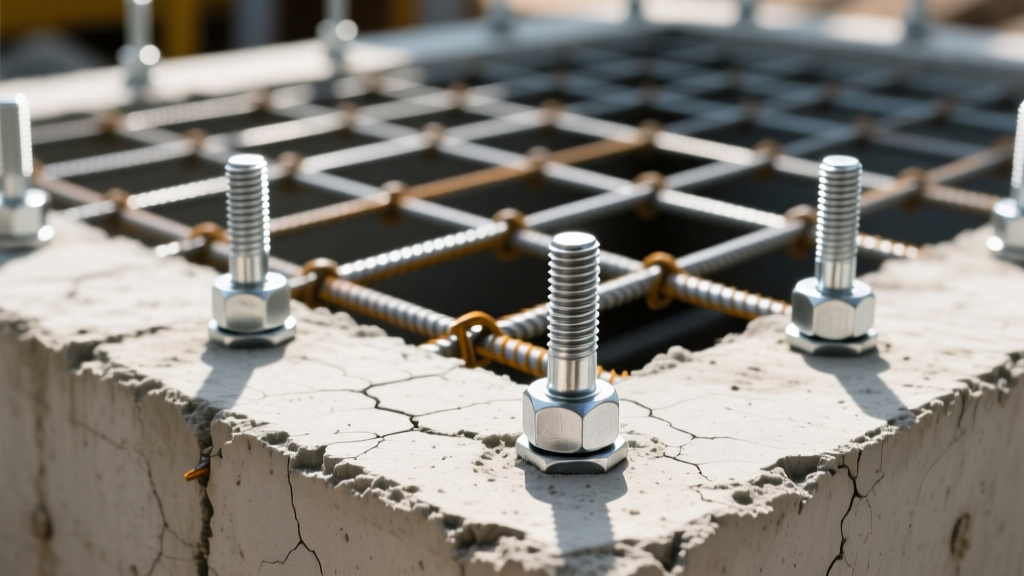
Cast-in-place anchors are positioned before the concrete is poured, relying on the bearing of a forged head or hooked end to transfer tensile loads. The governing material specification for steel CIP anchors in the United States is ASTM F1554, which categorizes bolts by yield strength.
ASTM F1554 Grade Classifications
- Grade 36: Low carbon steel, 36 ksi minimum yield strength. Highly weldable, making it the standard choice for anchor plates and welded assemblies.
- Grade 55: High-strength, low-alloy steel, 55 ksi minimum yield. Used for higher load applications; weldability requires specific carbon equivalent limits.
- Grade 105: Heat-treated alloy steel, 105 ksi minimum yield. Provides maximum tensile capacity but is generally not weldable in the field due to the risk of hydrogen embrittlement and loss of heat treatment.
For CIP anchors, the development length ($l_d$) must be sufficient to prevent pullout. According to ACI 318, the bearing area of the headed bolt must be at least 2.5 times the area of the bolt shaft to ensure that concrete breakout governs the failure mode rather than steel pull-through.
ACI 318-19 Chapter 17 Design Framework
Structural engineers must evaluate multiple failure modes to determine the governing design strength ($\phi N_n$ or $\phi V_n$) of an anchor group. The design framework follows a strict hierarchy of checks:
- Steel Failure: Calculate the nominal steel strength ($N_{sa} = A_{se} \times f_{uta}$). This is a ductile failure mode and is highly preferred in seismic design.
- Concrete Breakout: Evaluate the concrete cone failure ($N_{cb}$) using the Concrete Capacity Design (CCD) method. This brittle failure mode depends heavily on embedment depth ($h_{ef}$) to the power of 1.5.
- Pullout / Bond Failure: Check the mechanical interlock or chemical bond capacity. For adhesive anchors, this is calculated using the characteristic bond stress ($\tau_{cr}$ or $\tau_{uncr}$) multiplied by the bond surface area.
- Pryout Failure: Relevant for short, stout anchors in shear, where the concrete behind the anchor shears off in a shallow cone.
To ensure ductile system behavior, ACI 318-19 mandates that the steel strength must be the governing failure mode, or the concrete breakout strength must be at least 1.2 times the steel strength, preventing sudden, catastrophic structural collapse without warning.
Frequently Asked Technical Questions
Can adhesive anchors be used in cracked concrete for seismic applications?
Yes, but only if the specific adhesive product has passed the rigorous ACI 355.4 testing protocol for cracked concrete and seismic qualification. When designing for cracked concrete, engineers must apply a reduction factor ($\psi_{cp}$) to the characteristic bond stress, which typically reduces the allowable tensile load by 20% to 40% compared to uncracked concrete calculations.
What is the minimum concrete compressive strength ($f'_c$) required for structural anchors?
While some light-duty mechanical anchors can be installed in 2,000 psi concrete, ACI 318-19 structural design provisions generally assume a minimum $f'_c$ of 2,500 psi. For critical structural connections, base plates, and seismic force-resisting systems, a minimum specified compressive strength of 4,000 psi is standard industry practice to ensure predictable concrete breakout capacities.
How does galvanization affect the torque specifications of mechanical anchors?
Hot-dip galvanizing increases the friction coefficient between the nut and the anchor threads. If standard torque specifications are applied to galvanized wedge anchors, the actual expansion force generated in the concrete may be significantly lower than intended, leading to premature slip. Engineers must specify the use of lubricated nuts or apply manufacturer-provided torque multipliers (often 1.2x to 1.5x standard torque) when utilizing galvanized fasteners.
Written by
Sarah WhitfieldSarah Whitfield is a chartered quantity surveyor (MRICS) and construction cost analyst with 15 years of experience in material pricing, procurement strategy, and project budgeting. She earned her degree in Construction Management from the University of Reading (UK) and has worked on projects ranging from $2M custom homes to $180M mixed-use developments across North America and Europe. Sarah currently leads cost estimating for BuildMat Insight, maintaining a proprietary database of 4,000+ material price points updated quarterly. She is a frequent contributor to RSMeans cost data panels and has presented at the International Cost Engineering Council (ICEC) congress. Based in Denver, CO, Sarah is an avid trail runner and volunteer mentor for Women in Construction.
More from Sarah Whitfield
View all
Wood & Lumber
What Are the Different Types of Wood? A Builder's Guide
Compare structural softwoods, finish hardwoods, and engineered lumber. Analyze Janka ratings, MOE values, and 2026 pricing for construction.
Aug 4, 2026

Walls & Panels
Steel Framing vs Wood Framing: Corrosion and Moisture Defense
Compare steel framing vs wood framing for moisture resistance. Learn about galvanized coatings, condensation risks, and corrosion protection strategies.
Jul 21, 2026

Stone & Masonry
How to Cut Stone Veneer: Wet Saw vs Grinder Comparison
Compare the best tools for cutting stone veneer. We review wet saws, angle grinders, and chop saws to help you achieve clean, chip-free cuts.
Jul 21, 2026