Sakrete Concrete Mix PSI Ratings and Performance Specifications
Analyze Sakrete concrete mix performance ratings, 28-day PSI specifications, water ratios, and structural applications for optimal results.
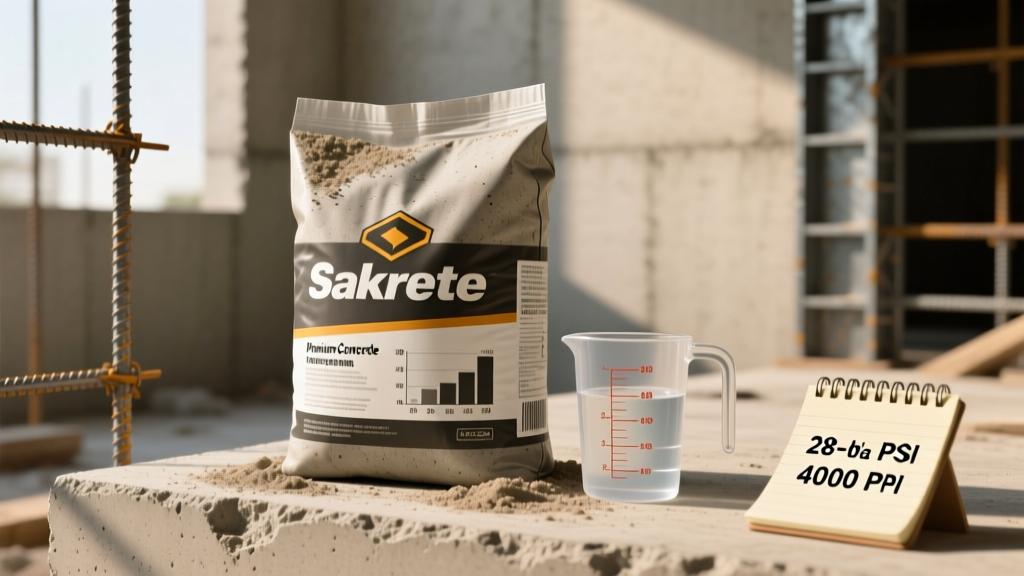
Decoding Sakrete's Compressive Strength (PSI) Tiers
When engineering residential and light-commercial structures, selecting the correct pre-packaged concrete formulation is a matter of structural mathematics, not just convenience. Sakrete manufactures a spectrum of bagged concrete mixes governed by ASTM C387 standards, which dictate the packaging, yield, and compressive strength of dry, combined materials. Understanding the exact 28-day Pounds per Square Inch (PSI) ratings of these mixes is critical for matching the material to the structural load and environmental stress it will endure.
Concrete reaches approximately 65% of its ultimate strength at 7 days, and 99% at 28 days. When evaluating Sakrete specifications, all PSI ratings referenced below represent the 28-day cured compressive strength under standard laboratory conditions (73°F and 100% relative humidity).
Technical Specifications Matrix: Core Sakrete Formulations
Not all bagged mixes are created equal. The aggregate size, cementitious binder ratio, and inclusion of admixtures drastically alter the performance profile. Below is the technical matrix for Sakrete's primary structural mixes.
| Product Formulation | 28-Day PSI | Initial Set Time | Max Aggregate Size | Ideal Structural Application |
|---|---|---|---|---|
| High Strength Concrete Mix | 5,000 PSI | 24 Hours | 3/8 in. (9.5 mm) | Driveways, heavy-load pads, structural footings |
| Max Strength Concrete Mix | 4,000 PSI | 24 Hours | 3/8 in. (9.5 mm) | Sidewalks, patios, standard fence post footings |
| Fast Setting Concrete Mix | 4,000 PSI | 30 Minutes | 3/8 in. (9.5 mm) | Post anchors, urgent repairs, HVAC pad leveling |
| Crack Resistant Concrete Mix | 4,000 PSI | 24 Hours | 3/8 in. (9.5 mm) | Flatwork prone to plastic shrinkage, retaining walls |
High Strength vs. Max Strength: The 5000 vs. 4000 PSI Debate
The jump from 4,000 PSI (Max Strength) to 5,000 PSI (High Strength) represents a 25% increase in compressive load capacity. According to American Concrete Institute (ACI) guidelines, 4,000 PSI is the baseline for exterior flatwork exposed to freezing and thawing. However, the 5,000 PSI High Strength mix utilizes a lower water-to-cement (w/c) ratio in its proprietary dry blend, resulting in a denser, less permeable matrix once cured. This reduced permeability makes the 5,000 PSI mix vastly superior for driveways that will bear the point-loads of heavy vehicles or for regions utilizing harsh de-icing salts, as the denser matrix resists chloride ion penetration.
Performance Under Stress: Freeze-Thaw and Shrinkage Metrics
Compressive strength alone does not guarantee longevity in volatile climates. Concrete fails primarily through tensile stress induced by thermal expansion, freeze-thaw cycles, and plastic shrinkage.
Standard bagged Sakrete High Strength and Max Strength mixes do not contain sufficient air-entraining admixtures (AEA) to survive severe freeze-thaw cycles on their own. If pouring exterior flatwork in climates with more than 15 freeze-thaw cycles annually, you must either use the Crack Resistant formulation (which includes synthetic micro-fibers to bridge micro-cracks) or manually dose a liquid AEA into the mixing water to achieve a 4% to 6% air void system.
The Sakrete Crack Resistant Concrete Mix addresses tensile failure through the integration of synthetic macro-fibers. These fibers do not increase the 28-day compressive PSI, but they increase the flexural strength and drastically reduce plastic shrinkage cracking by providing a three-dimensional micro-reinforcement grid during the critical first 24 hours of hydration.
Mixing Ratios and Yield Calculations for Structural Integrity
The most common point of failure with pre-bagged concrete is improper hydration. Adding excess water to improve workability destroys the structural integrity of the mix. Every additional gallon of water per cubic yard of concrete can drop the final PSI by up to 10%.
Exact Hydration Protocol for 80 lb Bags
- Calculate Yield: One 80 lb (36.2 kg) bag of Sakrete yields exactly 0.60 cubic feet (0.017 cubic meters). You will need 16.6 bags per cubic yard.
- Initial Water Charge: Add exactly 3.5 pints (1.65 Liters) of clean, potable water to the mixer or wheelbarrow first.
- Incorporate Dry Material: Add the 80 lb bag of Sakrete mix while agitating.
- Adjust for Slump: The target slump for structural bagged concrete is 3 to 4 inches. Add water in increments of 0.5 pints (236 ml) only if the mix is unworkable. Never exceed 4.5 pints total per 80 lb bag.
- Mix Time: Mix for a minimum of 5 minutes after all materials are introduced to ensure complete cement hydration and uniform aggregate distribution.
Real-World Failure Modes and How to Avoid Them
Even with a 5,000 PSI mix, poor site preparation and finishing techniques will result in structural failure. Below is a diagnostic framework for common bagged concrete failures.
- Surface Scaling and Dusting: Cause: Finishing the concrete while bleed water is still on the surface, or adding dry cement to the surface to soak up water. Fix: Wait for the bleed water to evaporate. Use a magnesium float for the initial pass, and only apply a steel trowel finish once the concrete can support body weight with only a 1/4-inch indentation.
- Plastic Shrinkage Cracking: Cause: Rapid moisture evaporation from the surface due to high winds, low humidity, or high ambient temperatures before the concrete sets. Fix: Erect temporary windbreaks. Apply a liquid evaporation retardant (like Sakrete Surface Cure) immediately after screeding if temperatures exceed 85°F.
- Delamination over Existing Slabs: Cause: Pouring new Sakrete mix directly over an old, unprepared concrete slab without a bonding agent. Fix: Mechanically scarify the old slab, apply a liquid concrete bonding adhesive, and ensure the minimum overlay thickness is at least 2 inches for the 5,000 PSI High Strength mix.
Curing Protocols for Maximum PSI Attainment
The chemical reaction of hydration requires continuous moisture. If a 5,000 PSI Sakrete mix is allowed to dry out on the surface within the first 7 days, the surface PSI may never exceed 2,500 PSI, leading to premature spalling.
Expert Curing Directive: For flatwork, apply a membrane-forming curing compound immediately after final finishing, or cover the slab with 4-mil polyethylene sheeting or wet burlap for a minimum of 7 days. For vertical footings and post anchors, keep the forms in place and backfill with damp earth as soon as the concrete achieves sufficient rigidity (typically 48 hours).
Sourcing and Cost Expectations
As of current market conditions, pricing for Sakrete bagged mixes fluctuates based on regional aggregate costs and retail distribution networks. Expect the following baseline pricing for 80 lb bags at major home improvement centers and specialized masonry suppliers:
- Max Strength (4,000 PSI): $5.50 – $6.50 per bag.
- High Strength (5,000 PSI): $6.80 – $8.20 per bag.
- Fast Setting (4,000 PSI): $7.50 – $9.00 per bag.
- Crack Resistant (4,000 PSI + Fibers): $8.00 – $9.50 per bag.
When calculating project budgets, factor in the "pallet discount." Purchasing a full pallet (typically 42 to 50 bags) from a dedicated masonry supply yard rather than a big-box retailer can reduce the per-bag cost by 12% to 18%, and ensures the bags have been stored in climate-controlled or properly tarped environments, preventing pre-hydration from ambient humidity.
By strictly adhering to the specified water-to-cement ratios, understanding the structural limits of the 3/8-inch aggregate profile, and implementing rigorous 7-day curing protocols, builders can reliably achieve the published PSI ratings of Sakrete's engineered concrete formulations.