Concrete Acid Stain vs Water Based Stain: Application Showcase
Compare concrete acid stain vs water based stain through real-world applications. Discover costs, visual outcomes, and best use cases for your project.

The Chemistry of Color: Reactive vs. Non-Reactive Pathways
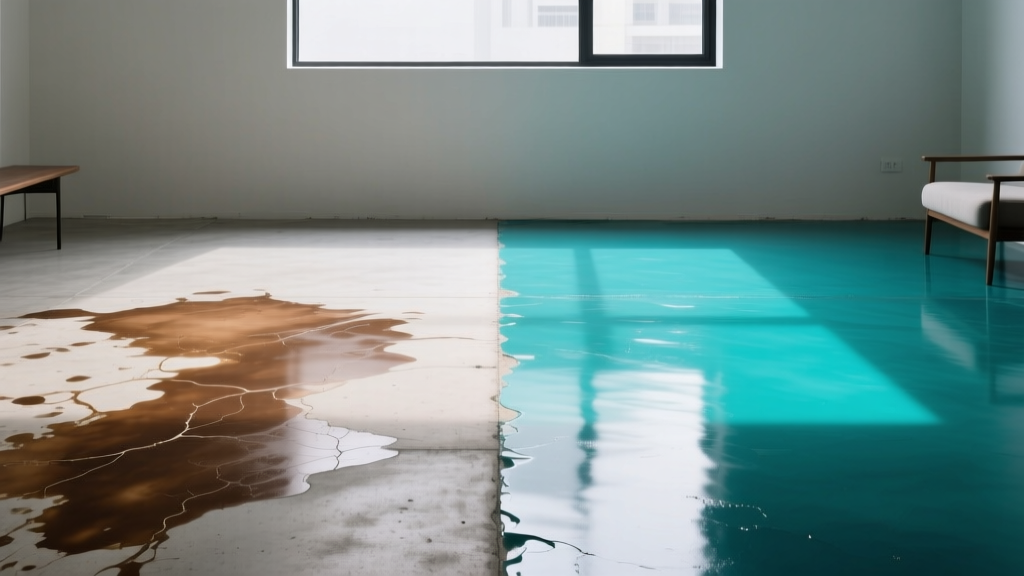
Choosing between concrete acid stain vs water based stain requires understanding the fundamental chemical divergence between the two. Acid stains are reactive solutions containing metallic salts and mild hydrochloric acid. When applied, the acid opens the concrete pores while the metallic salts react with the free lime (calcium hydroxide) present in the cement matrix. This reaction permanently alters the concrete's chemical structure, producing translucent, variegated, and mottled earth tones.
Water-based stains, conversely, are non-reactive. They consist of microscopic pigment particles suspended in an acrylic polymer or water carrier. Rather than reacting chemically, these pigments physically penetrate the concrete pores and bind to the surface. This mechanism allows for a vastly broader color palette, including vibrant blues, reds, and whites, which are chemically impossible to achieve with reactive acid stains.
Showcase 1: High-Traffic Commercial Retail Floors (Acid Stain)
For commercial spaces requiring a sophisticated, organic aesthetic that hides dirt and scuff marks, reactive acid stains remain the industry benchmark. A prime example is the modern winery tasting room or boutique retail floor.
Project Profile: The Rustic Retail Floor
- Product Used: Kemiko Stone Tone (Colors: 'Cola' and 'English Red')
- Visual Outcome: A marbled, leather-like finish with natural dark and light variations. No two square feet look identical.
- Application Technique: Applied via a pump sprayer using overlapping circular motions to avoid harsh overlap lines. A second, diluted coat of 'English Red' was misted to deepen the warmth.
- Why Acid Wins Here: The inherent mottling of acid stain naturally masks foot traffic wear patterns and dust, drastically reducing daily maintenance visibility in high-traffic commercial zones.
Showcase 2: Modern Residential Patios and Pool Decks (Water-Based)
When homeowners demand specific, uniform colors or require UV-stable finishes for exterior applications exposed to direct sunlight, water-based stains take the lead. Modern exterior living spaces, particularly stamped concrete overlays and pool decks, rely heavily on these non-reactive pigments.
Project Profile: The Vibrant Exterior Patio
- Product Used: Direct Colors Liquid Colored Antique and Vibrance Dyes
- Visual Outcome: A solid, opaque slate-gray base with vibrant teal accents highlighting the stamped grout lines.
- Application Technique: The base coat was applied with a microfiber mop for uniform coverage. The accent dye was applied via an HVLP (High Volume Low Pressure) sprayer to target the textured crevices of the stamped concrete.
- Why Water-Based Wins Here: Acid stains are limited to earth tones and can react unpredictably with exterior weathering. Water-based pigments offer absolute UV stability and allow for the high-contrast, multi-tonal designs expected in modern stamped concrete.
According to decorative concrete experts at Concrete Network, water-based stains are increasingly favored for exterior applications because they do not leave behind corrosive chemical residues that could damage surrounding landscaping or pool equipment.
Head-to-Head Project Matrix: 500 Sq. Ft. Patio Comparison
The following matrix breaks down the real-world metrics for a standard 500-square-foot exterior concrete slab, comparing a reactive acid application against a non-reactive water-based application.
| Metric | Acid Stain (Reactive) | Water-Based Stain (Non-Reactive) |
|---|---|---|
| Material Cost | $110 - $180 ($0.22 - $0.36/sq ft) | $175 - $300 ($0.35 - $0.60/sq ft) |
| Labor Cost (Pro) | $2,000 - $3,500 (Heavy prep & neutralization) | $1,500 - $2,750 (Faster application) |
| Prep & Clean Up | High (Requires alkaline wash, neutralization, and heavy water extraction) | Low (Requires light cleaning and vacuuming) |
| Color Palette | 8-12 Earth Tones (Browns, Tans, Soft Blues/Greens) | 30+ Colors (Full spectrum, including brights and whites) |
| Cure/Dry Time | 24 hours before sealing (must be completely dry post-wash) | 2-4 hours before sealing |
Edge Cases & Failure Modes: When Projects Go Wrong
Understanding the failure modes of both systems is critical for specification. The most common application failures stem from ignoring the underlying concrete mix design or environmental conditions.
The Fly Ash Trap (Acid Stain Failure)
Modern concrete mix designs frequently incorporate 15% to 30% fly ash to improve workability and reduce carbon footprint. However, Class F fly ash undergoes a pozzolanic reaction that consumes calcium hydroxide (free lime) as the concrete cures. Because acid stains require free lime to react, a slab with high fly ash content will yield pastel, washed-out, or entirely non-existent color when stained with metallic salts.
Specification Rule: If the concrete mix contains more than 10% fly ash or slag, do not specify reactive acid stain. Pivot to a water-based penetrating stain or apply a 1/8-inch micro-topping overlay to provide a reactive surface.
The MVT Blister (Water-Based Stain Failure)
Water-based stains are frequently sealed with solvent-based or water-based acrylics. If the concrete slab has high Moisture Vapor Transmission (MVT) rates—common in exterior slabs without a vapor barrier or interior slab-on-grade pours—the trapped moisture vapor will push against the non-breathable acrylic sealer. This results in blistering, whitening, and delamination of the sealer, taking the water-based pigment with it.
To mitigate this, test the slab for MVT using an anhydrous calcium chloride test (ASTM F1869). If levels exceed 3-5 lbs per 1,000 sq ft per 24 hours, utilize a breathable penetrating sealer like a silane/siloxane blend, or apply a moisture-mitigating epoxy primer before staining and top-coating.
The Sealer Mandate: Locking in the Showcase
Neither acid nor water-based stains provide a protective wear layer on their own; they are purely decorative. The sealer dictates the final gloss level, slip resistance, and UV protection. Industry guidelines detailed by Bob Vila's expert network emphasize matching the sealer to the stain type and environment.
- For Acid Stains (Interior): A solvent-based acrylic sealer (e.g., TK Products TK-290) enhances the dark, rich tones of the metallic salts, creating a 'wet look'. Follow with a sacrificial wax or polyurethane topcoat for commercial scuff resistance.
- For Water-Based Stains (Exterior): A water-based, UV-stable polyurethane or polyaspartic topcoat is mandatory. Solvent-based acrylics will yellow and degrade under direct UV exposure, muting the vibrant pigments of the water-based stain. Add a micronized anti-slip additive (like SureCrete SureGrip) at a rate of 1 lb per 5 gallons to maintain slip resistance around pool decks.
For a comprehensive breakdown of chemical interactions and prep protocols, contractors should consult the technical application guides provided by the Concrete Network's acid staining archives, which remain the definitive resource for troubleshooting reactive applications.
Application Summary Decision Framework
Choose Acid Stain if: You are working on an interior commercial floor, desire a highly variegated marble effect, want to hide dirt and wear patterns, and have confirmed the concrete mix has low fly ash content.
Choose Water-Based Stain if: You are staining an exterior patio or pool deck, require specific brand-matching colors or bright hues, are working with high-fly-ash concrete mixes, or need a rapid turnaround time between staining and sealing.
Written by
Elena RodriguezElena Rodriguez is a civil engineer and technical writer specializing in concrete technology, masonry systems, and ASTM/ACI compliance. She earned her B.S. in Civil Engineering from Texas A&M University and spent a decade at a materials testing laboratory, performing over 2,000 concrete compressive strength tests and masonry prism evaluations. Elena is an ACI-certified Field Testing Technician (Grade I) and a member of ASTM Committee C12 on Natural Building Stone. She currently consults on forensic engineering cases involving concrete failures and moisture intrusion. Based in San Antonio, TX, Elena is a proud member of the Society of Women Engineers (SWE) and coaches her daughter's FIRST Robotics team.
More from Elena Rodriguez
View all
Walls & Panels
Cost Analysis: Light Gauge Steel Framing Advantages and Disadvantages
Evaluate light gauge steel framing advantages and disadvantages through a strict cost analysis lens, comparing material, labor, and lifecycle expenses.
Aug 4, 2026

Walls & Panels
Gypsum Board Types: Exact Specifications, Thickness & Dimensions
Compare standard, Type X, and moisture-resistant gypsum board types. Get exact specifications, thicknesses, dimensions, and ASTM standards for your project.
Aug 4, 2026

Fire Resistance
Best Fire-Resistant Outdoor Decking Materials: 2026 Buyer Guide
Discover the best fire-resistant outdoor decking materials for 2026. Compare Class A PVC, aluminum, and hardwood options for WUI compliance and safety.
Aug 4, 2026