Lowes Concrete Mixes: 2026 Performance Specs & PSI Ratings Guide
Analyze 2026 performance specs, PSI ratings, and yield data for Lowes concrete mixes, including Quikrete 5000, Sakrete, and fast-setting formulas.
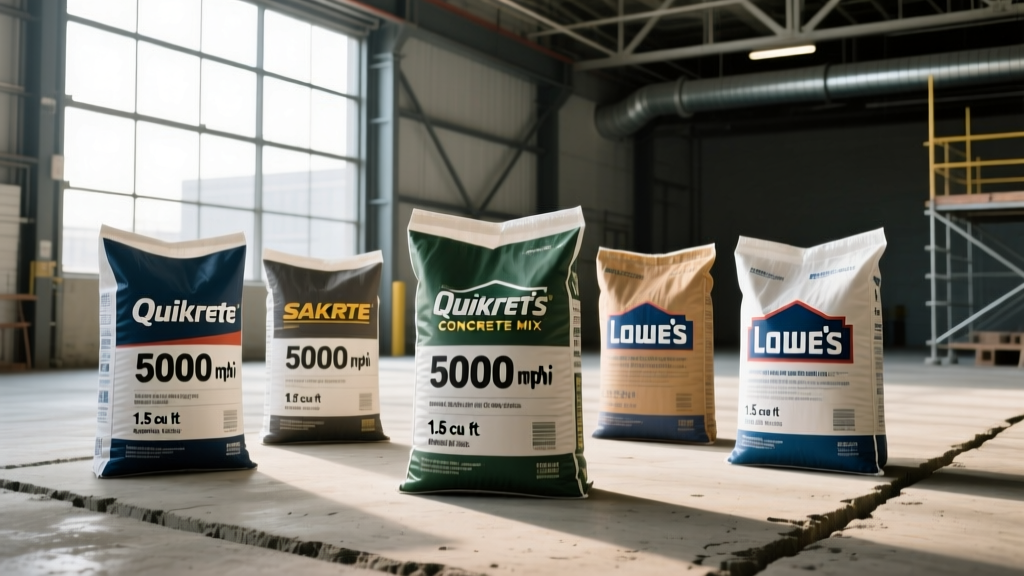
Decoding the Bag: Core Performance Metrics for Retail Concrete
Procuring bagged concrete from a major retailer like Lowe's offers immediate accessibility for structural repairs, footing pours, and slab work. However, the packaging often obscures the critical engineering data required for load-bearing applications. When evaluating Lowes concrete options—primarily dominated by Quikrete and Sakrete product lines—contractors and advanced DIYers must look beyond the marketing claims and focus on 28-day compressive strength (PSI), early-strength gain, slump tolerances, and water-to-cement (w/c) ratio limitations.
Bagged concrete sold at Lowe's in 2026 adheres to strict ASTM C1701 standards for prepackaged dry-mixed concrete. The performance of these mixes is ultimately dictated by the Portland cement content, the maximum aggregate size (typically 3/8-inch to 1/2-inch gravel in retail bags), and the presence of chemical admixtures or synthetic fibers. Understanding these specifications prevents catastrophic structural failures, such as frost heaving in footings or spalling in driveway patches.
2026 Specification Matrix: Standard vs. High-Strength Lowes Concrete
The following matrix breaks down the exact technical specifications for the most common 80 lb. bagged concrete mixes available at Lowe's. Pricing reflects early 2026 national averages and may vary by regional distribution centers.
| Product / Brand | Model / SKU | 28-Day PSI | 3-Day PSI | Initial Set | Water / 80lb Bag | 2026 Avg Price |
|---|---|---|---|---|---|---|
| Quikrete Concrete Mix | #1101 | 2,500 | ~1,200 | 30-45 mins | 2.8 - 3.2 qts | $5.98 |
| Sakrete High Strength | #13022 | 4,000 | ~2,000 | 45-60 mins | 2.5 - 3.0 qts | $6.28 |
| Quikrete 5000 | #1007 | 5,000 | ~2,500 | 90-120 mins | 2.5 - 2.8 qts | $7.48 |
| Quikrete Fast-Setting | #1004 | 4,000 | N/A (Rapid) | 20-40 mins | 2.8 - 3.2 qts | $8.48 |
| Quikrete Crack-Resistant | #1006 | 3,500 | ~1,800 | 60-90 mins | 2.8 - 3.0 qts | $7.98 |
Deep Dive: High-Strength and Specialty Formulations
Quikrete 5000 (Model #1007): The Commercial-Grade Standard
Quikrete 5000 is the highest-strength standard bagged mix available at Lowe's. Engineered to achieve 5,000 PSI at 28 days, it utilizes a higher proportion of Portland cement and specialized early-strength admixtures. According to the Quikrete technical data sheet, this mix reaches 2,500 PSI in just 72 hours, making it ideal for structural footings, heavy-duty equipment pads, and winter pours where early freeze-thaw resistance is critical. The trade-off for this high early strength is a reduced working time; the initial set occurs in roughly 90 minutes at 70°F, requiring precise screeding and floating operations.
Sakrete High Strength (Model #13022): The 4,000 PSI Alternative
Sakrete’s High Strength mix offers a middle ground between standard and ultra-high-strength formulations. Rated at 4,000 PSI, it features a slightly more forgiving workability window than the Quikrete 5000. It is heavily specified for driveway aprons, sidewalk replacements, and structural column encasements. The aggregate gradation in Sakrete bags tends to feature slightly more rounded river gravel, which improves the slump and flowability without requiring excess water.
Quikrete Crack-Resistant (Model #1006): Fiber-Reinforced Mechanics
This 3,500 PSI mix integrates millions of discrete, multi-filament polypropylene fibers. These fibers do not increase the ultimate compressive strength (PSI); rather, they drastically improve the tensile and flexural strength of the matrix. The fibers act as micro-rebar, intercepting micro-cracks caused by plastic shrinkage during the first 24 hours of curing. This formulation is mandatory for thin pours (under 4 inches) and slabs exposed to high wind or low humidity conditions where surface evaporation outpaces bleed water migration.
The Water-to-Cement Ratio Trap: Avoiding Field Failures
The most common cause of structural failure when using Lowes concrete mixes is field-added water. Bagged concrete is proportioned at the plant to achieve maximum density at a specific water volume. The Portland Cement Association (PCA) emphasizes that the water-to-cement (w/c) ratio is the single most important factor governing concrete strength and durability.
- Optimal w/c Ratio: 0.40 to 0.45 (Requires mechanical vibration to consolidate).
- Retail Bag Target: 0.50 to 0.55 (Designed for hand-tamping and standard rodding).
- Over-watered (Soup Mix): >0.60 (Results in severe bleeding, aggregate segregation, and a 30%+ drop in PSI).
Curing Profiles, Yield, and Temperature Derating
Calculating True Field Yield
A standard 80 lb. bag of Lowes concrete yields exactly 0.60 cubic feet of mixed concrete under laboratory conditions. However, field yield loss occurs due to material left in the mixing tub, subgrade absorption, and formwork deflection. When calculating material requirements for a project, apply a 12% waste and consolidation factor. For example, a 4x4 foot footing that is 12 inches deep requires 16 cubic feet. Mathematically, that is 26.6 bags. With a 12% field loss factor, you must procure 30 bags to ensure continuous pouring without cold joints.
Temperature Derating and ASTM C39 Testing
Compressive strength ratings are verified via ASTM C39 testing protocols. However, these lab tests assume a continuous curing temperature of 73°F. When pouring Lowes concrete in extreme temperatures, the chemical hydration process alters drastically:
- Cold Weather (Below 50°F): Hydration slows exponentially. Quikrete 5000, which normally hits 2,500 PSI in 3 days, may take 7 to 10 days to reach that threshold. If the internal concrete temperature drops below freezing before reaching 500 PSI, the water expands, permanently destroying the cementitious matrix.
- Hot Weather (Above 85°F): Fast-setting mixes like Quikrete #1004 can flash-set in the wheelbarrow within 10 minutes. In high heat, use cold mixing water (or substitute 20% of the water volume with crushed ice) to retard the initial set and maintain workability.
"Retail bagged concrete is an incredibly consistent product when mixed to the manufacturer's exact water specifications. The variable is almost always the human element—specifically, the temptation to add 'just one more handful of water' to make the screeding process easier. That single handful is the difference between a 5,000 PSI structural pad and a 3,000 PSI dust-bowl that will spall after one winter." — Senior Structural Materials Engineer
Troubleshooting Retail Mix Anomalies
Even with strict adherence to specifications, field anomalies can occur. Here is how to diagnose and address common issues specific to bagged mixes purchased from big-box retailers:
- Aggregate Segregation (Rocks at the bottom, paste at the top): Caused by over-mixing or excessive slump. Stop mixing immediately. Do not attempt to remix by adding dry cement; discard the batch if segregation is severe, as the structural integrity is compromised.
- Plastic Shrinkage Cracking (Surface spider-webbing within 2 hours): Occurs when evaporation exceeds bleed water. Immediately apply a spray-on evaporation retardant (like E-Con) or cover the slab with wet burlap and 6-mil polyethylene sheeting to trap moisture.
- Dusting / Chalking Surface: Caused by troweling bleed water back into the surface or troweling while the concrete is still releasing water. The fix requires mechanical grinding and the application of a lithium densifier/hardener post-cure.
Final Procurement Strategy
When sourcing Lowes concrete for structural applications, always check the manufacturing date code printed on the bottom or back of the bag. Portland cement begins to hydrate and degrade when exposed to ambient humidity. Reject any bags that feel hard, contain lumps that cannot be crushed with two fingers, or are older than 90 days from the manufacture date. For critical load-bearing footings, mandate the use of Quikrete 5000 or Sakrete High Strength, strictly limit water addition to the lower end of the manufacturer's tolerance, and implement a 7-day continuous wet-curing regimen using saturated burlap.