Top Concrete Bonding Adhesive Brands: Sika vs Quikrete 2026
Compare top concrete bonding adhesive brands for 2026. We test SikaLatex and Quikrete #9032 for shear strength, coverage, and interior vs exterior use.
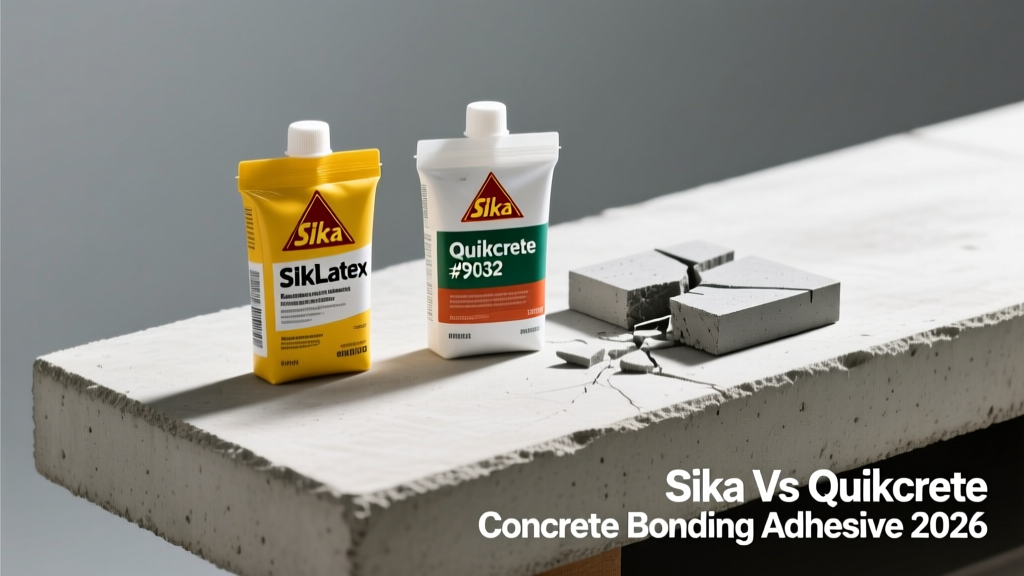
The Chemistry of Adhesion: PVA vs. Acrylic Emulsions
When overlaying new concrete or applying a patching compound to an existing substrate, the primary challenge is preventing delamination caused by differential shrinkage and weak tensile strength at the cold joint. A concrete bonding adhesive solves this by creating a continuous polymer film that chemically and mechanically bridges the old and new material. However, not all adhesives are formulated for the same environment. The market is dominated by two distinct chemical families: Polyvinyl Acetate (PVA) and Acrylic Emulsions.
PVA-based adhesives, which include standard big-box store options, rely on water evaporation to form a tacky, high-tensile film. While they offer excellent initial grab and are highly cost-effective for interior applications, PVA polymers are inherently hydrophilic. If exposed to continuous moisture, hydrostatic pressure, or exterior freeze-thaw cycles, the film can re-emulsify, leading to catastrophic bond failure. Conversely, acrylic and styrene-butadiene emulsions cross-link as they cure, creating a non-re-emulsifiable, UV-stable, and waterproof barrier suitable for harsh exterior and below-grade environments.
Head-to-Head Product Matrix: 2026 Specifications
| Feature | Quikrete Concrete Bonding Adhesive (#9032) | SikaLatex R Acrylic Emulsion |
|---|---|---|
| Chemical Base | Polyvinyl Acetate (PVA) | Non-re-emulsifiable Acrylic |
| 2026 Retail Price (1 Gal) | $21.99 - $24.50 | $38.50 - $42.00 |
| Coverage Rate | 200 - 300 sq ft / gal | 150 - 250 sq ft / gal (undiluted) |
| Application Method | Paint on, wait for tack (15-30 mins) | Paint on (wet-on-wet) or mix into gauging water |
| Exterior / Wet Use | No (Protected exterior only) | Yes (Fully waterproof when cured) |
| ASTM C1583 Tensile | ~250 psi (concrete failure) | >350 psi (concrete failure) |
Deep Dive: Quikrete Concrete Bonding Adhesive (#9032)
The Quikrete #9032 is the undisputed volume leader in the North American residential market. It is a milky-white, PVA-based liquid that dries to a clear, highly adhesive film. Its primary advantage is its extreme ease of use and forgiving open time for DIYers and general contractors executing interior slab patches, basement floor leveling, or dry-zone sidewalk repairs.
Application Specifics and Edge Cases
For Quikrete #9032 to achieve its rated shear strength, the substrate must be structurally sound and completely free of laitance. The adhesive must be applied undiluted using a stiff-bristled nylon brush or a 3/8-inch nap roller. A critical mistake made by novice applicators is pouring the new mortar onto the adhesive while it is still wet. The PVA film requires 15 to 30 minutes (depending on ambient humidity and temperature) to reach a 'tacky' state. If you pour over wet PVA, the water in the fresh concrete will dilute the adhesive, destroying the polymer matrix and resulting in a weak, chalky slip plane.
Deep Dive: SikaLatex R Acrylic Emulsion
For commercial repairs, exterior overlays, and structural modifications, SikaLatex R represents the professional standard in acrylic bonding agents. Unlike PVA, SikaLatex R is an acrylic polymer emulsion that can be utilized in two distinct ways: as a topical bonding bridge (painted onto the substrate) or as a liquid admixture mixed directly into the gauging water of the repair mortar to increase flexural strength and reduce permeability.
Application Specifics and Edge Cases
When used as a topical concrete bonding adhesive, SikaLatex R does not require the same 'tacky' waiting period as PVA. It can be applied 'wet-on-wet', meaning the repair mortar can be placed while the acrylic emulsion is still wet, provided the substrate has absorbed the initial liquid and no puddling remains. This drastically speeds up workflow on large commercial slab restorations. Furthermore, because the acrylic cross-links upon curing, it is entirely impervious to water once set, making it the mandatory choice for marine environments, wastewater treatment plants, and exterior balcony overlays.
Critical Failure Modes & Troubleshooting
Why Do Bonding Adhesives Fail in the Field?
- Dust Contamination (The #1 Culprit): If the concrete is scarified and swept but not vacuumed or blown with compressed air, the adhesive bonds to the micro-dust layer rather than the concrete pores. The overlay will peel off with a thin layer of dust attached to the underside.
- Improper Concrete Surface Profile (CSP): According to International Concrete Repair Institute (ICRI) guidelines, a CSP of 3 to 5 is ideal. If the surface is too smooth (CSP 1), there is insufficient mechanical interlock. If too rough (CSP 7+), the adhesive will bridge the peaks and leave voids in the valleys, creating air pockets that compromise the bond.
- Applying Over Curing Compounds: If the existing slab was treated with a film-forming curing compound or a silane/siloxane sealer, the bonding adhesive cannot penetrate the pores. The existing surface must be shot-blasted or scarified until water droplets instantly absorb into the concrete.
ICRI-Compliant Surface Preparation Protocol
To ensure maximum tensile transfer across the cold joint, follow this exact preparation sequence before applying any PVA or Acrylic bonding agent:
- Mechanical Scarification: Use a walk-behind grinder equipped with a 16-grit or 20-grit diamond cup wheel to remove the top 1/16-inch of the concrete surface. This removes laitance, carbonation, and microscopic contaminants.
- Edge Sawing: Use a concrete saw to score a 1/4-inch deep perimeter around the repair area. This creates a clean, straight joint and prevents the feather-edge of the new overlay from chipping under traffic loads.
- Debris Extraction: Sweep with a stiff push broom, followed immediately by a commercial HEPA vacuum. Do not rely on blowing the dust with a leaf blower, as this often forces dust into the micro-pores of the concrete.
- Saturation (For Acrylics Only): If using an acrylic emulsion like SikaLatex R, pre-soak the substrate with clean water for 4 hours prior to application, then remove all standing puddles. This prevents the dry, porous substrate from flash-absorbing the water out of the acrylic emulsion, which would cause the polymer to flash-cure into a brittle, non-adhesive film.
- Adhesive Application: Apply the chosen bonding agent at the manufacturer's specified mil thickness, ensuring complete, uniform coverage without pooling.
Frequently Asked Questions
Can I mix concrete bonding adhesive directly into my bagged concrete mix?
Only if the product is specifically formulated as an admixture (like SikaLatex R or SikaBond). Standard PVA adhesives like Quikrete #9032 are designed strictly for topical application. Mixing PVA directly into the batch water can severely retard the hydration process of the Portland cement, leading to a weak, crumbly patch that never reaches its design compressive strength.
How long does the adhesive remain tacky before I must pour the overlay?
For PVA-based products, the tacky window is typically 45 to 90 minutes in standard conditions (70°F, 50% RH). If the adhesive fully dries to a hard, glossy film before the concrete is placed, you must re-coat the area with a fresh layer of adhesive to reactivate the bond. Acrylic emulsions applied wet-on-wet do not have this limitation, provided they have not dried to a continuous plastic sheet.
Are there structural limitations to using bonding adhesives for column or beam repairs?
Yes. While bonding adhesives are excellent for horizontal slab overlays and non-structural patching, vertical or overhead structural repairs (such as spalled beams or columns) require specialized epoxy-bonding agents or structural grouts. Acrylic and PVA emulsions lack the sheer modulus required to transfer heavy structural loads across a cold joint in vertical orientations. For structural repairs, refer to the ACI 546R Guide to Concrete Repair for specific epoxy and mechanical anchoring protocols.