Cost of Concrete Patio vs Pavers: 2026 Price Breakdown
Compare the 2026 cost of concrete patio vs pavers. Deep dive into material pricing, labor, base prep, and long-term maintenance economics.

The Baseline: Material vs. Total Installed Costs
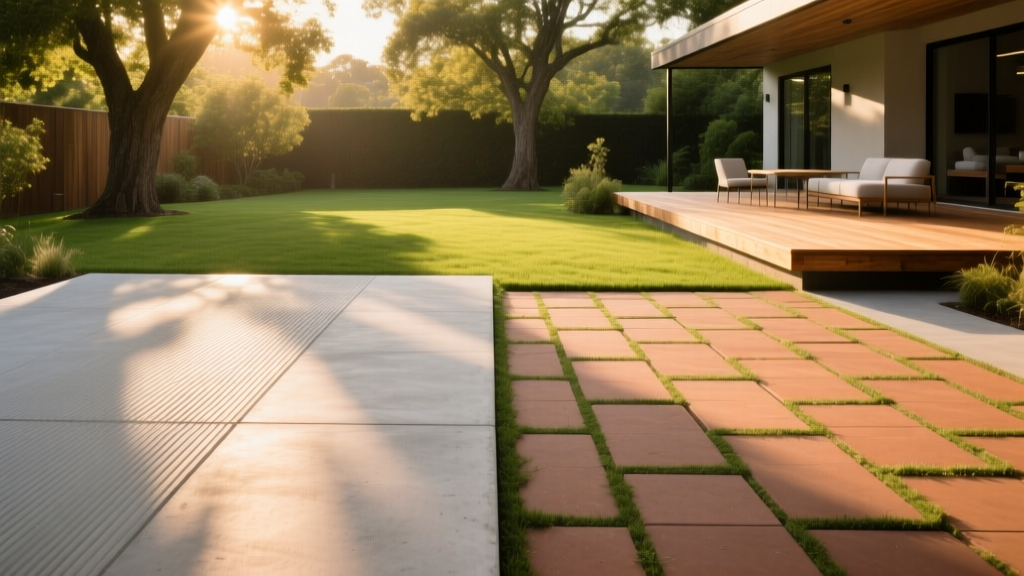
Evaluating the cost of concrete patio vs pavers requires looking past the surface material price. In 2026, supply chain stabilization has leveled out extreme price volatility, but labor and site-preparation costs remain the dominant factors in hardscape budgeting. A common mistake homeowners and contractors make is comparing the raw cost of a bag of concrete mix to a single paver stone. The true metric is the total installed cost per square foot, which includes excavation, base aggregation, reinforcement, and finishing.
| Hardscape Type | Material Cost (per sq. ft.) | Labor & Base Prep (per sq. ft.) | Total Installed Cost (2026) | Expected Lifespan |
|---|---|---|---|---|
| Basic Poured Concrete (Broom Finish) | $2.50 - $4.00 | $5.50 - $8.00 | $8.00 - $12.00 | 25-30 Years |
| Stamped / Colored Concrete | $6.00 - $10.00 | $9.00 - $15.00 | $15.00 - $25.00 | 25-30 Years |
| Standard Concrete Pavers | $3.00 - $6.00 | $7.00 - $10.00 | $10.00 - $16.00 | 30-50+ Years |
| Permeable / High-End Pavers | $8.00 - $15.00 | $12.00 - $20.00 | $20.00 - $35.00 | 30-50+ Years |
Poured Concrete Patio Cost Breakdown
Poured concrete remains the most cost-effective option for large, continuous surface areas. According to the National Ready Mixed Concrete Association (NRMCA), the price of ready-mix concrete in 2026 averages $145 to $165 per cubic yard, depending on regional aggregate availability and admixture requirements.
Hidden Concrete Costs: Reinforcement and Soil Prep
The longevity of a concrete slab relies entirely on what happens before the truck arrives. A standard 4-inch thick slab requires a minimum of a 4-inch compacted sub-base of gravel. If your soil is expansive clay, you must budget an additional $1.50 to $2.50 per square foot for over-excavation and importing structural fill.
Many budget contractors default to 6x6 W2.9xW2.9 welded wire mesh (WWM) to save on labor. For a patio subjected to freeze-thaw cycles or heavy point loads (like a hot tub), specify #3 (3/8-inch) or #4 (1/2-inch) rebar tied in a grid at 16-inch centers. Rebar costs roughly $0.75 to $1.10 more per square foot than WWM but provides vastly superior tensile strength to prevent structural faulting.
Furthermore, a 4000 PSI air-entrained mix (with 5-7% microscopic air bubbles) is mandatory in northern climates to prevent surface spalling. Air entrainment adds approximately $8 to $12 per cubic yard to the material cost but is non-negotiable for durability, as noted by the Portland Cement Association.
Paver Patio Cost Breakdown
Interlocking concrete pavers offer a modular aesthetic and superior reparability, but the cost of concrete patio vs pavers skews heavily toward pavers when factoring in the base system. The pavers themselves are only 30% to 40% of the total project cost.
The Paver Base: Where Budgets Succeed or Fail
The Interlocking Concrete Pavement Institute (ICPI) mandates rigorous base specifications for vehicular and pedestrian loads. A pedestrian patio requires a minimum 4-inch to 6-inch base of compacted, angular crushed aggregate (often called Class II road base or 3/4-inch minus).
- Excavation & Haul Away: $2.00 - $4.00 per sq. ft. (Pavers require deeper excavation than concrete to accommodate the base, sand, and paver thickness).
- Geotextile Fabric: $0.30 - $0.50 per sq. ft. (Mandatory for clay or silt soils to prevent the aggregate base from sinking into the subgrade).
- Aggregate Base Material: $1.50 - $2.50 per sq. ft. (delivered and mechanically compacted in 2-inch lifts).
- Bedding Sand: $0.50 - $0.80 per sq. ft. (Must be coarse, washed concrete sand meeting ASTM C33 standards; never use mason sand or play sand, which retains moisture and causes frost heave).
Do not use cheap plastic spike-edge restraints that warp under UV exposure and thermal expansion. Budget for rigid aluminum L-channel or heavy-duty polymer snap-edge restraints (like PermaEdge) secured with 10-inch galvanized spikes. For joints, specify high-quality polymeric sand (e.g., Alliance Gator Dust or Techniseal). Standard jointing sand costs $0.20 per sq. ft., while polymeric sand costs $1.00 to $1.50 per sq. ft. but locks the joints against weed growth and ant excavation for up to a decade.
Long-Term ROI and Maintenance Economics
The initial installation is only the first half of the financial equation. Evaluating the lifecycle cost reveals distinct maintenance profiles for both materials.
"Concrete is a monolithic slab; when it fails, it cracks. Pavers are a flexible matrix; when they fail, they settle. You can reset a settled paver in twenty minutes for five dollars. You cannot invisibly repair a faulted concrete slab."
— Structural Hardscape Engineering Principles
Concrete Maintenance Costs
Basic broom-finished concrete requires minimal maintenance, though applying a penetrating silane/siloxane sealer every 3 to 5 years ($0.40 to $0.80 per sq. ft.) will drastically reduce water infiltration and freeze-thaw damage. Stamped or exposed aggregate concrete, however, demands an acrylic topical sealer reapplied every 2 to 3 years at a cost of $0.80 to $1.20 per sq. ft. to maintain color vibrancy and UV protection. If a concrete slab cracks outside of a control joint, mudjacking or slab replacement can cost $500 to $1,500+ per localized section.
Paver Maintenance Costs
Pavers do not crack, but they do shift. Over a 10-year period, expect to spend $1.50 to $2.50 per square foot to re-apply polymeric sand to high-traffic areas where joints have degraded. Weed control is largely mitigated by polymeric sand, but occasional application of organic joint-stabilizing sealers ($1.00 per sq. ft.) may be required in damp, shaded environments to prevent moss growth.
Decision Framework: When to Choose Which
Use this practical framework to finalize your material selection based on your specific site conditions and budget constraints.
Choose Poured Concrete If:
- Budget is the primary constraint: You need a large, functional entertainment space (400+ sq. ft.) and want to keep the total installed cost under $12.00 per square foot.
- Site access is excellent: Ready-mix trucks or concrete pumps can easily access the pour site without incurring massive pump-line fees ($800+ per day).
- You prefer a modern, minimalist aesthetic: Large expanses of smooth or lightly textured concrete with scored geometric control joints fit contemporary architecture perfectly.
Choose Interlocking Pavers If:
- Soil conditions are poor or heavily rooted: If your yard has aggressive tree roots or expansive clay soil, a flexible paver system will move and settle without catastrophic structural failure. You can simply pull up the pavers, re-grade the base, and relay them.
- Utility access is required: If the patio area covers main water lines, gas lines, or sewer cleanouts, pavers can be unzipped and replaced perfectly after utility work is completed.
- Permeability is mandated: Many municipalities in 2026 require permeable hardscapes to manage stormwater runoff. Permeable pavers installed over an open-graded aggregate base allow water to infiltrate directly into the water table, bypassing the need for expensive French drains or dry wells.
Written by
Marcus ChenMarcus Chen is a licensed structural engineer (PE) and building materials analyst with over 12 years of experience across residential, commercial, and industrial construction. He holds a Master of Science in Civil Engineering from UC Berkeley and spent six years at Thornton Tomasetti before transitioning to independent consulting and technical writing. Marcus specializes in material selection for seismic-prone regions, concrete reinforcement strategies, and lifecycle cost analysis. His work has been cited by the American Concrete Institute (ACI) and the Structural Engineers Association of California (SEAOC). When he is not on a job site or at his desk, you will find him hiking the Sierra Nevada or restoring a 1920s craftsman bungalow in Oakland, CA.
More from Marcus Chen
View all
Construction Cost
How Much Did the Eiffel Tower Cost to Build?
How much did the Eiffel Tower cost to build in 1889? We adjust for inflation and compare its budget to modern skyscraper construction.
Aug 4, 2026

Fire Resistance
What Is a Fire Resistant Material? Testing & Certification Guide
Discover what is a fire resistant material through ASTM and UL testing. Learn how fire ratings, certifications, and assemblies work in construction.
Aug 4, 2026

Construction Cost
How Much Did the Burj Khalifa Cost to Build?
How much did the Burj Khalifa cost to build? We break down the $1.5B project and extract 5 money-saving strategies for your next build.
Jul 30, 2026