Stamped Concrete Patios Cost Calculator & 2026 Pricing Guide
Calculate exact material quantities and 2026 costs for stamped concrete patios. Includes yardage formulas, sealer coverage, and hidden labor expenses.
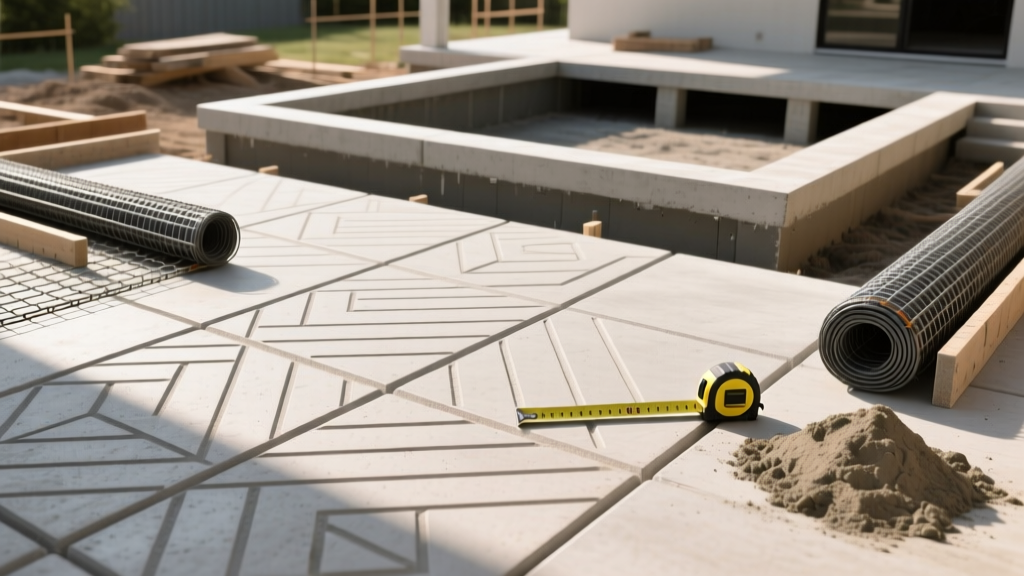
The True Cost of Stamped Concrete Patios in 2026
Estimating the cost of stamped concrete patios requires moving beyond basic square-foot averages. In 2026, national installation costs range from $14 to $28 per square foot, but this variance is driven by pattern complexity, coloring methods, and site-specific preparation. A 400-square-foot patio using a single-color seamless skin texture will cost approximately $6,400, while the same footprint featuring a multi-color ashlar slate pattern with custom saw-cut borders and integral color can exceed $11,200.
To build an accurate budget, you must calculate both the raw material quantities (concrete yardage, color hardener, release agents, and sealers) and the localized labor variables. According to data from HomeGuide, material costs typically account for 30% to 40% of the total project, with labor, equipment, and site prep consuming the remainder.
Step-by-Step Quantity Calculator for Materials
Accurate material estimation prevents mid-pour shortages, which can cause cold joints and ruin a stamping schedule. Below is the mathematical framework for a standard 400-square-foot patio with a 4-inch thickness.
1. Calculating Concrete Yardage (The 3D Math)
Standard residential patios require a 4-inch thick slab. The formula to convert square footage to cubic yards is: (Length × Width × Depth in feet) ÷ 27.
- Base Volume: 400 sq ft × 0.33 ft (4 inches) = 132 cubic feet.
- Cubic Yards: 132 ÷ 27 = 4.88 cubic yards.
- Waste & Grade Factor: Always add 10% to account for subgrade irregularities, formwork spillage, and pump truck hose retention. 4.88 + 10% = 5.37 cubic yards.
Order 5.5 cubic yards of concrete. For stamped applications, specify a 4,000 PSI mix design with a 3/4-inch maximum aggregate size, a 4-to-5-inch slump, and synthetic fiber mesh reinforcement. If you live in a freeze-thaw climate, the Portland Cement Association mandates an air-entrainment level of 5% to 7% to prevent surface spalling.
2. Color Hardener & Release Agent Estimates
Surface coloring is achieved through broadcast color hardener and antiquing release agents. Coverage rates vary by pigment density; darker colors (like terra cotta or slate gray) require more material to achieve opacity than lighter tones.
- Color Hardener: Apply at a rate of 1.5 lbs per square foot for dark colors, or 1.0 lbs for light colors. For a 400 sq ft dark patio: 400 × 1.5 = 600 lbs. At 60 lbs per bucket, you need 10 buckets.
- Antiquing Release Agent: This powder prevents the polyurethane stamp mats from sticking to the wet concrete while providing secondary color veining. Coverage is roughly 1 lb per 100 sq ft. For 400 sq ft, you need 4 to 5 lbs (one standard pail).
3. Sealer & Adhesion Promoter
A solvent-based acrylic sealer (such as a xylene-carrier formula) is industry standard for exterior stamped concrete, providing UV stability and a wet-look finish that enhances the release agent colors.
- Coverage: 300 square feet per gallon for two coats.
- Calculation: 400 sq ft ÷ 300 = 1.33 gallons per coat. For two coats, you need 2.66 gallons. Purchase 3 gallons of sealer and 1 gallon of xylene solvent for cleanup and future spot-repairs.
Material Coverage & Unit Cost Matrix
The following table outlines 2026 unit costs for professional-grade stamping materials. Prices reflect contractor-packaging sizes (e.g., 60-lb pails) rather than retail big-box store equivalents, which often lack the necessary pigment concentration for exterior durability.
| Material Component | Standard Unit Size | Average Coverage Rate | 2026 Unit Cost |
|---|---|---|---|
| 4,000 PSI Fiber-Mesh Concrete | 1 Cubic Yard | 81 sq ft (at 4" thick) | $165 - $195 |
| Broadcast Color Hardener | 60 lb Bucket | 60 - 90 sq ft | $65 - $85 |
| Antiquing Release Agent | 10 lb Pail | 200 - 300 sq ft | $45 - $60 |
| Polyurethane Stamp Mat Set | Daily Rental (6-8 mats) | N/A (Tooling) | $150 - $250 / day |
| Solvent-Based Acrylic Sealer | 5 Gallon Pail | 1,500 sq ft (two coats) | $220 - $280 |
| Anti-Slip Additive (SharkGrip) | 1 lb Bag | Mixes into 1 gallon sealer | $18 - $25 |
Labor vs. DIY: Breaking Down Installation Costs
While the material math is straightforward, labor is where budgets fluctuate wildly. Stamping concrete is a time-sensitive operation. Once the concrete reaches its initial set, the window for imprinting closes rapidly. According to the Concrete Network, a professional crew of four can stamp approximately 1,000 square feet in a single day under optimal weather conditions.
Labor Cost Tiers
- Basic Stamping (Seamless Skins / Single Color): $6 to $9 per sq ft. Requires fewer mats and less detail work on edges.
- Mid-Range (Ashlar Slate / Cobblestone / Two Colors): $10 to $14 per sq ft. Requires precise mat alignment, hand-chiseling at edges, and washing off excess release agent.
- High-End (Custom Borders / Stained Accents / Saw-Cuts): $15 to $20+ per sq ft. Involves multiple pours, intricate forming, and post-cure acid staining.
Hidden Costs & Edge Cases That Blow Budgets
Estimators frequently miss site-specific variables that add thousands to the final invoice. Factor these into your calculator before signing a contract:
- Demo and Haul-Away: Removing an existing 400 sq ft concrete patio costs $4 to $8 per square foot, including dump fees. If heavy machinery cannot access the backyard, manual demolition and wheelbarrow hauling will double this rate.
- Subgrade Preparation: Expansive clay soils require over-excavation (6 to 8 inches) and a compacted base of 3/4-inch minus gravel. Budget $1.50 to $3.00 per square foot for base material and mechanical compaction.
- Concrete Pump Trucks: If a ready-mix truck cannot back directly up to the forms (e.g., narrow side yards, fences, or overhead wires), you must hire a boom pump. Expect a flat mobilization fee of $800 to $1,200, plus an hourly rate.
- Forming Complex Curves: Bending Masonite or kerfing 2x4s for radius edges increases carpentry labor by 20% to 30% compared to standard 90-degree corners.
Expert Subgrade Warning: Never stamp concrete directly over uncompacted topsoil or tree root zones. Differential settling will cause the rigid 4-inch slab to snap. Always over-excavate to stable subgrade and use a laser transit to ensure a minimum 1/8-inch per foot slope away from the home's foundation for drainage.
Stamped Concrete vs. Interlocking Pavers
Homeowners frequently cross-shop stamped concrete patios against interlocking concrete pavers. Below is a direct comparison of the long-term financial and structural implications.
- Initial Installation Cost: Stamped concrete ($14–$22/sq ft) is generally 15% to 25% cheaper than high-end pavers ($18–$30/sq ft) because it eliminates the cost of the sand-setting bed and individual unit placement.
- Maintenance Cycle: Pavers require polymeric sand re-application every 3 to 5 years and occasional weed pulling. Stamped concrete requires power washing and resealing every 2 to 4 years ($0.75 to $1.25 per sq ft).
- Failure Modes: Pavers shift and settle but can be individually lifted and re-leveled. Stamped concrete is monolithic; if the subgrade washes out, the slab will crack and require mudjacking or full replacement. Control joints (saw cuts) are mandatory in stamped concrete to dictate where shrinkage cracks occur, which slightly disrupts the visual pattern.
Long-Term Maintenance & Resealing Projections
The lifespan of a stamped concrete patio is directly tied to its sealer integrity. UV radiation and freeze-thaw cycles degrade acrylic resins. Plan to reseal the patio every 24 to 36 months. For a 400-square-foot patio, hiring a professional to clean, prep, and apply two coats of solvent-based sealer will cost between $350 and $550 in 2026. If you DIY the resealing, material costs drop to approximately $150, but you must carefully broadcast an anti-slip additive (like SharkGrip) into the final wet coat to prevent the surface from becoming dangerously slick when wet.
Frequently Asked Questions
Will the color fade over time?
Integral colors and UV-stable color hardeners do not fade, but the acrylic sealer degrades, making the concrete look chalky and washed out. Resealing instantly restores the original color depth and contrast.
Can stamped concrete be installed over an existing patio?
Overlay stamping is possible using polymer-modified micro-toppings (1/4 inch thick), but it is highly susceptible to delamination if the existing slab has any structural cracks or moisture vapor transmission issues. Full demolition and replacement is the safer long-term investment.
How long before I can walk or place furniture on it?
Foot traffic is permitted after 24 to 48 hours. However, you must wait a minimum of 7 to 10 days before placing heavy patio furniture or grills, and 28 days for the concrete to reach its full 4,000 PSI design strength.