Textured Concrete Applications: A Scenario Matching Guide
Discover the best applications for textured concrete. Match specific stamping, broom, and exposed finishes to pool decks, driveways, and interiors.
The Physics of Surface Friction and Texture Depth
Selecting the correct textured concrete profile is fundamentally an exercise in managing the Static Coefficient of Friction (SCOF) and thermal conductivity. A smooth steel-troweled finish yields an SCOF of roughly 0.4, which becomes dangerously slick when wet. By introducing texture, you alter the surface topography to increase mechanical interlock with footwear or tires. The Americans with Disabilities Act (ADA) recommends an SCOF of 0.6 for flat walking surfaces and 0.5 for ramps, dictating that texture depth must be precisely calibrated to the expected moisture and shear forces of the environment.
Scenario Matrix: Matching Texture to Environment
Not all textures perform equally across different microclimates. Use this decision matrix to align the physical properties of the texture with the environmental demands of the project.
| Texture Type | Profile Depth | Optimal Scenario | Contraindicated Scenario | Required Sealer Chemistry |
|---|---|---|---|---|
| Transverse Broom | 1/16' to 1/8' | Driveways, municipal sidewalks, ramps | Interior floors, barefoot pool decks | Silane/Siloxane penetrating |
| Exposed Aggregate | 3/8' to 1/2' | High-traction walkways, steep aprons | Snow-plow routes, wheelchair pathways | Acrylic cure-and-seal (UV stable) |
| Knockdown (Splatter) | 1/8' peaks | Pool decks, sunrooms, outdoor kitchens | Heavy vehicular traffic, driveway aprons | Water-based acrylic or urethane |
| Seamless Stamp | 1/4' to 3/8' | Patios, commercial plazas, courtyards | High-shear turning radii, steep grades | Breathing penetrating sealer |
Vehicular and High-Shear Zones: Driveways and Aprons
Driveways subject concrete to two distinct forces: vertical compression and horizontal shear from tire pivoting. The most common failure in textured driveway applications is the delamination of stamped overlays or the tearing of deep-ridge stamp mats under the torque of heavy SUVs.
The Case for Transverse Broom and Light Exposed Aggregate
For primary vehicular zones, a transverse broom finish (pulling the broom perpendicular to the direction of travel) remains the gold standard. It provides an SCOF exceeding 0.7 when wet, allowing for rapid water channeling. If an aesthetic upgrade is required, light exposed aggregate utilizing 3/8-inch river rock is highly effective. The American Concrete Institute (ACI) notes that exposing the aggregate removes the weak surface mortar layer, revealing the high-compressive-strength stone beneath.
Wet and Barefoot Environments: Pool Decks and Patios
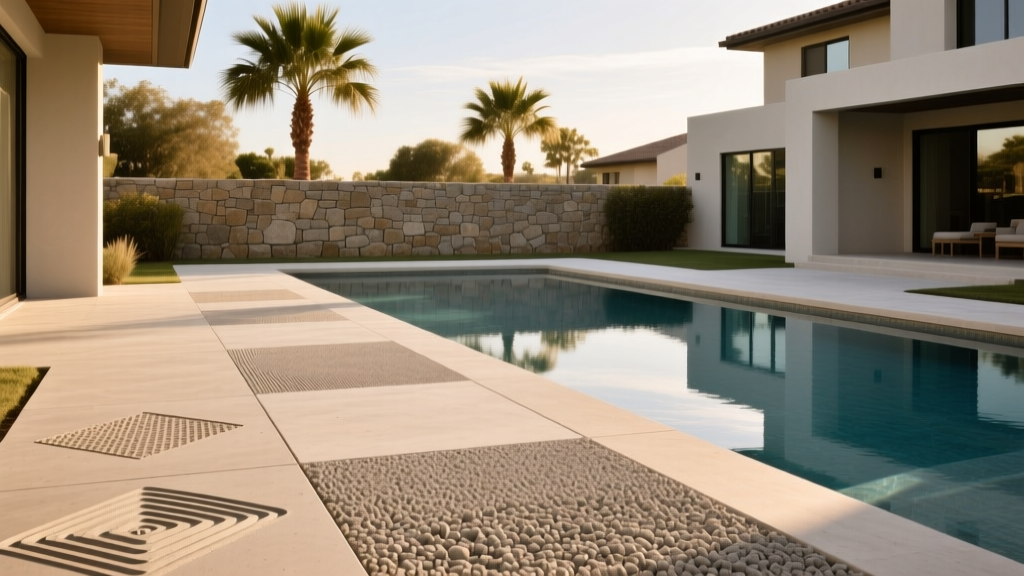
Pool decks require a delicate balance: the surface must be slip-resistant when saturated with chlorinated or salt water, yet smooth enough to prevent abrasions to bare feet. Furthermore, thermal conductivity is a critical, often overlooked factor. Dark, dense concrete can reach 130°F in direct summer sunlight, causing severe burns.
Knockdown Texture and Thermal Mitigation
Knockdown (or splatter) texture is applied by spraying a polymer-modified cementitious overlay and immediately knocking down the peaks with a trowel. This creates a 1/8-inch stippled profile that provides excellent wet-traction while remaining comfortable on bare feet. More importantly, the application of light-colored integral pigments (such as Butterfield Color PermaCast in 'Sandalwood') combined with the air pockets created by the knockdown texture reduces thermal mass transfer, keeping surface temperatures up to 20°F cooler than smooth, dark concrete.
Interior and Commercial Spaces: Micro-Textures and Grit Additives
Interior concrete demands high cleanability and low rolling resistance for carts and furniture, which rules out aggressive broom or exposed aggregate finishes. However, highly polished concrete can become a slip hazard during wet cleaning or in entryways tracking in rain.
The solution is micro-texturing via grit additives or controlled honing. Instead of polishing to a 3,000-grit burnished finish, commercial floors should be honed to an 80-grit or 120-grit metal-bond resin threshold. This leaves microscopic scratches that provide a 'micro-bite' for rubber soles without compromising the ability to auto-scrub the floor. For entryways, integrating aluminum oxide grit additives (like Euclid Chemical EUCO DIAMOND HARD with broadcast aggregate) into the final sealer coat provides localized slip resistance without altering the overall floor profile.
Critical Failure Modes and Edge Cases
Understanding how textured concrete fails is just as important as knowing how to install it. Texture alters the surface-area-to-volume ratio, which directly impacts moisture ingress and freeze-thaw durability.
Spalling on Exposed Aggregate from De-icing Salts
Exposed aggregate is highly vulnerable to winter de-icing chemicals. The Portland Cement Association (PCA) emphasizes that freeze-thaw resistance relies on a microscopic air-void system (typically 5% to 7% air entrainment). When calcium chloride or rock salt melts snow, the resulting brine is absorbed into the exposed stone pores. Upon refreezing, the hydraulic pressure exceeds the tensile strength of the mortar matrix, causing 'pop-outs' where the aggregate violently ejects from the surface. Fix: Mandate the use of air-entraining admixtures at the batch plant and strictly prohibit calcium-based de-icers; specify calcium magnesium acetate (CMA) instead.
Sealer Blushing on Stamped Concrete
Stamped concrete features deep valleys that trap moisture vapor migrating up from the subgrade. If a non-breathable solvent-based acrylic sealer is applied, the vapor becomes trapped beneath the film. When the sun heats the slab, the vapor expands, creating white, cloudy patches known as 'blushing' or delamination. Fix: For exterior stamped concrete, abandon film-forming acrylics. Use a penetrating, breathable silane/siloxane sealer like Prosoco Consolideck Siloxa-Tek 8500, which lines the pores without capping the surface, allowing vapor transmission while repelling liquid water.
Cost Implications by Texture Type (2026 Market Rates)
Budgeting for textured concrete requires factoring in both the initial installation premium and the long-term maintenance cycle. The following data reflects national averages for residential and light-commercial applications.
| Texture Application | Installed Cost (per Sq. Ft.) | Maintenance Cycle | Lifetime Cost Factor |
|---|---|---|---|
| Standard Broom Finish | $6.50 - $8.50 | Seal every 3-5 years | Low |
| Exposed Aggregate (New Pour) | $10.00 - $14.00 | Seal every 2-3 years | Medium |
| Knockdown Overlay (Existing Slab) | $9.00 - $13.00 | Seal every 2-4 years | Medium |
| Seamless Stamp (New Pour) | $14.00 - $22.00 | Reseal every 1-2 years | High |
Decision Flowchart: Selecting Your Texture
Use this logical progression to finalize your specification:
- Step 1: Is the zone subject to vehicular shear?
- Yes: Restrict to Transverse Broom or light (3/8') Exposed Aggregate.
- No: Proceed to Step 2.
- Step 2: Will the surface be frequently saturated with water or walked on barefoot?
- Yes: Specify Knockdown overlay or light Salt Finish. Avoid sharp exposed aggregate.
- No: Proceed to Step 3.
- Step 3: Is high aesthetic mimicry (stone/brick) required for a pedestrian plaza or patio?
- Yes: Utilize Seamless Stamp mats with a 1/4' relief profile. Specify penetrating siloxane sealers to prevent vapor trapping.
- No: For interior or commercial flat-work, specify an 80-grit honed finish with localized aluminum oxide grit additives at entryways.