Cement Sealer Performance Ratings and Specifications Guide
Master cement sealer performance ratings. Compare ASTM standards, MVT limits, and chemical specs for siloxane, epoxy, and polyurethane sealers.
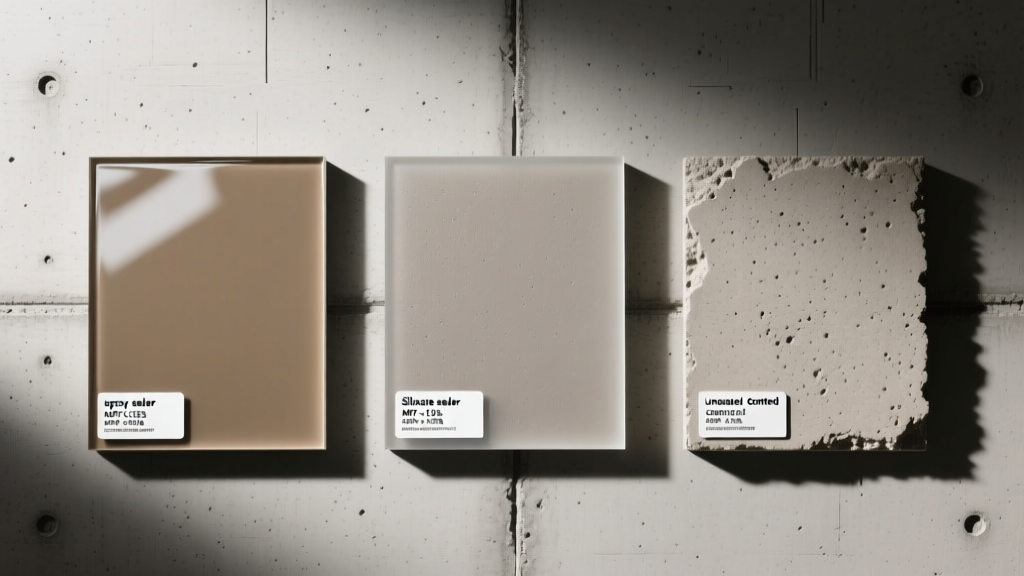
Decoding Cement Sealer Performance Ratings
Marketing brochures for cement sealers frequently rely on subjective terms like "heavy-duty" or "premium protection." For architects, specifiers, and contractors, these adjectives are useless. True performance is dictated by standardized laboratory metrics, chemical formulations, and substrate compatibility. Selecting the wrong chemistry based on superficial claims leads to catastrophic failure modes: osmotic blistering, UV degradation, delamination, and trapped efflorescence. This guide strips away the marketing layer to analyze the exact ASTM standards, chemical specifications, and environmental limits that govern cement sealer performance in 2026.
ASTM & NCHRP Standards: The Metrics That Matter
When evaluating a sealer's technical data sheet (TDS), look for verifiable test results rather than proprietary in-house metrics. The following industry standards form the baseline for structural and aesthetic durability.
| Standard | Test Name | What It Measures | Minimum Acceptable Spec |
|---|---|---|---|
| ASTM C1583 | Tensile Pull-Off Strength | Adhesion of film-forming sealers to the cementitious substrate. | >200 psi (concrete failure, not adhesive failure) |
| ASTM D4060 | Taber Abrasion Resistance | Wear resistance of film-forming coatings under abrasive traffic. | <50 mg weight loss (CS-10 wheel, 1000g, 1000 cycles) |
| NCHRP 244 | Chloride Ion Penetration | Reduction in water and chloride absorption for penetrating sealers. | >80% reduction vs. untreated control |
| ASTM F2170 | In-Situ Relative Humidity | Substrate moisture levels prior to applying impermeable film sealers. | <75% RH at 40% slab depth |
| ASTM G154 | Accelerated UV Weathering | Resistance to yellowing, chalking, and gloss loss under UV exposure. | <2.0 Delta E color shift after 2000 hours |
According to the Portland Cement Association, penetrating sealers must demonstrate a minimum 80% reduction in water absorption via NCHRP 244 to be considered effective against freeze-thaw scaling. If a manufacturer cannot provide third-party verified NCHRP 244 or ASTM C1583 data, exclude the product from your specification.
Penetrating vs. Film-Forming: Specification Matrix
The fundamental decision in sealer specification is whether to block moisture from entering the pores (penetrating) or to bridge the surface with a continuous membrane (film-forming). Below is a direct comparison of the primary chemistries used in commercial and residential applications.
| Chemistry | Type | Penetration Depth | Dry Film Thickness (DFT) | Breathability | UV Stability | Material Cost (per sq ft) |
|---|---|---|---|---|---|---|
| Silane (Solvent/Water) | Penetrating | 1/4" to 3/8" | 0 mils | 100% | Excellent | $0.25 - $0.45 |
| Siloxane (Water-based) | Penetrating | 1/8" to 1/4" | 0 mils | 100% | Excellent | $0.15 - $0.25 |
| Aliphatic Polyurethane | Film-Forming | Surface only | 2 - 3 mils | Low | Excellent | $0.80 - $1.30 |
| 100% Solids Epoxy | Film-Forming | Surface only | 10 - 15 mils | None | Poor (Ambers) | $2.50 - $4.00 |
| Acrylic (Solvent-based) | Film-Forming | Surface only | 1 - 2 mils | Medium | Good | $0.20 - $0.35 |
Moisture Vapor Transmission (MVT) and Delamination Risks
The most common cause of catastrophic film-forming sealer failure is ignoring Moisture Vapor Transmission (MVT). Concrete is inherently porous and continuously wicks moisture from the subgrade. When an impermeable film-forming sealer (like a 100% solids epoxy or high-build polyurethane) is applied to a slab with high internal moisture, the hydrostatic pressure builds beneath the coating.
Do not apply non-breathable film-forming sealers if in-situ relative humidity (ASTM F2170) exceeds 75%, or if calcium chloride testing (ASTM F1869) exceeds 3 lbs/1000 sq ft/24 hours. Exceeding these limits will result in osmotic blistering within 30 to 90 days, requiring complete mechanical scarification and reapplication. If MVT exceeds these limits, specify a moisture-mitigating epoxy primer or switch to a 100% breathable penetrating silane.
Penetrating sealers do not suffer from MVT failure because they do not form a surface membrane. They line the capillary pores with hydrophobic resins while leaving the pore structure open enough to allow water vapor to escape. This makes silanes and siloxanes the only viable specification for exterior slabs-on-grade without a functioning vapor barrier beneath the slab.
VOC Specifications and 2026 Regulatory Limits
Volatile Organic Compound (VOC) regulations strictly dictate which solvent-based sealers can be legally sold and applied in various jurisdictions. The Environmental Protection Agency (EPA) enforces the Architectural and Industrial Maintenance (AIM) coatings rule, but local air quality management districts often impose stricter limits.
- Federal AIM Limit: 400 g/L for non-flat concrete coatings and sealers.
- SCAQMD Rule 1113 (California/South Coast): 100 g/L for concrete protective sealers (as of 2026 enforcement).
- LEED v4.1 Compliance: Requires VOC content below the SCAQMD Rule 1113 thresholds to earn indoor environmental quality credits.
To meet strict VOC limits without sacrificing penetration depth, formulators have shifted to high-solids, low-VOC solvent carriers (like acetone or tertiary butyl acetate, which are VOC-exempt in some regions) or advanced water-based emulsions. When specifying for LEED-certified projects or strict municipal zones, explicitly require the TDS to state compliance with SCAQMD Rule 1113, not just federal EPA AIM limits.
Substrate-Specific Selection Framework
Use the following decision matrix to align the cement sealer chemistry with the specific environmental and structural demands of the project.
Scenario A: Exterior Stamped Concrete with UV Exposure
The Challenge: Stamped concrete requires color enhancement and UV protection, but exterior slabs-on-grade are subject to high MVT and freeze-thaw cycles.
The Specification: Apply a high-solids solvent-based acrylic (for initial color wetting and aesthetic enhancement), followed by a topcoat of aliphatic polyurethane for UV and abrasion resistance. Alternatively, use a non-yellowing water-based polyurethane dispersion (PUD) formulated with UV absorbers. Never use aromatic polyurethanes or epoxies, as they will amber and degrade under direct sunlight within 12 months.
Scenario B: Exterior Bridge Decks and Marine Structures
The Challenge: Extreme chloride ion ingress from de-icing salts or seawater, leading to rebar corrosion and spalling.
The Specification: 100% active silane. Silane molecules are significantly smaller than siloxanes, allowing them to penetrate dense, high-strength structural concrete (typically >4,000 psi). Specify a minimum application rate of 150 sq ft per gallon to ensure deep pore lining. Verify performance via NCHRP 244 testing demonstrating >90% chloride reduction.
Scenario C: Interior Industrial Warehouse Flooring
The Challenge: Heavy forklift traffic, chemical spills, and zero UV exposure. MVT is controlled by a sub-slab vapor barrier.
The Specification: 100% solids bisphenol-A epoxy base coat (10-12 mils DFT) for maximum chemical resistance and compressive strength, top-coated with an aliphatic polyurethane (2-3 mils DFT) to provide Taber abrasion resistance and ease of cleaning. The epoxy provides the structural build and adhesion (ASTM C1583 >300 psi), while the polyurethane sacrifices itself to physical abrasion, protecting the epoxy underneath.
For comprehensive guidelines on surface preparation and application tolerances, always cross-reference the American Concrete Institute (ACI) committee reports on surface treatments and protective coatings. Proper specification is only half the battle; ensuring the concrete surface profile (CSP) is achieved via diamond grinding or shot blasting prior to film-forming application is mandatory for achieving the rated pull-off strengths.