White Cement Selection Guide: Grades, Costs, and Mix Designs
Compare white cement grades, costs, and mix designs. Learn when to specify white Portland cement for architectural concrete and decorative finishes.
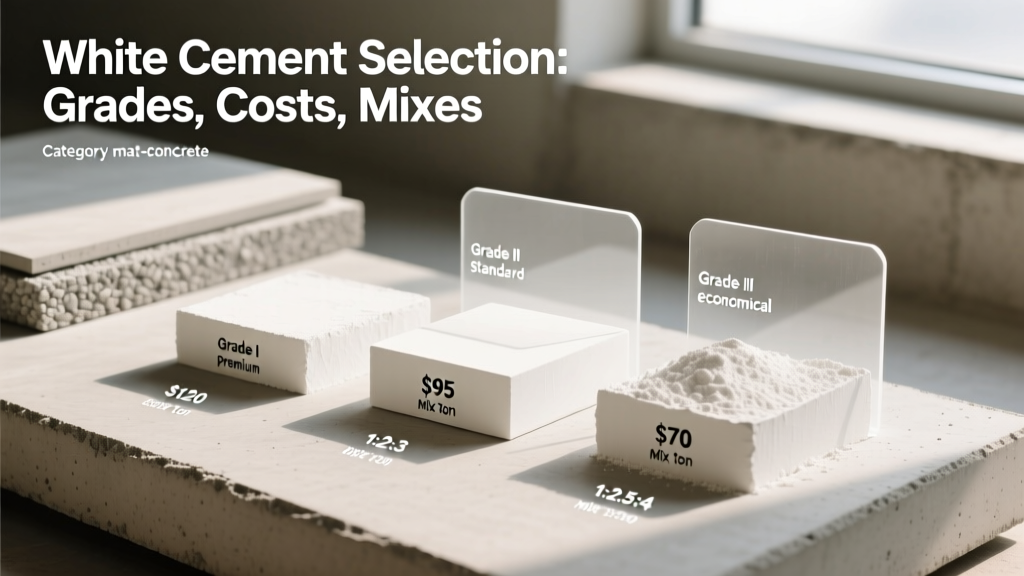
The Metallurgical Taxonomy of White Portland Cement
White Portland cement is not merely a dyed or bleached version of standard gray cement; it is a fundamentally distinct hydraulic binder produced through strict metallurgical control. The color of standard gray cement is primarily derived from tetracalcium aluminoferrite (C4AF), which contains iron oxide (Fe2O3) and manganese. To achieve a true white hue, manufacturers must restrict the iron oxide content to less than 0.5% and manganese to less than 0.1%.
This chemical restriction alters the raw material sourcing. Instead of standard clay and shale, white cement is manufactured using kaolin clay and white quartz sand. Furthermore, the kiln firing process requires oil or natural gas rather than coal, preventing the introduction of gray coal ash into the clinker. According to the Portland Cement Association, the resulting clinker is ground with white limestone or titanium dioxide to achieve the final brilliant white powder. Because the C4AF phase is virtually eliminated, the fluxing action it normally provides in the kiln is lost, requiring higher firing temperatures (up to 3000°F) and resulting in a significantly higher manufacturing cost.
White vs. Gray Cement: Performance and Cost Matrix
Structurally, white cement performs identically to its gray counterpart when matched to the equivalent ASTM C150 specification. However, the absence of iron and the differing particle size distribution (white cement is often ground finer to compensate for early strength) create distinct behavioral profiles in the field.
| Metric | Standard Gray Cement (Type I) | White Portland Cement (Type I) |
|---|---|---|
| Approximate Cost (94lb Bag) | $12.00 - $16.00 | $38.00 - $48.00 |
| Iron Oxide (Fe2O3) Content | 2.5% - 5.0% | < 0.5% |
| Fineness (Blaine Air Permeability) | 3,200 - 3,500 cm²/g | 3,800 - 4,500 cm²/g |
| Heat of Hydration (7 Days) | Moderate | Slightly Higher (due to fineness) |
| Primary Application | Structural, Flatwork, Foundations | Architectural Precast, Terrazzo, Decorative |
Selecting the Correct ASTM Grade for Architectural Use
When specifying white cement, you must align the ASTM designation with the structural and scheduling demands of your project. The American Concrete Institute (ACI) Committee 242 provides extensive guidelines on architectural concrete, emphasizing that the cement type dictates the forming and stripping schedule.
Type I: General Architectural Applications
White Type I is the baseline specification for cast-in-place architectural walls, site-cast pavers, and standard terrazzo floors. It offers a standard rate of strength gain, reaching approximately 2,500 psi at 3 days and 4,000+ psi at 28 days. This is the correct choice for projects where forms can remain in place for 48 to 72 hours without impacting the critical path.
Type III: High Early Strength for Precast Operations
White Type III is ground significantly finer and features a higher tricalcium silicate (C3S) content. It achieves 3,000+ psi within 24 hours. This grade is mandatory for precast concrete plants manufacturing architectural cladding panels, glass fiber reinforced concrete (GFRC) shells, and complex 3D-printed concrete elements where rapid demolding is required to maintain production throughput.
White Masonry Cement (Types N, S, and M)
For mortar applications rather than structural concrete, specify white masonry cement. Type N is used for exterior veneer and parapets, Type S for structural masonry and below-grade block, and Type M for high-load bearing walls. These products are pre-blended with hydrated lime and air-entraining agents to ensure workability and water retention in thin-set applications.
Mix Design: Aggregates, Water, and Pigment Loading
The most frequent failure in white concrete specification is ignoring the aggregate. White cement is merely the binder; the aggregate constitutes 60% to 75% of the mix volume. If you mix white cement with standard river sand or crushed gray limestone, the resulting concrete will be a mottled light gray, not white.
Optimal Proportions and Pigment Integration
While white cement is often used to achieve a pure white finish, it is also the premier base for integrally colored concrete. Because the base is white, pigments do not have to overcome the dark undertones of gray cement.
- Water-to-Cement (w/c) Ratio: Maintain a strict w/c ratio between 0.40 and 0.45. Higher water content increases capillary porosity, which darkens the surface appearance and invites efflorescence.
- Pigment Loading Limits: Synthetic iron oxide pigments should be limited to 3% to 5% by weight of the cementitious material. Because of the white base, achieving bright pastels (yellows, light blues, soft reds) requires only 1% to 2% pigment loading, compared to the 4% to 6% required for gray cement.
- Supplementary Cementitious Materials (SCMs): Avoid standard fly ash (which is gray) and slag cement. If SCMs are required for heat reduction or LEED credits, specify white metakaolin or silica fume, which will not alter the color profile.
Curing Protocols and Efflorescence Mitigation
Architectural white concrete is highly unforgiving during the curing phase. Standard curing methods used in gray flatwork will cause permanent staining or discoloration on white surfaces.
Do not use standard brown burlap for wet curing. The tannins and dyes in standard burlap will leach into the concrete, leaving permanent yellow and brown streaks. If wet curing is required, specify polyethylene sheets or white burlap-poly blankets.
Do not use standard liquid membrane-forming curing compounds. Many standard curing compounds are tinted yellow or brown for visibility during application. You must specify clear, dissipating resin-based curing compounds that meet ASTM C309 Type 1 (clear, non-staining). Alternatively, use water-based acrylic sealers that penetrate and cure without leaving a visible surface film.
Efflorescence—the migration of soluble calcium hydroxide to the surface where it carbonates into white calcium carbonate—is ironically less visible on white concrete than on gray, but it still alters the surface texture and gloss. To mitigate this, integrate a liquid stearate-based waterproofing admixture at the batch plant to reduce capillary water movement, and ensure the concrete is densified with a lithium silicate hardener after 28 days of curing.
Procurement and Supply Chain Realities
Unlike gray cement, which is produced at dozens of regional kilns and available on demand, white cement production is highly consolidated. In North America, only a handful of facilities (such as those operated by Heidelberg Materials and CEMEX) manufacture true white Portland cement.
When estimating project costs, factor in the logistics. White cement is rarely available in bulk pneumatic tankers outside of major metropolitan precast hubs. It is predominantly shipped in 94lb multi-wall paper bags or 3,000lb super sacks. For large cast-in-place architectural pours requiring 100+ cubic yards, you must coordinate with the batch plant weeks in advance to ensure they have physically siloed the white cement and thoroughly purged their mixer drums of residual gray slurry to prevent cross-contamination.