Blacktop vs Concrete: Mix Design, Durability, and Cost Analysis
Compare blacktop vs concrete mix designs, structural strength, and installation costs. Discover which paving material fits your project specs.
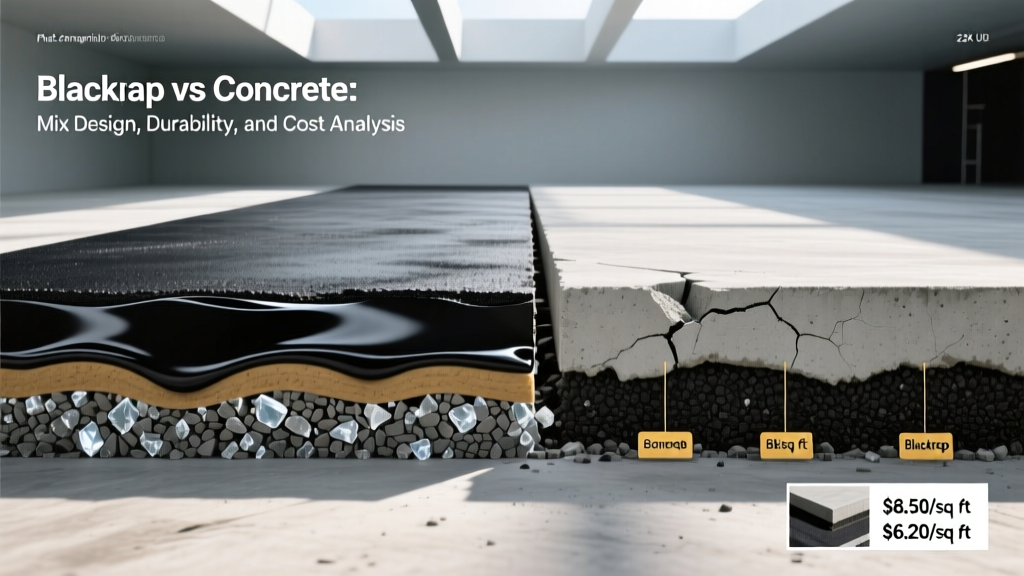
The Core Chemistry: Bitumen Binder vs. Portland Cement
When evaluating blacktop vs concrete for paving and structural applications, the fundamental divergence lies in the chemical binder holding the aggregates together. Blacktop, technically classified as Hot Mix Asphalt (HMA) concrete, relies on bitumen—a viscous, black hydrocarbon derived from the fractional distillation of crude oil. This binder is thermoplastic, meaning it softens when heated and hardens as it cools, providing a flexible matrix that accommodates minor subgrade shifts without snapping.
Conversely, Portland cement concrete utilizes a hydraulic cement binder. Produced by calcining limestone and clay at temperatures exceeding 1,450°C (2,642°F), Portland cement forms calcium silicates that undergo a hydration reaction when mixed with water. Unlike the thermoplastic nature of bitumen, cement hydration creates a rigid, crystalline matrix that continues to gain strength over decades. According to the American Concrete Institute, this rigid structure gives concrete its immense compressive strength but also dictates its vulnerability to tensile stress and freeze-thaw cycling if not properly engineered.
Aggregate Grading and Mix Proportions
Both materials are essentially composite rocks bound by glue, but their mix designs require entirely different engineering approaches to achieve optimal density and durability.
Standard Mix Proportions by Volume
- Blacktop (HMA): 94-96% crushed aggregates (stone, sand, mineral filler) and 4-6% asphalt binder (by weight of total mix).
- Concrete: 60-75% coarse and fine aggregates, 10-15% Portland cement, and 15-20% water (plus chemical admixtures).
Asphalt Binder Performance Grading (PG)
In modern blacktop mix design, the bitumen is specified using the Superpave Performance Grade (PG) system. For a standard driveway in a temperate climate, an engineer will specify a PG 64-22 binder. This indicates the asphalt will resist rutting at a maximum pavement temperature of 64°C (147°F) and resist thermal cracking down to -22°C (-8°F). The National Asphalt Pavement Association emphasizes that selecting the correct PG grade for the local microclimate is the single most critical factor in preventing premature surface deformation.
Concrete Water-Cement Ratio and Air Entrainment
Concrete mix design hinges on the water-cement (w/c) ratio. For exterior flatwork exposed to vehicle traffic and deicing salts, the w/c ratio must be kept at or below 0.45 to minimize capillary porosity. Furthermore, in regions experiencing freeze-thaw cycles, the mix must include air-entraining admixtures to create microscopic, disconnected air bubbles (typically 5-7% total air content). These bubbles act as internal expansion chambers, preventing the hydraulic pressure of freezing water from spalling the surface.
Structural Load Capacity and PSI Ratings
Comparing the structural capacity of blacktop vs concrete requires looking at different mechanical properties. Concrete is measured by its compressive and flexural strength, while blacktop is evaluated by its dynamic modulus and structural number (SN).
| Engineering Metric | Blacktop (HMA) | Portland Cement Concrete |
|---|---|---|
| Primary Strength Metric | Dynamic Modulus / Stability | Compressive Strength (psi) |
| Standard Target Value | 1,500,000+ psi (Stiffness at 70°F) | 4,000 psi (28-day compressive) |
| Flexural Strength (MR) | Highly flexible (bends under load) | 500 - 700 psi (rigid, requires joints) |
| Thickness for Driveways | 2 to 3 inches (over 6-8 inch base) | 4 to 5 inches (over 4-6 inch base) |
| Curing / Set Time | Cools and sets in 24-48 hours | 7 days for vehicles, 28 days for full cure |
Because concrete is a rigid pavement, it distributes vehicular loads over a wide area of the subgrade. Blacktop is a flexible pavement; it relies on a thick, heavily compacted crushed stone base to distribute loads downward in a cone shape. The Federal Highway Administration notes that while concrete requires less base material, blacktop requires a thicker aggregate foundation to prevent fatigue cracking under heavy axle loads.
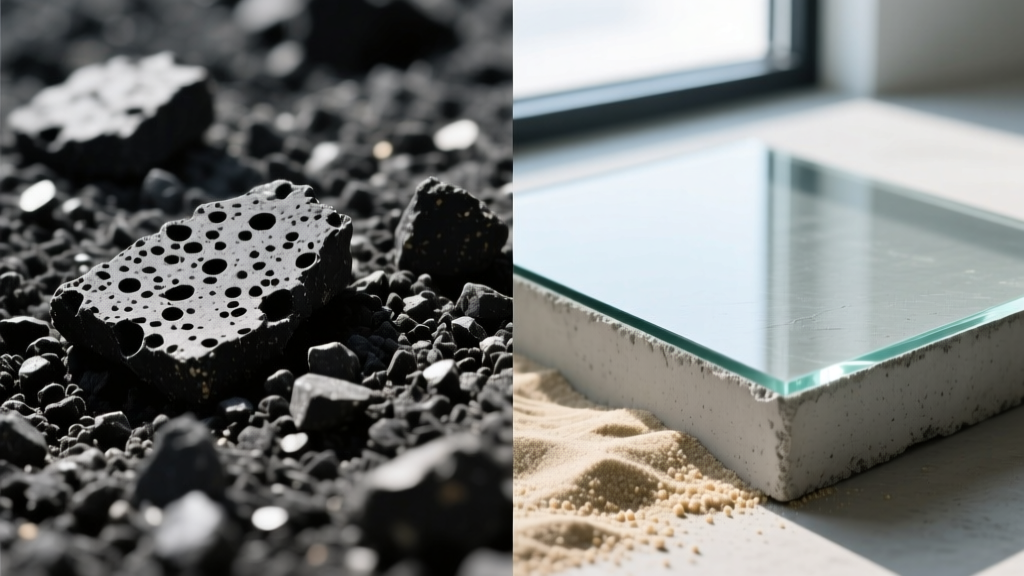
Failure Modes and Edge Cases
Understanding how these materials fail is critical for long-term mix design and maintenance planning.
Blacktop Failure Mechanisms
- Rutting: Occurs in high ambient temperatures when the asphalt binder softens and the aggregate matrix shifts under heavy, static, or slow-moving loads (e.g., garbage trucks or RVs parked for months).
- Oxidation and Raveling: UV radiation and oxygen cause the bitumen to lose its volatile oils, turning the surface gray and brittle. This leads to raveling, where the top layer of aggregate loosens and washes away.
- Petroleum Spills: Gasoline and oil act as solvents to the bitumen binder, rapidly dissolving the matrix and causing severe localized pitting.
Concrete Failure Mechanisms
- Scaling and Spalling: The application of magnesium chloride or calcium chloride deicers within the first year of placement destroys the surface mortar, especially if the concrete was finished with excess water (bleed water) troweled into the top layer.
- Joint Faulting: Concrete must be poured with control joints cut to a depth of 25% of the slab thickness. If joints are spaced too far apart (exceeding 10 feet for a 4-inch slab), the concrete will crack randomly to relieve tensile shrinkage stress.
- Alkali-Silica Reaction (ASR): A chemical reaction between the alkaline cement paste and reactive silica in certain aggregates, causing a gel to form, absorb water, expand, and map-crack the slab from the inside out.
Installation Timelines and Temperature Dependencies
Mix design is only half the battle; placement logistics heavily dictate the choice between blacktop vs concrete.
Temperature Placement Limits
Blacktop: Hot Mix Asphalt must be delivered and laid at temperatures between 275°F and 325°F. Paving cannot occur if the ambient temperature is below 45°F and dropping, as the mat will cool too rapidly to achieve proper compaction density.
Concrete: Concrete hydration slows dramatically below 50°F. In hot weather (above 90°F), the mix requires chilled mixing water and retarders to prevent flash-setting and plastic shrinkage cracking before finishing is complete.
Cost Breakdown: Material, Labor, and Lifecycle
Pricing for paving materials fluctuates based on regional aggregate availability and petroleum markets. The following reflects average national installed costs for standard residential and light-commercial applications.
- Blacktop Installation: $4.50 to $7.50 per square foot. This includes grading, a 6-inch compacted crushed stone base, and a 2.5-inch HMA surface course.
- Concrete Installation: $8.00 to $14.00 per square foot for a standard 4-inch slab with a broom finish and standard control joints. Stamped or exposed aggregate finishes push this to $16.00 - $22.00+ per square foot.
- Maintenance Lifecycle: Blacktop requires a sealcoat application every 3 to 5 years ($0.25 - $0.50 per sq ft) and typically requires a full mill-and-overlay after 15 to 20 years. Concrete requires virtually no surface maintenance beyond cleaning and joint caulking, with a structural lifespan of 30 to 50+ years.
The Decision Matrix: When to Specify Which Material
Use this framework to finalize your material specification based on project parameters:
Specify Blacktop (HMA) When:
- The budget is strictly constrained, and initial capital expenditure is the primary driver.
- The project is located in an extreme cold-weather climate where ground heaving is severe; blacktop's flexibility accommodates frost heave better, and patches are easier to execute in cold conditions.
- The pavement requires frequent utility trenching or subsurface access, as saw-cutting and patching asphalt is faster and cheaper than breaking and repouring rigid concrete.
- The surface must be opened to heavy traffic within 48 hours of placement.
Specify Portland Cement Concrete When:
- The project demands a lifespan exceeding 30 years with minimal ongoing maintenance budgets.
- The surface will be subjected to heavy, static point loads (e.g., boat trailers, RVs, or industrial dumpsters) that would cause blacktop to rut over time.
- The area is highly exposed to petroleum spills, such as a mechanic shop apron or gas station forecourt, where bitumen binders would dissolve.
- Aesthetic customization is required, including integral coloration, stamping, or polished finishes that asphalt cannot replicate.
Written by
David NakamuraDavid Nakamura is a licensed architect (AIA) and construction technology writer focused on sustainable building methods, mass timber engineering, and high-performance building envelopes. He holds a Master of Architecture from the University of Washington and is a certified Passive House Consultant (CPHC). David spent eight years at the Seattle firm Mithun, where he led the design of three LEED Platinum projects, before founding his own practice specializing in net-zero residential design. He serves on the editorial advisory board of GreenBuilder Magazine and has authored peer-reviewed papers on cross-laminated timber (CLT) connections for the Journal of Structural Engineering. In his spare time, David teaches woodworking at Pratt Fine Arts Center and kayaks the Puget Sound.
More from David Nakamura
View all
Construction Cost
Labor Cost to Build a Deck Per Sq Ft: 2026 Installation Guide
Discover the exact labor cost to build a deck per sq ft in 2026. This installation guide breaks down contractor rates, complexity factors, and hidden fees.
Aug 4, 2026

Construction Cost
How Much Does It Cost to Build a 3 Bedroom House? Financing Guide
Learn exactly how much it costs to build a 3 bedroom house and explore 2026 financing options, construction loan types, and budget frameworks for your build.
Aug 4, 2026

Construction Cost
Cost to Build a Tennis Court: 2026 Guide
How much does it cost to build a tennis court in 2026? Breakdowns for asphalt, concrete, and synthetic surfaces plus fencing and lighting.
Jul 30, 2026