Wire Mesh for Concrete: Durability, Lifespan, and Crack Control
Analyze how wire mesh for concrete impacts slab lifespan. Compare WWR gauges, corrosion risks, and installation protocols for 50-year durability.
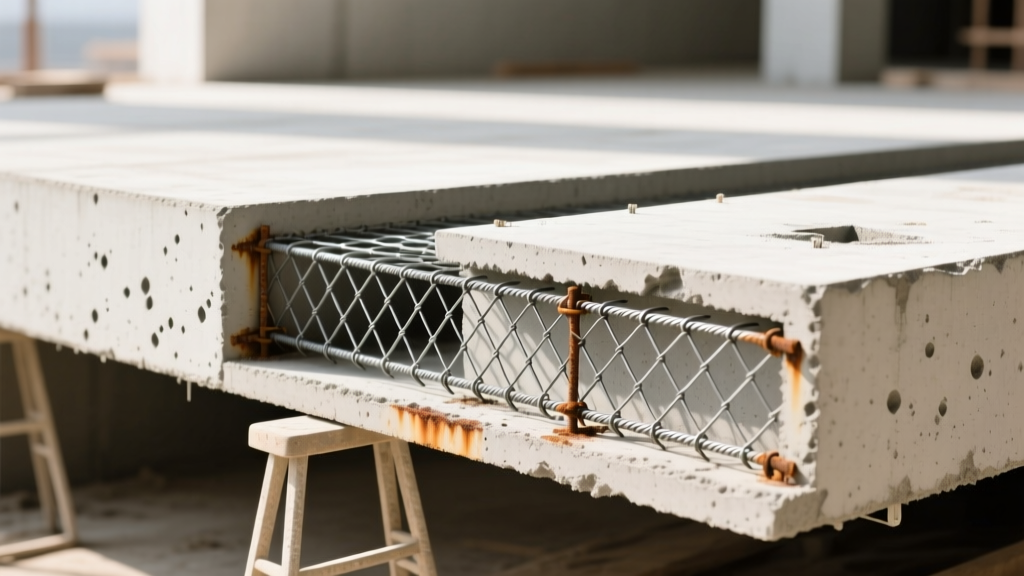
The Mechanics of Crack Control and Structural Lifespan
Concrete possesses exceptional compressive strength but is inherently weak in tension. As a concrete slab cures and undergoes volumetric shrinkage, tensile stresses develop. When these stresses exceed the concrete's modest tensile capacity (typically between 400 and 700 psi), micro-cracks form. Unreinforced concrete driveways and slabs-on-grade often experience severe map cracking within 15 to 20 years, allowing water ingress that accelerates freeze-thaw degradation and subgrade erosion.
Integrating wire mesh for concrete—technically classified as Welded Wire Reinforcement (WWR) or Welded Wire Fabric (WWF)—fundamentally alters the slab's lifecycle. WWR does not prevent shrinkage cracks from initiating; rather, it arrests their propagation. By bridging the micro-fissures, the mesh holds the crack faces tightly together. This maintains 'aggregate interlock,' preserving the structural continuity of the slab and preventing surface water from penetrating to the subbase. According to guidelines from the American Concrete Institute (ACI), properly positioned WWR can extend the functional, low-maintenance lifespan of a residential or light-commercial slab from 20 years to over 50 years.
Decoding ASTM A1064: Wire Gauge and Spacing Specifications
The durability of a reinforced slab is directly tied to the cross-sectional area of the steel used. In the United States, WWR is governed by ASTM A1064. The industry uses a 'W' designation system, which indicates the cross-sectional area of the wire in hundredths of a square inch. Selecting the wrong gauge for the anticipated load is a primary cause of premature slab failure.
| W-Designation | Imperial Gauge | Wire Diameter | Yield Strength (Min) | Primary Application & Lifespan Expectancy |
|---|---|---|---|---|
| W1.4 (6x6) | 10 Gauge | 0.135 in | 65,000 psi | Light-duty sidewalks, interior slabs-on-grade (30-40 years) |
| W2.0 (6x6) | 8 Gauge | 0.162 in | 65,000 psi | Residential garage floors, patios, light warehouse floors (40-50 years) |
| W2.9 (6x6) | 6 Gauge | 0.192 in | 65,000 psi | Driveways, commercial slabs, heavy vehicular traffic (50+ years) |
For standard 4-inch to 5-inch thick driveway slabs subject to passenger vehicles and occasional light trucks, W2.9 (6 gauge) at a 6x6 inch spacing is the minimum specification required to ensure long-term durability. Thinner gauges like W1.4 will yield under heavy point loads, rendering the reinforcement ineffective over time.
Corrosion Dynamics: Bare, Galvanized, and Epoxy-Coated Mesh
The ultimate limiting factor for the lifespan of steel-reinforced concrete is corrosion. When steel oxidizes, it compromises the slab from the inside out. The choice of mesh coating dictates the slab's resilience in aggressive environments, particularly in regions where chloride-based de-icing salts are used during winter.
When bare steel wire mesh oxidizes, the resulting iron oxide occupies up to 600% more volume than the original steel. This expansive force generates internal tensile stresses that easily exceed concrete's tensile capacity, leading to horizontal delamination and surface spalling. In environments with heavy de-icing salt exposure, bare mesh placed too close to the surface can trigger catastrophic spalling in as little as 12 to 15 years.
- Bare Black Steel (Standard): Relies entirely on the alkaline environment of the concrete (passivation layer) for corrosion protection. Suitable for interior slabs or exterior slabs in mild, dry climates where de-icing salts are not used.
- Galvanized (ASTM A153): Coated with a layer of zinc that acts as a sacrificial anode. Galvanized wire mesh for concrete extends the corrosion-free lifespan by 20 to 30 years in moderate chloride environments. It is highly recommended for residential driveways in northern climates.
- Epoxy-Coated (ASTM A884): Provides a physical barrier against moisture and chlorides. While offering the highest corrosion resistance, the coating is fragile; any scratches or cuts made during installation become focal points for accelerated localized pitting.
50-Year Durability Matrix: Wire Mesh vs. Rebar vs. Macro-Synthetic Fibers
When designing for maximum lifespan, engineers and contractors must choose the appropriate reinforcement strategy. Below is a comparative analysis of WWR against traditional rebar and modern macro-synthetic fibers.
| Reinforcement Type | Tensile Capacity | Shrinkage Crack Control | Corrosion Risk | 50-Year Lifespan Viability | Approx. Material Cost (per sq ft) |
|---|---|---|---|---|---|
| W2.9 Wire Mesh (6x6) | High (Continuous grid) | Excellent (Multi-directional) | Moderate (if bare) | High (if placed correctly) | $0.25 - $0.35 |
| #4 Rebar (12" o.c. grid) | Very High (Deep structural) | Poor (Wide spacing misses micro-cracks) | Moderate | Very High (Structural) | $0.60 - $0.85 |
| Macro-Synthetic Fibers | Moderate (Post-crack ductility) | Good (Three-dimensional dispersion) | None (Immune to rust) | High (No spalling risk) | $0.10 - $0.18 |
While National Ready Mixed Concrete Association (NRMCA) guidelines acknowledge the efficacy of macro-synthetic fibers for secondary shrinkage reinforcement, WWR remains superior for slabs requiring high tensile continuity and resistance to differential settlement over decades. Synthetic fibers cannot bridge large structural voids if the subgrade washes out, whereas W2.9 wire mesh can temporarily suspend the slab, preventing immediate collapse.
Critical Installation Protocols to Prevent Premature Failure
The most common cause of reduced lifespan in wire-mesh-reinforced concrete is improper placement. If the mesh is not positioned correctly within the slab cross-section, its structural benefits are nullified. Follow these non-negotiable installation protocols:
- Elevation and Support: Wire mesh must be located in the upper third of the slab thickness (for shrinkage control) or at the mid-depth (for general reinforcement). Never allow the mesh to rest directly on the subgrade or vapor barrier. Use continuous concrete 'dobies' or heavy-duty plastic chairs spaced every 3 to 4 feet to elevate the mesh. If the mesh is stepped on during the pour and pushed to the bottom, it provides zero shrinkage crack control.
- Lap Splicing: Adjacent sheets of WWR must overlap to transfer tensile stresses. The minimum lap splice length is 6 inches, or one full mesh spacing (whichever is greater). For W2.9 mesh at 6x6 spacing, a 6-inch overlap is mandatory. Secure the laps with tie wire every 12 inches to prevent the sheets from separating under the weight of the wet concrete and workers.
- Edge Clearances: Maintain a minimum 2-inch clearance from the edges of the slab and any formwork. Exposed mesh at the edges creates a direct pathway for moisture and chlorides to wick into the steel, initiating edge spalling.
- Subgrade Preparation: WWR controls cracking, but it does not compensate for a poor subgrade. Ensure the base material is compacted to 95% Proctor density. Differential settlement will snap even W2.9 mesh if the underlying soil shifts significantly.
Lifecycle Cost Analysis: The ROI of Reinforcement
Evaluating the cost of wire mesh for concrete requires a lifecycle perspective. Adding W2.9 galvanized wire mesh to a standard 4-inch driveway pour increases material costs by approximately $0.30 per square foot. For a 600-square-foot driveway, this represents an upfront investment of $180.
However, the cost to demolish, haul away, and repour a failed, heavily cracked, and spalled concrete driveway in 2026 averages between $8.00 and $12.00 per square foot. By spending $180 upfront on high-gauge, corrosion-resistant mesh and ensuring proper mid-slab elevation, homeowners and facility managers effectively insure against a $4,800 to $7,200 replacement expense. The durability gained by specifying the correct ASTM A1064 wire gauge and strictly enforcing placement protocols yields one of the highest returns on investment in modern concrete flatwork construction.