Full Blacktop vs Concrete Driveway Cost Analysis 2026
Compare the 2026 blacktop vs concrete driveway cost with our detailed breakdown. Analyze upfront pricing, 20-year maintenance, and base prep expenses.

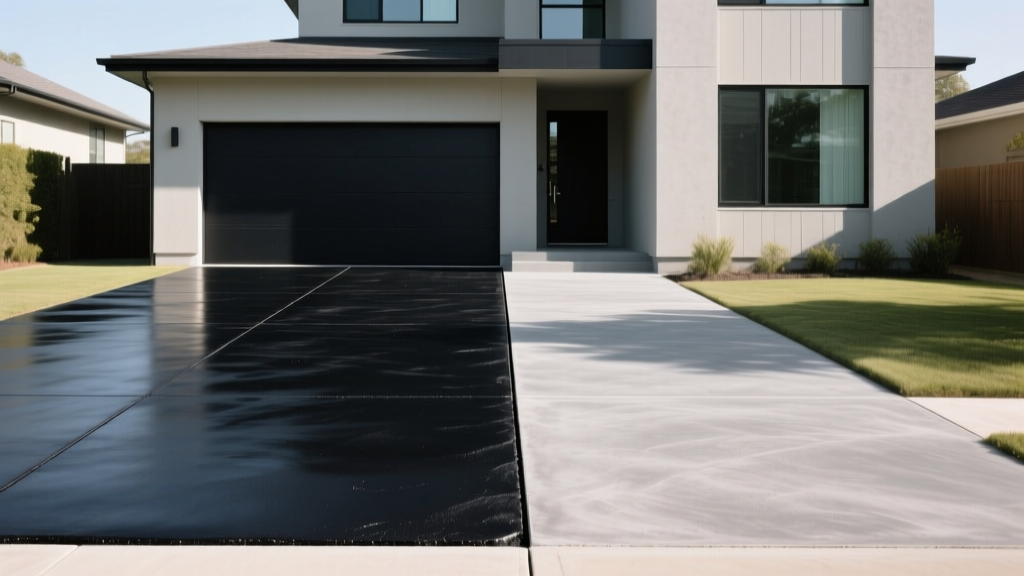
Evaluating the blacktop vs concrete driveway cost requires looking past the day-one installation invoice. While hot mix asphalt (HMA) presents a lower initial barrier to entry, concrete’s structural longevity fundamentally alters the 20-year total cost of ownership (TCO). In 2026, material supply chain shifts and labor rates have narrowed the gap between premium asphalt installations and basic concrete pours, making a granular cost breakdown essential for property owners.
The Baseline: Upfront Material and Labor Costs
The initial quote for a driveway encompasses excavation, base preparation, material delivery, and finishing labor. For a standard 600-square-foot residential driveway, the per-square-foot costs diverge significantly based on material specifications.
2026 Upfront Cost Snapshot (Per Square Foot)
- Blacktop (Asphalt): $4.50 to $8.50 per sq. ft.
- Concrete (Broom Finish): $9.00 to $14.00 per sq. ft.
- Concrete (Stamped/Exposed Aggregate): $15.00 to $22.00+ per sq. ft.
Note: Asphalt pricing is highly sensitive to crude oil indices, while concrete pricing is tethered to regional cement availability and skilled finishing labor rates.
Material Thickness and Reinforcement Variables
A proper blacktop driveway requires a minimum of 2 inches of binder course and 1.5 inches of surface course over a compacted aggregate base. Concrete driveways require a minimum 4-inch pour of 4,000 PSI mix. To prevent tensile cracking, concrete must be reinforced with #3 rebar on 24-inch centers or 6x6 W1.4xW1.4 welded wire mesh, adding $1.20 to $1.80 per square foot to the material cost—a structural expense asphalt does not require.
The Subbase: The Hidden Cost Equalizer
Both materials will catastrophically fail if placed on inadequate subgrades. According to guidelines from the American Concrete Institute, a stable, well-draining subbase is non-negotiable for preventing differential settlement. The cost to prepare this base is virtually identical for both materials, often accounting for 25% to 30% of the total project budget.
| Site Prep Phase | Specifications | Cost per Sq. Ft. |
|---|---|---|
| Excavation & Grading | Remove 8-10 inches of topsoil; establish 2% slope | $1.50 - $2.50 |
| Geotextile Fabric | Non-woven separation fabric (optional but recommended) | $0.35 - $0.60 |
| Aggregate Base | 4-6 inches Class II Road Base (3/4" minus) | $1.25 - $2.00 |
| Mechanical Compaction | Vibratory roller to 95% Proctor density | $0.50 - $0.85 |
20-Year Total Cost of Ownership (TCO)
The true financial divergence between blacktop and concrete emerges in the maintenance ledger. Asphalt is a flexible, viscoelastic material that requires ongoing surface protection, while concrete is a rigid, brittle material that requires joint management.
Blacktop Maintenance Realities
Asphalt oxidizes and becomes brittle when exposed to UV radiation and water. To prevent raveling and alligator cracking, a coal tar or asphalt emulsion sealcoat must be applied 6 to 12 months after installation, and every 3 to 4 years thereafter. In 2026, professional sealcoating costs between $0.25 and $0.45 per square foot. Additionally, hairline cracks must be routed and filled with hot-pour rubberized sealant annually, costing roughly $1.50 per linear foot.
Concrete Maintenance Realities
Concrete requires significantly less routine maintenance. The primary ongoing cost is the replacement of polyurethane joint sealant every 10 to 15 years to prevent water infiltration into the subbase, which costs about $2.50 per linear foot. If the subbase washes out and a slab settles, polyurethane foam jacking (mudjacking) costs $10 to $15 per square foot to level the affected panels—a localized repair rather than a full-depth replacement.
Climate and Environmental Cost Multipliers
Geography dictates material degradation rates, directly impacting long-term costs.
- Freeze-Thaw Cycles: In northern climates, water penetrates concrete capillaries and expands upon freezing, causing surface spalling if the mix lacks proper air-entrainment (4-6%). Blacktop handles freeze-thaw heaving better due to its flexibility, but suffers from severe cracking if water breaches the surface and freezes in the subbase.
- Extreme Heat: In southern regions, blacktop softens under sustained temperatures above 100°F, leading to rutting from heavy vehicles and requiring specialized polymer-modified asphalt binders (adding $1.00+ per sq. ft.). Concrete remains structurally rigid in extreme heat but is susceptible to thermal expansion, necessitating wider control joints.
"Properly proportioned concrete pavements can easily exceed 30 years of service life with minimal maintenance, provided the subgrade drainage and joint spacing are engineered for the local climate." — Portland Cement Association
End-of-Life: Demolition and Haul-Away Costs
When a driveway reaches the end of its functional life, removal costs must be factored into the lifecycle analysis. Concrete demolition requires heavy hydraulic breakers, and the resulting rubble is incredibly dense, leading to high weight-based tipping fees at landfills (often $75 to $120 per ton).
Conversely, the National Asphalt Pavement Association highlights that asphalt is America’s most recycled material. Old blacktop is milled and reclaimed as RAP (Reclaimed Asphalt Pavement). Because RAP holds high residual value for new hot mix production, many paving contractors will discount or entirely waive haul-away fees for asphalt removal, drastically reducing end-of-life expenses.
Decision Matrix: Which Material Fits Your Budget?
Choose Blacktop If:
- Your upfront capital is strictly capped, and you need the lowest day-one installation cost.
- You live in a region with severe freeze-thaw cycles and poor natural soil drainage, where flexible pavements outperform rigid ones.
- You prefer a dark surface that accelerates snow and ice melting during winter months.
- You are willing to commit to a strict 3-year sealcoating maintenance schedule.
Choose Concrete If:
- You plan to remain in the property for 10+ years, allowing the lower maintenance costs to offset the higher initial investment.
- You want to eliminate the ongoing hassle and chemical exposure of asphalt sealcoating.
- Your driveway will support heavy static loads (e.g., RVs, boat trailers) that would cause rutting in asphalt during summer heat.
- You require aesthetic customization (stamped patterns, integral colors, or exposed aggregate) to match high-end landscaping.
Written by
Elena RodriguezElena Rodriguez is a civil engineer and technical writer specializing in concrete technology, masonry systems, and ASTM/ACI compliance. She earned her B.S. in Civil Engineering from Texas A&M University and spent a decade at a materials testing laboratory, performing over 2,000 concrete compressive strength tests and masonry prism evaluations. Elena is an ACI-certified Field Testing Technician (Grade I) and a member of ASTM Committee C12 on Natural Building Stone. She currently consults on forensic engineering cases involving concrete failures and moisture intrusion. Based in San Antonio, TX, Elena is a proud member of the Society of Women Engineers (SWE) and coaches her daughter's FIRST Robotics team.
More from Elena Rodriguez
View all
Walls & Panels
Cost Analysis: Light Gauge Steel Framing Advantages and Disadvantages
Evaluate light gauge steel framing advantages and disadvantages through a strict cost analysis lens, comparing material, labor, and lifecycle expenses.
Aug 4, 2026

Walls & Panels
Gypsum Board Types: Exact Specifications, Thickness & Dimensions
Compare standard, Type X, and moisture-resistant gypsum board types. Get exact specifications, thicknesses, dimensions, and ASTM standards for your project.
Aug 4, 2026

Fire Resistance
Best Fire-Resistant Outdoor Decking Materials: 2026 Buyer Guide
Discover the best fire-resistant outdoor decking materials for 2026. Compare Class A PVC, aluminum, and hardwood options for WUI compliance and safety.
Aug 4, 2026