Burnished Concrete vs Polished Concrete: Technical Specs & Grit Guide
Compare burnished concrete vs polished concrete with technical specs, grit sequences, densifier chemistry, and 2026 cost data for commercial floors.

The Fundamental Mechanical Difference
Specifying the correct floor finish requires distinguishing between mechanical abrasion and high-speed friction. While both polished and burnished concrete yield reflective surfaces, their underlying physics and chemical interactions differ fundamentally.
Polished Concrete: A multi-step mechanical process using planetary grinders with progressively finer diamond abrasives (metal to resin bond) to physically cut and refine the concrete surface, followed by chemical densification. No topical film-forming sealers are used.
Burnished Concrete: A process that utilizes a high-speed burnisher (1,500 to 2,500 RPM) equipped with diamond-impregnated pads or natural hog hair pads to generate friction and heat. This process typically relies on a topical guard, sealer, or sacrificial coating to achieve the final sheen.
Abrasive Grit Sequences and Surface Profiles
The surface profile dictates the final Light Reflectance Value (LRV) and gloss units (GU). The progression of abrasive tooling is where the two systems diverge most sharply.
Polished Concrete: The 7-Step Diamond Progression
Mechanical polishing requires a strict sequence to eliminate scratches from the previous step. Planetary grinders operate at lower speeds (300 to 1,200 RPM) but apply immense downward pressure (often exceeding 800 lbs with added lead weights).
- Step 1-2 (Grinding): 30-grit and 60-grit metal-bond diamonds. Removes surface laitance and exposes aggregate (if specified).
- Step 3-4 (Honing): 100-grit and 200-grit metal or hybrid-bond diamonds. Refines the scratch pattern and prepares the pores for densifier penetration.
- Step 5 (Densification): Chemical silicate application (detailed below).
- Step 6-8 (Polishing): 400-grit, 800-grit, and 1500-grit (or 3000-grit) resin-bond diamonds. The resin matrix melts slightly under friction, burnishing the concrete microscopically to achieve 50-80 GU.
Burnished Concrete: High-Speed Friction Profiling
Burnishing skips the deep mechanical cutting. The slab is typically ground only to a 200-grit or 400-grit finish using standard grinders. The final sheen is achieved using a high-speed propane or electric burnisher.
- Pad Specification: 400-grit to 3000-grit diamond-impregnated maintenance pads or synthetic/hog hair pads.
- Friction Mechanics: At 2,000 RPM, the pad generates localized heat (120°F to 140°F at the contact point), which melts and buffs a topical acrylic, polyurethane, or lithium-based guard into the surface pores.
| Specification Metric | Mechanically Polished (1500 Grit) | High-Speed Burnished (with Guard) |
|---|---|---|
| Gloss Units (60° Angle per ASTM C1702) | 50 - 80 GU | 30 - 50 GU |
| Surface Cutting Depth | 1mm - 3mm (depending on aggregate exposure) | < 0.1mm (surface friction only) |
| Topical Coating Required | No (stain guard optional) | Yes (sacrificial guard required) |
| Machine RPM Range | 300 - 1,200 RPM | 1,500 - 2,500 RPM |
Chemical Densification: Silicate Chemistry Breakdown
Both systems rely on chemical densifiers to increase surface Mohs hardness and prevent dusting, but the application timing and chemistry vary. Densifiers react with the free calcium hydroxide (Ca(OH)2) in the concrete to form calcium silicate hydrate (C-S-H), the same binder that gives concrete its strength.
Lithium Silicate (Li2SiO3)
The industry standard for high-spec polished concrete. Lithium molecules are significantly smaller than sodium or potassium, allowing penetration up to 3mm into the capillary network. Crucially, lithium silicate does not require water to catalyze the reaction, preventing the risk of surface efflorescence (white powdery residue) that can ruin a resin-bond polish.
Sodium and Potassium Silicate
Often used in burnished concrete applications due to lower material costs. These larger molecules penetrate only 1mm to 2mm and require excess water to remain active during the chemical reaction. If not thoroughly rinsed and extracted, unreacted sodium silicate dries into a hard, white crust that will instantly clog 400-grit burnishing pads and cause micro-scratching.
Edge Case Warning: Never apply a sodium silicate densifier on a slab scheduled for a 1500-grit or higher mechanical polish without a rigorous extraction protocol. Residual alkaline salts will hydrolyze the resin matrix of your polishing pads, reducing pad lifespan by up to 60% and leaving permanent haze in the floor.
Performance Metrics: COF, LRV, and Hardness
When writing technical specifications for commercial or industrial facilities, aesthetic gloss is secondary to safety and durability metrics.
Dynamic Coefficient of Friction (DCOF)
Per ANSI A326.3, hard surface flooring must maintain a wet DCOF of ≥ 0.42 to be considered safe for level interior spaces. Mechanically polished concrete (without topical guards) consistently achieves a wet DCOF of 0.45 to 0.55 because the resin polishing process leaves microscopic peaks and valleys that provide traction. Burnished concrete, which relies on a topical acrylic or urethane guard, can drop below 0.35 when wet if the guard is over-applied, creating a hazardous, slippery film.
Mohs Hardness and Abrasion Resistance
Untreated concrete typically sits at a 3 to 4 on the Mohs scale. Properly densified and mechanically polished concrete reaches a 5 to 6, capable of resisting scratching from steel-wheeled carts. Burnished concrete achieves a surface hardness of 4 to 5, but the sacrificial topical guard itself is usually only a 2H to 3H pencil hardness, making it highly susceptible to scuffing from rubber-soled footwear and pallet jacks.
Failure Modes and Edge Cases
Understanding how these floors fail is critical for ACI 302 floor slab compliance and long-term lifecycle management.
Burnishing Over Soft Slabs (The 'Burn Mark' Failure)
If a burnisher is deployed on a slab with a low compressive strength (< 3,000 PSI) or inadequate densification, the high-speed pad will dig into the soft paste rather than gliding over it. This generates excessive heat, melting the pad resin and leaving permanent, dark 'burn marks' that cannot be removed without re-grinding the floor back to a 100-grit profile.
Moisture Vapor Emission Rate (MVER) Delamination
Burnished floors that utilize acrylic or polyurethane topical guards are highly susceptible to MVER failure. If the slab emits moisture vapor exceeding 3 lbs per 1,000 sq ft per 24 hours (per ASTM F1869 calcium chloride testing), the hydrostatic pressure will blister and peel the topical guard within 6 to 12 months. Mechanically polished concrete, being completely breathable and lacking a film-forming topical layer, is immune to MVER delamination.
2026 Installation Cost and Lifecycle Matrix
Initial installation costs must be weighed against the 10-year maintenance lifecycle. Burnished floors require continuous reapplication of sacrificial guards, while polished floors require only periodic mechanical re-honing.
| Cost Category | Polished Concrete (800-1500 Grit) | Burnished Concrete (with Guard) |
|---|---|---|
| Initial Installation (per sq. ft.) | $5.50 - $9.00 | $2.50 - $4.50 |
| Annual Maintenance Cost (per sq. ft.) | $0.05 - $0.10 (auto-scrubbing) | $0.25 - $0.40 (guard reapplication) |
| 10-Year Lifecycle Cost (per sq. ft.) | $6.00 - $10.00 | $5.00 - $8.50 |
| Expected Time to First Major Restoration | 7 - 12 Years | 3 - 5 Years |
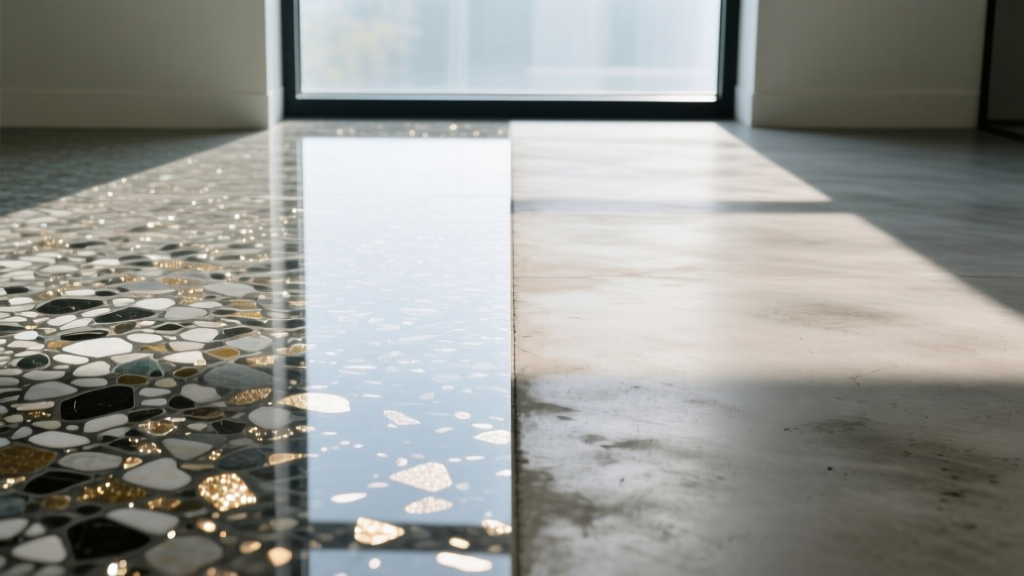
Specification Decision Framework
Use the following parameters to select the correct system for your project specifications:
- Specify Mechanically Polished Concrete when: The facility experiences heavy forklift traffic, requires strict hygiene protocols (food/beverage processing where topical sealers are banned), has high MVER readings, or demands a 15+ year lifecycle with minimal chemical maintenance.
- Specify Burnished Concrete when: The project has strict initial budget constraints, the slab is older and heavily patched (making deep mechanical grinding aesthetically unviable), or the facility requires a high-gloss 'wet look' that can be achieved quickly with topical urethane guards in retail environments.
Written by
Elena RodriguezElena Rodriguez is a civil engineer and technical writer specializing in concrete technology, masonry systems, and ASTM/ACI compliance. She earned her B.S. in Civil Engineering from Texas A&M University and spent a decade at a materials testing laboratory, performing over 2,000 concrete compressive strength tests and masonry prism evaluations. Elena is an ACI-certified Field Testing Technician (Grade I) and a member of ASTM Committee C12 on Natural Building Stone. She currently consults on forensic engineering cases involving concrete failures and moisture intrusion. Based in San Antonio, TX, Elena is a proud member of the Society of Women Engineers (SWE) and coaches her daughter's FIRST Robotics team.
More from Elena Rodriguez
View all
Walls & Panels
Cost Analysis: Light Gauge Steel Framing Advantages and Disadvantages
Evaluate light gauge steel framing advantages and disadvantages through a strict cost analysis lens, comparing material, labor, and lifecycle expenses.
Aug 4, 2026

Walls & Panels
Gypsum Board Types: Exact Specifications, Thickness & Dimensions
Compare standard, Type X, and moisture-resistant gypsum board types. Get exact specifications, thicknesses, dimensions, and ASTM standards for your project.
Aug 4, 2026

Fire Resistance
Best Fire-Resistant Outdoor Decking Materials: 2026 Buyer Guide
Discover the best fire-resistant outdoor decking materials for 2026. Compare Class A PVC, aluminum, and hardwood options for WUI compliance and safety.
Aug 4, 2026