Average Cost to Build a House in NC: 2026 Price Comparison
Find the average cost to build a house in NC for 2026. Compare regional pricing, material tiers, and hidden fees across the Piedmont, Coast, and Mountains.

The 2026 Baseline: What is the Average Cost to Build a House in NC?
When calculating the average cost to build a house in NC, the 2026 market reflects a stabilization in lumber prices but sustained pressure on skilled labor and site-preparation expenses. For a standard 2,000-square-foot, single-family home built on a flat lot with municipal utilities, the average cost to build a house in NC currently ranges from $165 to $225 per square foot. This translates to a total construction cost between $330,000 and $450,000, strictly excluding land acquisition, architectural fees, and landscaping.
Quick 2026 NC Construction Snapshot
- National Average (NAHB): $160 - $180 / sq ft
- North Carolina Average: $165 - $225 / sq ft
- Custom/Luxury Builds: $275 - $400+ / sq ft
- Average Build Timeline: 7.5 to 9.5 months
Data synthesized from the National Association of Home Builders (NAHB) Construction Cost Survey and regional contractor bids.
However, treating North Carolina as a single pricing zone is a critical estimating error. The state's drastic topographical shifts—from the Atlantic coastal plains to the Appalachian bedrock—create massive variances in foundation engineering, code requirements, and material logistics.
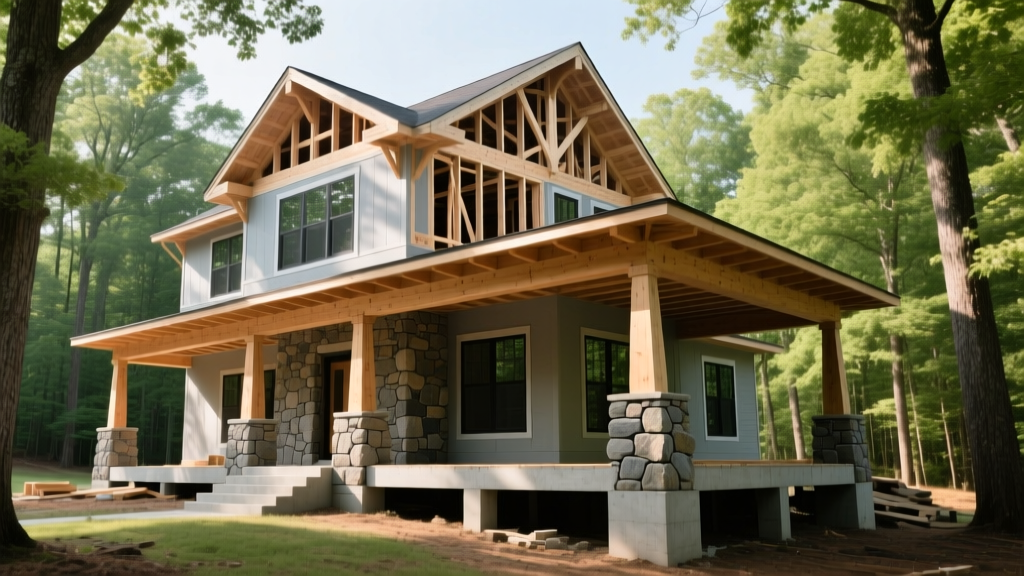
Regional Cost Matrix: Mountains vs. Piedmont vs. Coast
To accurately benchmark your project, you must adjust the baseline average cost to build a house in NC based on your specific county and topography. The following matrix breaks down regional pricing drivers for 2026.
| Region / Major Hubs | Cost per Sq Ft (Standard) | Primary Cost Drivers & Site Challenges |
|---|---|---|
| Piedmont (Raleigh, Durham, Charlotte) |
$175 - $230 | High labor demand; expansive red clay soils requiring engineered reinforced foundations; strict municipal tree-save ordinances. |
| Mountains (Asheville, Hendersonville, Boone) |
$195 - $260 | Steep slope engineering; dynamite/bedrock blasting; retaining walls; extended winter heating for concrete curing; well/septic mandates. |
| Coastal Plain (Wilmington, Outer Banks, Morehead City) |
$210 - $290+ | Hurricane windstorm codes (130-150 mph); elevated piling foundations; salt-air corrosion-resistant fasteners; flood insurance mandates. |
| Rural / Triad (Greensboro, Winston-Salem, Rural Counties) |
$155 - $195 | Lower labor rates; flat topography; slab-on-grade foundations; fewer municipal impact fees. |
Material Tier Comparison: Where Your Budget Actually Goes
The average cost to build a house in NC fluctuates wildly based on exterior envelope selections. North Carolina's climate—characterized by high summer humidity, severe thunderstorms, and occasional ice storms—demands specific material profiles to prevent moisture intrusion and structural degradation.
Exterior Envelope & Roofing
Standard Builder Grade
- Siding: Vinyl siding ($5.50 - $7.00 / sq ft installed). Prone to warping in high heat but low maintenance.
- Roofing: 3-tab or standard architectural asphalt shingles (Owens Corning Duration). $3.50 - $5.00 / sq ft.
- House Wrap: Standard Tyvek. Adequate, but lacks integrated water-resistive barrier (WRB) drainage gaps.
Premium / High-Performance
- Siding: James Hardie Fiber Cement (HardiePlank). $11.00 - $14.50 / sq ft. Impervious to woodpeckers and rot; highly recommended for NC humidity.
- Roofing: 24-gauge standing seam metal roofing. $14.00 - $18.00 / sq ft. Essential for coastal wind uplift resistance and mountain snow sheds.
- Sheathing: Huber ZIP System. Adds ~$2.50 / sq ft to framing but eliminates house wrap and provides superior structural shear against hurricane winds.
HVAC and Insulation Requirements
North Carolina spans three distinct climate zones (Zones 3, 4, and 5) according to the Department of Energy. A home built in Asheville (Zone 5) requires different thermal resistance than one in Wilmington (Zone 3).
- Attic Insulation: Zone 3 (Coast) requires R-30 to R-49. Zone 5 (Mountains) requires R-49 to R-60. Upgrading from standard blown-in fiberglass to closed-cell spray foam costs an additional $1.50 to $3.00 per board foot but drastically reduces HVAC sizing requirements and prevents ice dams in the western counties.
- HVAC Systems: For the humid Piedmont and Coastal regions, standard 14 SEER2 single-stage units struggle with latent moisture removal. Upgrading to a 16+ SEER2 variable-speed system (e.g., Trane XR15i or Lennox EL18XCV) adds $4,500 to $7,000 to the build cost but prevents the mold growth common in poorly dehumidified NC homes.
Hidden Cost Drivers in North Carolina Construction
Budget overruns rarely happen in the framing or drywall phases; they occur during site work and code compliance. When estimating the average cost to build a house in NC, factor in these localized variables.
⚠️ Warning: The Coastal Windstorm Code Premium
Building within 15 miles of the Atlantic coastline triggers strict North Carolina Department of Insurance (OSFM) windstorm building codes. You must install continuous load-path hardware (hurricane straps, heavy-duty tie-downs) and impact-resistant glazing or engineered shutters. Expect to add $15,000 to $25,000 to your structural and fenestration budget solely for coastal code compliance.
Site Prep: Soil and Bedrock
In the Piedmont region, expansive mica-schist and red clay soils shift drastically with moisture changes. Geotechnical engineers often mandate over-excavation and backfilling with engineered compacted gravel, or the use of stiffened raft slab foundations. This site prep can add $8,000 to $15,000 before the foundation is even poured.
Conversely, in the Mountain region, you are likely hitting solid granite or gneiss bedrock. Blasting or mechanical hammering to dig a crawlspace or basement footings routinely costs $5,000 to $12,000 per lot, a line item entirely absent in the sandy soils of the coastal plain.
Radon Mitigation in Western NC
The Appalachian mountains have naturally high concentrations of uranium-bearing granite, which decays into radon gas. While not universally mandated by state code for all private builds, installing a passive radon venting system during the foundation phase costs only $350 to $600. Retrofitting an active system post-construction costs upwards of $2,500. Always include a passive stub-out in your mountain build estimates.
Actionable Framework: Estimating Your Specific Build
To move beyond generic averages and calculate a realistic budget for your specific North Carolina lot, use this sequential framework:
- Establish the Base Shell Cost: Multiply your planned heated square footage by the regional baseline (e.g., 2,200 sq ft x $185 = $407,000 for a Piedmont build).
- Add Site-Specific Earthwork: Allocate 3% to 6% of the base shell cost for grading, well/septic (if rural), and driveway installation. A 400-foot gravel driveway in a rural county will add $12,000+ compared to a 40-foot municipal concrete apron.
- Apply the Envelope Multiplier: If upgrading from vinyl/asphalt to fiber cement/metal roofing, add 8% to 12% to your total base shell cost.
- Factor in Impact Fees and Permits: Municipalities like Charlotte and Raleigh charge heavy water/sewer capacity and school impact fees. Budget $8,000 to $14,000 for municipal soft costs, compared to $1,500 to $3,000 in unincorporated county zones.
- Include a Topographical Contingency: Add a 5% contingency for flat coastal lots, a 10% contingency for Piedmont clay soils, and a 15% contingency for steep-slope mountain lots to cover unforeseen engineering requirements.
Tracking construction costs requires localized precision. According to the U.S. Census Bureau Construction Data, regional permitting volumes directly correlate to local labor shortages; building in high-growth corridors like Wake or Cabarrus counties during peak spring seasons will push labor premiums up by 10% to 15%. Secure your general contractor and lock in material pricing during the Q4 winter slowdown to optimize your final build cost.
Frequently Asked Questions
Is it cheaper to buy an existing home or build in NC?
In 2026, building a new home in NC often costs 10% to 15% more upfront than buying a comparable existing home, primarily due to land acquisition and current site-prep inflation. However, new builds avoid the immediate $30,000+ deferred maintenance liabilities (HVAC replacement, roof repairs) common in NC's aging 1990s housing stock, making the 10-year total cost of ownership highly competitive.
How much does a basement cost in North Carolina?
Basements are rare in the Piedmont and Coast due to high water tables and clay soils. In the Mountain region, a full unfinished walk-out basement adds approximately $45 to $65 per square foot of basement area. A fully finished basement with egress windows and a wet bar will push that cost to $110 to $150 per square foot.
Do I need a licensed general contractor to build my own house in NC?
North Carolina law allows property owners to act as their own general contractor (owner-builder) if they intend to reside in the home for at least 12 months after completion. However, you must pass an examination with the local building inspector's office, and all electrical, plumbing, and HVAC work must still be performed by state-licensed subcontractors.
Written by
Priya KapoorPriya Kapoor is a real estate market analyst and construction economics researcher with expertise in housing affordability, development feasibility, and infrastructure investment. She holds a Master of Regional Planning from Cornell University and previously worked as a senior analyst at CBRE's Investment Properties group, where she modeled returns for $4B in mixed-use development pipelines. Priya now runs an independent research practice advising developers, municipalities, and REITs on construction cost forecasting and market timing. She publishes the quarterly "BuildMat Market Pulse" report tracking material price indices across 12 commodity categories. Based in Austin, TX, Priya serves on the board of Habitat for Humanity Austin and is a marathon runner.
More from Priya Kapoor
View all
Construction Cost
Cost to Build a 1600 Sq Ft Home in 2026: Full Breakdown
Accurate 2026 cost to build a 1600 sq ft home—material, labor, and regional pricing breakdowns included. Plan your budget with real-time estimates.
Aug 11, 2026

Wood & Lumber
Name the Types of Wood for Pressure Treatment and Preservation
Learn how to name the types of wood best suited for pressure treatment. Compare species treatability, chemical retention levels, and 2026 preservation costs.
Aug 4, 2026

Stone & Masonry
Stone Veneer Suppliers Lindenhurst: 2026 Cost Analysis
Analyze 2026 stone veneer costs in Lindenhurst, NY. Compare local supplier pricing, delivery fees, and Suffolk County installation labor rates.
Aug 4, 2026