How Much Does It Cost to Build a Small Pool? Complete Guide
Discover how much it costs to build a small pool. Breakdowns for fiberglass, vinyl, and concrete plunge pools, plus hidden excavation fees.

Defining the Small Pool Footprint
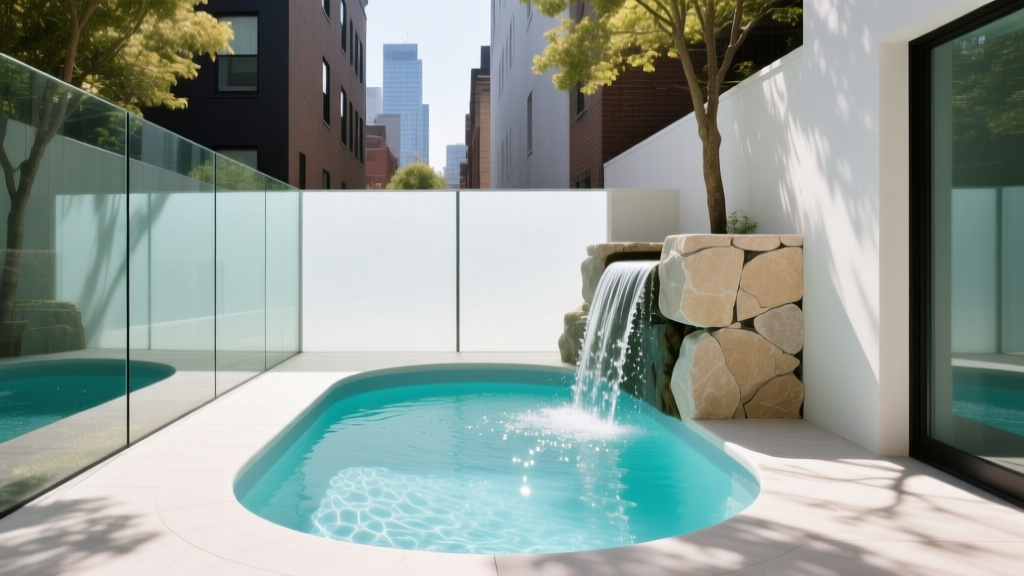
When estimating construction costs, the term "small pool" generally refers to aquatic structures under 400 square feet. These compact footprints are engineered for specific use cases rather than lap swimming. Understanding the exact classification of your project dictates the structural requirements and baseline material costs.
- Plunge Pools (10x15 ft to 12x24 ft): Designed for cooling off and wading. Typically 4 to 5 feet deep with a flat bottom. Average surface area: 150 to 288 sq ft.
- Spools (Spa/Pool Combo): Usually 10x15 ft, featuring dual temperature zones or a large integrated spa bench. Requires specialized dual-plumbing manifolds and higher BTU heating systems.
- Cocktail Pools (10x10 ft to 12x12 ft): Shallow (3 to 4 feet), often featuring perimeter lounging ledges (Baja decks) and integrated fire bowls. High hardscape-to-water ratio.
Material Cost Matrix: Fiberglass, Vinyl, and Gunite
The shell material accounts for 35% to 50% of the total project budget. Below is a comparative cost matrix for a standard 12x24 ft small pool installation as of 2026.
| Material Type | Shell Cost (Only) | Total Installed Cost | Lifespan | Surface Maintenance |
|---|---|---|---|---|
| Vinyl Liner | $4,500 - $7,000 | $18,000 - $28,000 | Liner: 7-10 yrs Frame: 25+ yrs |
Liner replacement ($4,500+); susceptible to tearing from pets or sharp objects. |
| Fiberglass | $9,000 - $16,000 | $28,000 - $45,000 | 30+ years | Gelcoat buffing every 10-15 years; lowest chemical demand due to non-porous surface. |
| Gunite/Concrete | N/A (Poured on-site) | $40,000 - $65,000+ | 50+ years | Acid washing and replastering every 12-15 years ($8,000+); highest chemical demand. |
Note: Fiberglass shells from manufacturers like Thursday Pools or Viking Pools are molded off-site. The "Shell Cost" reflects the unit price before crane delivery and backfill.
Hidden Cost Drivers: Excavation and Site Access
The most frequent cause of budget overruns in small pool construction is site logistics. A compact backyard often means restricted access for heavy machinery.
If your side-yard gate is narrower than 8 feet, standard trackhoes and skid steers cannot access the dig site. For fiberglass shells, a 100-ton mobile crane must hoist the 4,000 lb shell over your house. Crane mobilization and lift fees add $2,500 to $6,000 to the project. For gunite pools, manual mucking or conveyor belt soil removal can add $4,000 to $8,000 in labor.
Soil Export and "Muck Out" Fees
A 12x24 ft pool dug to a depth of 5 feet yields approximately 53 cubic yards of dirt. Because soil expands by 20% to 30% when excavated (swell factor), you are hauling away 65 to 70 cubic yards. At $150 to $250 per dump truck load (10 cubic yards), soil export alone costs $1,000 to $1,800. If the excavator hits bedrock, hydraulic hammering or rock blasting will incur hourly rates of $250 to $400.
Mandatory Code Compliance and Safety Add-Ons
Small pools are subject to the exact same safety codes as Olympic-sized commercial pools. Ignoring these requirements will result in failed inspections and halted construction.
Fencing and Barrier Requirements
According to the U.S. Consumer Product Safety Commission (CPSC), all residential pools must be enclosed by a barrier at least 4 feet high with self-closing, self-latching gates that open outward.
- Aluminum Fencing: $30 to $50 per linear foot. (Most cost-effective).
- Frameless Glass Fencing: $150 to $250 per linear foot. (Required for modern aesthetic small pools where sightlines matter).
- Masonry Walls: $75 to $120 per linear foot.
Plumbing and Drain Safety
The Pool & Hot Tub Alliance (PHTA) strictly enforces the Virginia Graeme Baker (VGB) Pool and Spa Safety Act. Every small pool must be equipped with VGB-compliant anti-entrapment drain covers. Furthermore, the International Code Council (ICC) mandates that residential pool pumps utilize dual main drains plumbed in parallel, spaced at least 3 feet apart, to eliminate single-block suction hazards. Expect to pay $800 to $1,200 extra for this dual-drain plumbing manifold compared to older single-drain setups.
Long-Term Operational and Equipment Costs
While a small pool holds less water (typically 5,000 to 10,000 gallons compared to 20,000+ for standard pools), the equipment sizing does not scale down linearly. You still require adequate turnover rates and sanitation.
- Variable-Speed Pumps: As of 2026, the Department of Energy mandates variable-speed pumps for most residential pools. A 1.5 HP Pentair IntelliFlo or Hayward EcoStar costs $1,400 to $1,800 installed but reduces electrical consumption by up to 70% compared to single-speed models.
- Heating: Heating a 10x15 ft spool to 102°F in the winter requires a minimum 140,000 BTU heat pump ($3,500 - $4,500) or a 250,000 BTU gas heater ($2,800 - $3,500). Gas heaters cost significantly more to operate monthly ($300-$500/month in winter) versus heat pumps ($50-$100/month).
- Sanitation: Saltwater chlorine generators (e.g., Hayward AquaRite) add $1,500 upfront but reduce annual chemical costs from $800 to roughly $150.
Decision Framework: Matching Budget to Backyard
Use this framework to determine the most financially sound construction path for your specific property constraints.
Scenario A: The Strict Budget & Standard Access
Profile: Budget under $30,000. Wide side-yard access (8ft+). Rectangular shape preference.
Recommendation: Vinyl Liner Pool. Utilize a prefabricated steel-wall or polymer-wall kit. The rapid installation (often 3-4 weeks) minimizes labor costs. Plan for a liner replacement reserve fund of $4,500 every decade.
Scenario B: The Low-Maintenance Urban Plunge
Profile: Budget $30,000 - $45,000. Narrow yard requiring a crane lift. Desire for minimal weekly maintenance.
Recommendation: Fiberglass Shell. The non-porous gelcoat surface prevents algae adhesion, cutting chemical and brushing time by 60%. Factor the $4,000 crane lift into your initial quote negotiations.
Scenario C: The Custom Architectural Feature
Profile: Budget $50,000+. Irregularly shaped lot, requiring infinity edges, integrated tanning ledges, or glass tile waterlines.
Recommendation: Gunite/Shotcrete. Gunite allows for infinite customization. Ensure the contractor uses a 4,000 PSI mix design and cures the shell with a continuous water spray for 28 days to prevent structural micro-cracking before the plaster phase.
Written by
James ThorntonJames Thornton is a construction industry veteran with 25 years of hands-on experience in wood framing, lumber grading, and residential building codes. He started as a framing carpenter in rural Oregon, earned his ICC Residential Building Inspector certification, and eventually became a senior plan reviewer for the City of Portland Bureau of Development Services. James holds a B.S. in Wood Science & Technology from Oregon State University and is a certified lumber grader through the West Coast Lumber Inspection Bureau (WCLIB). He has inspected over 3,000 residential construction sites and authored the city's internal guide on advanced framing techniques (2x6 at 24" O.C.). James lives in Bend, OR, where he builds custom timber-frame cabins and competes in lumberjack sports.
More from James Thornton
View all
Insulation
Best Home Insulation Materials: Complete 2026 Guide
Compare top home insulation materials for 2026. Find R-values, installed costs per square foot, and best uses for fiberglass, spray foam, and mineral wool.
Aug 4, 2026

Sustainable Building
Certify Your Green Building Material for LEED and WELL
Step-by-step guide to certifying a green building material for LEED v5 and WELL v2. Master EPDs, HPDs, and VOC limits for 2026 project specifications.
Aug 4, 2026

Stone & Masonry
Veneer Stacked Stone Panels: Interior Design & Style Showcase
Discover how veneer stacked stone panels transform interiors. Explore modern design profiles, material pairings, and technical installation specs.
Aug 4, 2026