MSC World America Cost to Build: Scope & Cost Analysis
Explore the MSC World America cost to build, analyzing its massive scope, tonnage, and price per square foot against land-based mega-resorts.

The Scale of Floating Cities: MSC World America Overview
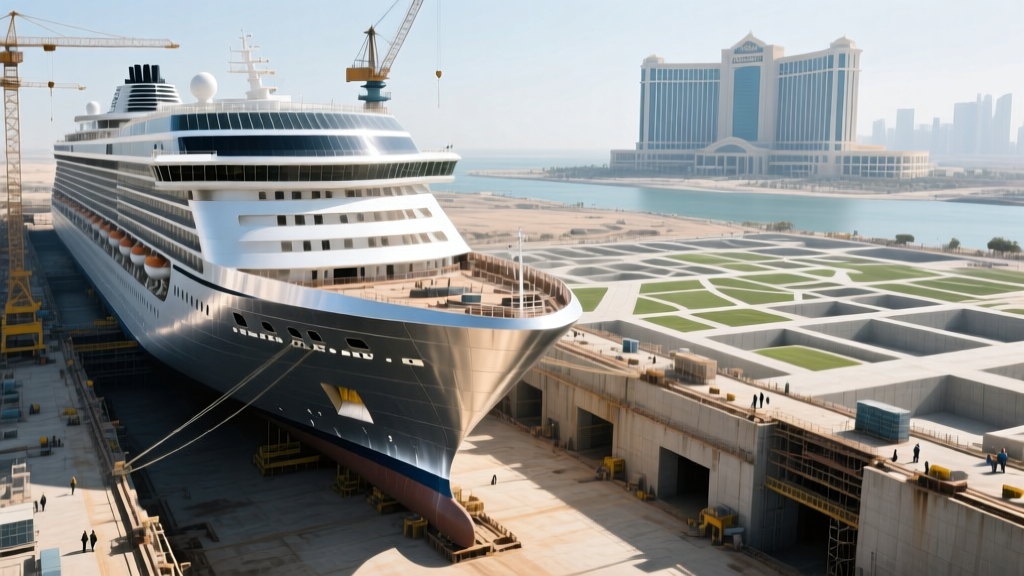
When evaluating the upper limits of commercial hospitality construction, the MSC World America represents a masterclass in extreme scope and complex systems integration. As the sister vessel to the MSC World Europa, this LNG-powered mega-ship pushes the boundaries of maritime engineering. For construction estimators and developers, analyzing the MSC World America cost to build provides a unique benchmark for comparing ultra-high-density floating infrastructure against terrestrial mega-resorts.
Unlike standard commercial buildings where foundation and framing dominate the budget, maritime mega-projects allocate the majority of their capital to specialized outfitting, weight-management engineering, and marine-grade life safety systems. Understanding this cost distribution is critical for anyone utilizing a size and scope calculator for complex, high-capacity hospitality projects.
Core Scope & Baseline Metrics
- Gross Tonnage (GT): 215,863 GT (Equivalent to roughly 6.1 million cubic feet of internal volume)
- Length / Beam: 333 meters (1,093 ft) / 47 meters (154 ft)
- Decks: 20 passenger and crew decks
- Maximum Capacity: 6,762 passengers + 2,138 crew members
- Estimated Build Cost: $1.4 Billion USD (Adjusted for 2026 maritime inflation)
Breaking Down the MSC World America Cost to Build
Constructing a vessel of this magnitude at the Chantiers de l'Atlantique shipyard in France requires a highly specialized supply chain. The estimated $1.4 billion price tag breaks down into distinct construction phases that differ radically from land-based commercial estimating.
1. Hull Fabrication and Propulsion (25% | ~$350M)
The hull utilizes AH36 high-tensile marine steel, designed to withstand dynamic ocean torsion. Unlike static building foundations, the hull must flex. The propulsion system features five WinGD dual-fuel LNG engines and specialized Azipod thrusters. The integration of cryogenic LNG storage tanks within the hull structure adds a 15% premium over traditional marine diesel setups, driven by the complex insulation and safety baffling required for liquefied gas at -162°C.
2. Outfitting and Interior Architecture (45% | ~$630M)
This is where the MSC World America cost to build diverges most sharply from terrestrial resorts. Every interior material must meet strict International Maritime Organization (IMO) and US Coast Guard (USCG) fire-retardancy standards. Standard drywall and commercial carpeting are unusable. Instead, estimators must account for marine-grade composite panels, specialized mineral wool bulkheads, and custom-milled aluminum joinery. Furthermore, every fixture must be weight-calculated to maintain the vessel's precise center of gravity.
3. HVAC, Plumbing, and Life Safety Systems (20% | ~$280M)
A floating resort housing nearly 9,000 people requires a self-sufficient municipal infrastructure. The HVAC system must process 100% fresh outside air (no recirculation, per post-2020 maritime health standards) while managing extreme humidity and salt-air corrosion. Plumbing includes advanced blackwater treatment plants and reverse-osmosis desalination units capable of producing millions of liters of potable water daily.
4. Design, Regulatory, and Project Management (10% | ~$140M)
Because the MSC World America is specifically designed to operate in US waters, it must comply with USCG Subchapter H regulations, which are significantly more stringent than standard international SOLAS (Safety of Life at Sea) requirements. This necessitates redundant fire zones, specialized structural fire protection, and enhanced evacuation routing, adding roughly 8-12% to the baseline European build cost.
Size & Scope Calculator: Floating Resort vs. Land-Based Mega-Resort
To contextualize the MSC World America cost to build, we must compare it against the largest terrestrial hospitality projects. Using a standardized scope calculator, we evaluate the cost per guest capacity and the cost per enclosed volume.
| Project Name | Total Build Cost | Capacity / Rooms | Cost Per Guest/Key | Primary Structural Material |
|---|---|---|---|---|
| MSC World America | $1.4 Billion | ~8,900 (Pax + Crew) | $157,300 | AH36 Marine Steel / Aluminum |
| Resorts World Las Vegas | $4.3 Billion | 3,500 Rooms | $1,228,500 | Steel Frame / Concrete Core |
| The Venetian (Las Vegas) | $1.5 Billion (1999) | 4,049 Suites | $370,461* | Steel / Reinforced Concrete |
*Note: The Venetian cost is unadjusted for inflation. Adjusted for 2026 construction indices, the cost per key would exceed $850,000.
According to data tracked by the Las Vegas Convention and Visitors Authority (LVCVA), terrestrial mega-resorts require massive land acquisition, deep pile foundations, and extensive external utility tie-ins. In contrast, the MSC World America eliminates land costs but replaces them with extreme density engineering. The cost per guest on the cruise ship is roughly 10% to 15% of the cost per hotel key in a modern Las Vegas mega-resort, highlighting the extreme spatial efficiency and stacked-deck construction methodology of maritime vessels.
Unique Construction Variables in Maritime Mega-Projects
When running a size and scope calculator for a project of this nature, standard commercial construction multipliers will yield highly inaccurate estimates. Estimators must account for the following maritime-specific variables:
- Weight Margins and Ballasting: Every material installed above the waterline must be offset. If a casino floor uses heavy stone tile, the estimator must factor in the cost of removing equivalent weight from lower decks or adding permanent ballast, which impacts fuel efficiency and propulsion sizing.
- Vibration and Acoustic Damping: Unlike a concrete high-rise, a ship's hull transmits engine and wave vibration. Bulkheads and deck ceilings require floating floor systems and resilient acoustic mounts, increasing flooring installation costs by up to 40% compared to terrestrial hotels.
- Modular Cabin Construction: The 2,626 passenger cabins are not built stick-by-stick. They are manufactured as complete, pre-wired, and pre-plumbed modular units in off-site factories, then craned into the hull. This requires precise logistical sequencing and specialized heavy-lift crane time.
- Corrosion Allowances: Exterior and high-humidity interior zones require specialized epoxy coatings and marine-grade stainless steel (316L), which carries a significant premium over the 304-grade stainless steel used in standard commercial kitchens and facades.
Scope Creep and Supply Chain Realities (2026 Perspective)
The maritime construction sector has experienced severe supply chain recalibration over the last few years. According to the UNCTAD Review of Maritime Transport, shipbuilding cost indices have been heavily influenced by the global transition to alternative fuels and specialized steel tariffs.
For the MSC World America, the integration of LNG dual-fuel technology and the preparation for future synthetic fuel retrofits requires specialized engine bay architecture. Furthermore, as detailed in technical profiles by Ship Technology, the 'World Class' vessels feature complex Y-shaped hull designs and massive aft promenades. These architectural anomalies require advanced 3D modeling and custom steel bending, driving up the initial hull fabrication costs by roughly 18% compared to standard box-cruise ship designs.
Estimator Warning: Drydock Limitations
Only a handful of drydocks globally (primarily in France, Germany, Italy, and South Korea) possess the physical dimensions and crane lift capacities to assemble a 215,000+ GT vessel. This bottleneck gives shipyards immense pricing power, meaning the MSC World America cost to build is heavily insulated from standard competitive bidding processes that drive down costs in terrestrial commercial real estate.
Frequently Asked Questions
How does the cost per square foot compare to land-based resorts?
Maritime construction is measured in Gross Tonnage (volume), not square footage. However, translating the 215,863 GT into estimated usable square footage (approx. 4.5 million sq ft) yields a build cost of roughly $311 per square foot. This is highly competitive with luxury terrestrial resorts, but the maritime figure includes all self-sustaining infrastructure (power plants, water treatment), which would be excluded from standard land-based building estimates.
Why is the MSC World America more expensive to build than older MSC ships?
The premium is driven by USCG Subchapter H compliance, the integration of LNG propulsion systems, and the sheer scale of the 'World Class' platform. The advanced waste-heat recovery systems and specialized shore-power connectivity required for US port compliance add tens of millions to the baseline electrical engineering scope.
What is the expected lifespan and depreciation model for this build cost?
While terrestrial hotels may require major structural overhauls after 40 years, a mega-ship like the MSC World America is typically designed for a 25-to-30-year primary service life before being sold to secondary markets or scrapped. The initial $1.4 billion capital expenditure is depreciated over this shorter, high-intensity lifecycle, requiring massive daily revenue generation to service the construction debt.
Written by
Sarah WhitfieldSarah Whitfield is a chartered quantity surveyor (MRICS) and construction cost analyst with 15 years of experience in material pricing, procurement strategy, and project budgeting. She earned her degree in Construction Management from the University of Reading (UK) and has worked on projects ranging from $2M custom homes to $180M mixed-use developments across North America and Europe. Sarah currently leads cost estimating for BuildMat Insight, maintaining a proprietary database of 4,000+ material price points updated quarterly. She is a frequent contributor to RSMeans cost data panels and has presented at the International Cost Engineering Council (ICEC) congress. Based in Denver, CO, Sarah is an avid trail runner and volunteer mentor for Women in Construction.
More from Sarah Whitfield
View all
Wood & Lumber
What Are the Different Types of Wood? A Builder's Guide
Compare structural softwoods, finish hardwoods, and engineered lumber. Analyze Janka ratings, MOE values, and 2026 pricing for construction.
Aug 4, 2026

Walls & Panels
Steel Framing vs Wood Framing: Corrosion and Moisture Defense
Compare steel framing vs wood framing for moisture resistance. Learn about galvanized coatings, condensation risks, and corrosion protection strategies.
Jul 21, 2026

Stone & Masonry
How to Cut Stone Veneer: Wet Saw vs Grinder Comparison
Compare the best tools for cutting stone veneer. We review wet saws, angle grinders, and chop saws to help you achieve clean, chip-free cuts.
Jul 21, 2026