Average Cost to Build House in Texas: 2026 Size & Scope Guide
Calculate the average cost to build a house in Texas. Explore 2026 size and scope pricing matrices, regional labor rates, and foundation requirements.

The Texas Housing Market: Baseline Costs per Square Foot
Determining the average cost to build house in texas requires moving beyond statewide medians and analyzing the intersection of square footage, finish scope, and regional site conditions. According to the U.S. Census Bureau Construction Data, the South region maintains a lower baseline cost per square foot than the Northeast or West Coast, but Texas-specific variables—such as expansive clay soils and extreme cooling loads—create distinct cost premiums that generic national calculators fail to capture.
For 2026, the baseline construction cost (excluding land acquisition, site development, and architectural fees) for a single-family home in Texas ranges from $145 to $425 per square foot. This massive spread is dictated entirely by the scope of finishes and the engineering required for the specific build site.
- Builder-Grade / Production Scope: $145 - $175 per sq. ft. (Standard asphalt shingles, vinyl windows, slab-on-grade, builder-grade HVAC).
- Semi-Custom Scope: $185 - $245 per sq. ft. (Engineered hardwood, upgraded insulation, 16+ SEER2 HVAC, stone veneer accents).
- High-End Custom Scope: $260 - $425+ per sq. ft. (Standing seam metal roofing, structural lumber upgrades, smart home integration, luxury appliance packages).
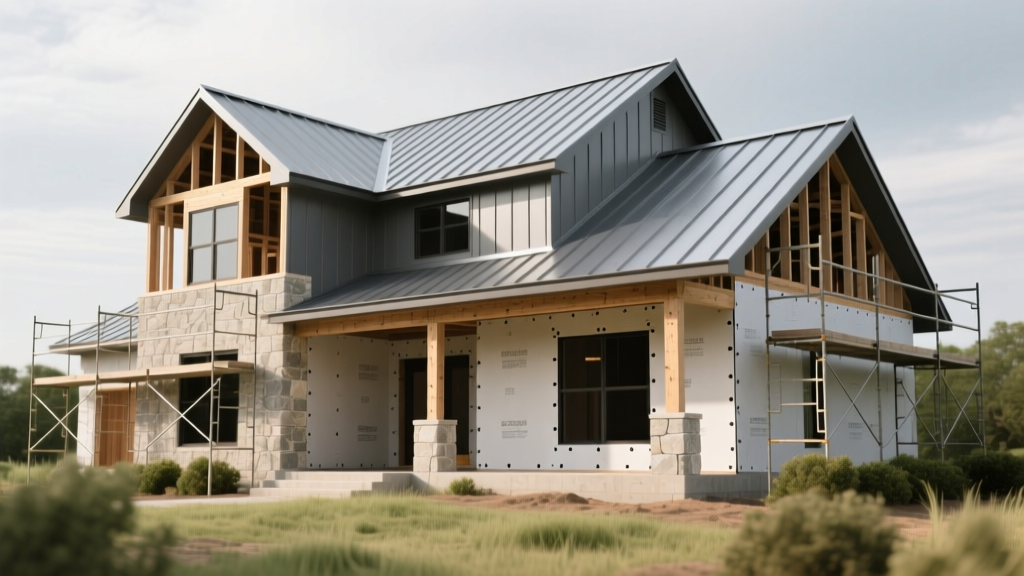
Size & Scope Matrix: Total Project Cost Breakdown
To accurately budget your project, cross-reference your target square footage with your desired finish level. The following matrix outlines total vertical construction costs based on current Texas material and labor rates.
| Home Size (Sq. Ft.) | Builder-Grade Scope | Semi-Custom Scope | Luxury Custom Scope |
|---|---|---|---|
| 1,500 sq. ft. | $217,500 - $262,500 | $277,500 - $367,500 | $390,000 - $637,500 |
| 2,500 sq. ft. | $362,500 - $437,500 | $462,500 - $612,500 | $650,000 - $1,062,500 |
| 3,500 sq. ft. | $507,500 - $612,500 | $647,500 - $857,500 | $910,000 - $1,487,500 |
| 5,000 sq. ft. | $725,000 - $875,000 | $925,000 - $1,225,000 | $1,300,000 - $2,125,000 |
Regional Variations: How Metro vs. Rural Impacts Your Budget
Texas is not a monolith. Labor availability, municipal zoning, and localized supply chains cause significant deviations from the statewide average.
Austin & The Hill Country
Building in Austin proper or the surrounding Hill Country introduces a 10% to 15% labor premium due to high market demand. More critically, Austin enforces strict impervious cover limits and tree preservation ordinances. Expect to spend an additional $8,000 to $20,000 on specialized site engineering, retaining walls, and tree protection fencing before vertical construction even begins. In the Hill Country, limestone bedrock often requires blasting or specialized rock trenching for utilities, adding $5 to $12 per linear foot to site prep.
Dallas-Fort Worth (DFW) Metroplex
The DFW area sits atop the Blackland Prairie, characterized by highly expansive clay soils with a high Plasticity Index (PI). Standard slab-on-grade foundations frequently fail here. Builders must utilize post-tension slabs or drilled concrete piers anchored into bedrock. According to local structural engineering standards, upgrading to a post-tension foundation adds $3.50 to $6.00 per square foot to your foundation scope. For a 3,000 sq. ft. home, this is a mandatory $10,500 to $18,000 structural premium.
Houston & The Gulf Coast
Houston’s primary cost driver is flood mitigation. If your lot is in a 100-year or 500-year FEMA floodplain, local codes require the lowest living floor to be elevated above the Base Flood Elevation (BFE). Bringing in engineered fill dirt to raise a standard 50x100 foot lot by two feet can cost between $12,000 and $22,000, factoring in material, compaction testing, and retaining structures.
Rural Texas (West Texas, Panhandle, East Texas)
While rural land is cheaper, construction costs often rise due to mobilization fees and infrastructure requirements. Subcontractors typically charge a 5% to 10% travel premium for sites located more than 30 miles from their base. Furthermore, lacking municipal water and sewer means budgeting $15,000 to $35,000 for a private water well, aerobic septic system, and propane tank installation.
Critical Texas-Specific Scope Variables
When utilizing a size and scope calculator, you must manually adjust for climate and environmental factors unique to the state. The U.S. Department of Energy Climate Zone Map places most of Texas in Zones 2 and 3, dictating specific thermal and structural requirements.
HVAC & Insulation Scope
Texas summers demand rigorous cooling infrastructure. Standard 14 SEER systems are no longer sufficient for high-performance homes. Budget for 16 to 18 SEER2 variable-speed heat pumps or dual-fuel systems. For a 2,500 sq. ft. home, upgrading from a standard builder-grade HVAC system to a multi-zone, high-SEER2 system with advanced dehumidification will add $6,500 to $11,000 to your mechanical scope.
Pair this with closed-cell spray foam insulation (R-7 per inch) on the roof deck to create a conditioned attic space. This prevents HVAC ductwork from losing 20% of its cooling capacity in a 140°F attic, ultimately reducing the required tonnage of your HVAC equipment.
Roofing & Impact Resistance
Hail storms in North and Central Texas cause millions in property damage annually. Upgrading your roofing scope from standard 3-tab architectural shingles to Class 4 Impact-Resistant (IR) shingles (such as Owens Corning Duration Flex or Malarkey Vista) adds roughly $1.50 to $2.50 per square foot. Alternatively, a 24-gauge standing seam metal roof will cost $14 to $22 per square foot installed, but it virtually eliminates hail damage risks and drastically reduces cooling loads via solar reflectance.
Step-by-Step Scope Calculator: Building Your Budget
To generate a highly accurate estimate for your specific Texas build, follow this sequential budgeting framework:
- Calculate Base Shell & Foundation: Multiply your target square footage by $75-$95/sq. ft. Add your regional soil premium (e.g., +$5/sq. ft. for DFW post-tension slabs or +$15,000 for Houston fill dirt).
- Add MEP (Mechanical, Electrical, Plumbing): Allocate $35-$55/sq. ft. Upgrade this tier if you are installing tankless water heaters, PEX-A manifolds, or smart electrical panels (like SPAN).
- Define Interior Finish Scope: This is the highest variance category. Builder-grade finishes run $40/sq. ft., while luxury custom finishes (quartzite counters, white oak hardwoods, custom millwork) easily exceed $150/sq. ft.
- Factor in Site Work & Permitting: Allocate 8% to 12% of your total vertical construction cost for site grading, utility trenching, driveway concrete, and municipal impact fees. Refer to the NAHB Construction Cost Surveys for updated national and regional soft-cost benchmarks.
- Apply the Contingency Multiplier: Multiply your final sum by 1.10 (10% contingency) for custom builds, or 1.05 (5% contingency) for production-style builds with pre-locked material contracts.
Many size calculators omit municipal impact fees. In rapidly growing Texas suburbs (e.g., Frisco, Celina, Buda), city water and sewer tap fees, plus school district impact fees, can range from $12,000 to $22,000 per single-family lot. Always verify municipal fee schedules with the local building department before finalizing your land acquisition budget.
Frequently Asked Questions
Does building a two-story house in Texas cost less per square foot than a single-story?
Yes, generally. A two-story home requires a smaller foundation footprint and less roofing material for the same square footage, reducing costs by roughly 8% to 12% compared to a sprawling single-story ranch. However, you must offset these savings against the cost of structural floor trusses and a secondary HVAC zone for the upstairs, which is mandatory for Texas climate comfort.
How much does a barndominium cost to build in Texas compared to a traditional stick-built home?
A barndominium (post-frame construction with a metal exterior) typically costs 10% to 15% less than a traditional wood-framed home at the shell level. However, once high-end interior finishes are applied, the cost per square foot equalizes. Expect to pay $130 to $180 per square foot for a turnkey barndominium in rural Texas, heavily dependent on the interior scope.
Are material costs in Texas dropping in 2026?
Lumber and steel prices have largely stabilized compared to the extreme volatility of previous years. However, specialized electrical components (transformers, smart panels) and high-efficiency HVAC compressors still experience supply chain bottlenecks, keeping MEP costs elevated. Labor rates remain the primary driver of year-over-year cost increases in the Texas market.
Written by
David NakamuraDavid Nakamura is a licensed architect (AIA) and construction technology writer focused on sustainable building methods, mass timber engineering, and high-performance building envelopes. He holds a Master of Architecture from the University of Washington and is a certified Passive House Consultant (CPHC). David spent eight years at the Seattle firm Mithun, where he led the design of three LEED Platinum projects, before founding his own practice specializing in net-zero residential design. He serves on the editorial advisory board of GreenBuilder Magazine and has authored peer-reviewed papers on cross-laminated timber (CLT) connections for the Journal of Structural Engineering. In his spare time, David teaches woodworking at Pratt Fine Arts Center and kayaks the Puget Sound.
More from David Nakamura
View all
Construction Cost
Labor Cost to Build a Deck Per Sq Ft: 2026 Installation Guide
Discover the exact labor cost to build a deck per sq ft in 2026. This installation guide breaks down contractor rates, complexity factors, and hidden fees.
Aug 4, 2026

Construction Cost
How Much Does It Cost to Build a 3 Bedroom House? Financing Guide
Learn exactly how much it costs to build a 3 bedroom house and explore 2026 financing options, construction loan types, and budget frameworks for your build.
Aug 4, 2026

Construction Cost
Cost to Build a Tennis Court: 2026 Guide
How much does it cost to build a tennis court in 2026? Breakdowns for asphalt, concrete, and synthetic surfaces plus fencing and lighting.
Jul 30, 2026