The True Cost to Build a Wine Cellar: Detailed Breakdown
Discover the true cost to build a wine cellar. Detailed pricing for vapor barriers, cooling units, custom racking, and structural envelope requirements.

The True Cost to Build a Wine Cellar: Beyond the Racking
When calculating the cost to build a wine cellar, most homeowners mistakenly allocate the majority of their budget to custom racking and aesthetic finishes. In reality, the structural envelope, vapor isolation, and precision climate control systems dictate the longevity of your collection and consume the bulk of the capital. A properly engineered cellar is essentially a walk-in refrigerator wrapped in a moisture-impermeable shell. In 2026, material costs for closed-cell spray foam, thermal glazing, and specialized split HVAC systems have stabilized, but custom fabrication and specialized labor remain premium expenses.
2026 Wine Cellar Cost Matrix
| Project Scope | Square Footage | Estimated Cost Range | Cost Per Sq. Ft. |
|---|---|---|---|
| Closet Conversion | 25 - 50 sq ft | $12,000 - $22,000 | $400 - $480 |
| Dedicated Room | 100 - 200 sq ft | $45,000 - $85,000 | $425 - $450 |
| Large Custom Cellar | 250 - 400+ sq ft | $110,000 - $250,000+ | $440 - $625+ |
Phase 1: The Structural Envelope and Vapor Isolation
The most critical and frequently botched phase of cellar construction is the envelope. Wine requires a stable environment of 55°F and 50% to 70% relative humidity. Without a continuous vapor barrier, moisture from the warmer adjacent rooms will migrate into the cold cellar walls, condense, and trigger catastrophic mold growth behind the drywall. The Environmental Protection Agency (EPA) strictly outlines how hidden moisture intrusion compromises structural integrity and indoor air quality.
To prevent vapor drive, builders must install a continuous 6-mil polyethylene vapor barrier on the warm side of the walls (the exterior of the cellar envelope). Following this, insulation must be applied. According to the U.S. Department of Energy, closed-cell spray foam is the superior choice for climate-controlled spaces. You must specify 2lb closed-cell spray foam, which provides an R-value of approximately R-6.5 per inch. Target a minimum of R-13 for walls and R-19 for the ceiling. Standard fiberglass batts are unacceptable in wine cellars because they trap moisture and lose their insulating properties when damp.
Phase 2: Precision Climate Control Systems
Standard residential HVAC systems cannot achieve the 55°F setpoint required for wine storage, nor can they manage the latent humidity load. You must install a purpose-built wine cooling unit. These systems are priced based on their BTU/h capacity, which must be calculated using a thermal load assessment that factors in wall insulation, glass surface area, and ambient room temperatures.
- Self-Contained (Through-the-Wall) Units: Cost between $2,500 and $5,000. These are easier to install but require venting into an adjacent room that is at least twice the size of the cellar to dissipate heat. They are louder and have a shorter lifespan due to compressor vibration.
- Split Systems (e.g., Wine Guardian, WhisperKOOL): Cost between $6,500 and $14,000 installed. The evaporator coil sits inside the cellar, while the noisy condenser is mounted remotely outdoors or in an attic. This is the mandatory choice for high-end residential builds, offering precise humidity control and whisper-quiet operation.
- Ducted Split Systems: Cost $10,000 to $18,000+. Used when ceiling space is limited or when the cooling unit must be entirely hidden. Requires specialized low-velocity ductwork to prevent freezing the coils.
Phase 3: Door and Glazing Specifications
Using a standard interior door is a guaranteed failure point. Interior doors lack the core density and weather-sealing required to hold back a 15-to-20-degree temperature differential and a massive humidity gradient. The door must be exterior-grade, solid-core, and at least 1.75 inches thick. It requires full-perimeter weatherstripping and an automatic door bottom (drop seal) to engage when closed. Budget $1,800 to $4,500 for a properly sealed, custom-finished exterior door.
If your design incorporates glass walls or a glass door, the glazing specifications are equally stringent. You must use double-pane, argon-filled, Low-E glass with a U-factor of 0.30 or lower. Single-pane glass will cause the cooling unit to run continuously, leading to compressor burnout and excessive condensation on the interior glass surface. Thermal glass panels for a cellar wall typically cost $120 to $180 per square foot.
Phase 4: Racking Economics and Material Selection
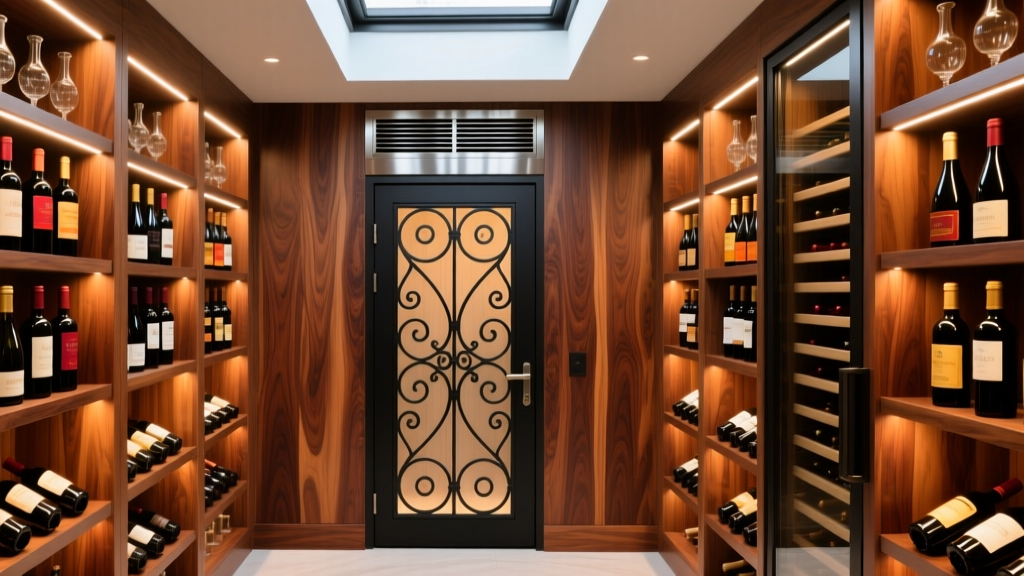
Racking represents the most variable cost in the build. Prefabricated kits can be assembled for a fraction of the cost of custom-milled, floor-to-ceiling installations. When selecting materials, prioritize dimensional stability and moisture resistance over visual grain patterns.
| Material | Cost Per Bottle (Custom) | Moisture Resistance | Best Application |
|---|---|---|---|
| All-Heart Redwood | $8.00 - $14.00 | Exceptional | Premium custom cellars, resists mold naturally |
| Honduran Mahogany | $10.00 - $18.00 | Excellent | High-end aesthetics, takes stain beautifully |
| Black Walnut | $12.00 - $22.00 | Good | Modern designs, requires high-quality sealant |
| Powder-Coated Steel | $6.00 - $15.00 | Exceptional | Industrial/modern aesthetics, high-density storage |
Phase 5: Lighting and Flooring
Ultraviolet (UV) light degrades wine by catalyzing the breakdown of organic compounds, leading to "light strike" and premature aging. Incandescent and halogen bulbs also emit excessive heat, which disrupts the cellar's thermal load. You must exclusively use low-voltage LED lighting with zero UV emissions. Recessed cans must be IC-rated (Insulation Contact) and airtight to prevent breaking the ceiling's vapor barrier. Budget $1,500 to $3,500 for a comprehensive, dimmable LED lighting plan, including display shelf backlighting.
Flooring must withstand constant 60% humidity without warping, cupping, or harboring mold. Hardwood is generally discouraged unless it is heavily sealed with marine-grade polyurethane. The most reliable and cost-effective choices are natural stone (slate, travertine), porcelain tile, or sealed concrete. Ensure the installer uses a high-quality, polymer-modified thin-set mortar and an epoxy-based grout to prevent moisture penetration into the subfloor. Expect to pay $18 to $35 per square foot for premium stone installation.
Critical Failure Modes in Cellar Construction
Avoid These Expensive Mistakes
- Vapor Barrier Reversal: Placing the poly sheeting on the cold (interior) side of the wall. This traps moisture inside the wall cavity, rotting the studs within five years.
- Undersized Cooling Units: Sizing the BTU load based purely on square footage while ignoring the thermal bleed from adjacent glass walls or poorly insulated attic spaces above. Always oversize the unit by 20% to allow the compressor to cycle off, rather than running continuously.
- Unsealed Penetrations: Failing to spray foam around electrical outlets, recessed lights, and pipe penetrations. Even a pinhole leak in the vapor envelope will draw in warm, humid air, causing the cooling unit's evaporator coil to freeze solid.
- Exhaust Fans: Installing a standard bathroom exhaust fan inside the cellar. This creates negative pressure, violently pulling unconditioned, humid air through the door seals and wall joints.
Frequently Asked Questions
Can I convert an existing closet into a wine cellar without adding insulation?
No. Even if the closet is interior, the ambient temperature of the home (typically 70°F to 75°F) is far too warm for long-term wine storage. Without insulation and a dedicated cooling unit, the wine will age prematurely, and the corks will dry out. You must strip the drywall, install the vapor barrier, apply spray foam, and re-drywall to create a sealed envelope.
Do I need a dedicated electrical circuit for the cooling unit?
Yes. Wine cooling units, particularly split systems and large self-contained models, draw significant amperage upon compressor startup. A dedicated 20-amp, 120-volt circuit is standard for most residential units, while larger commercial-grade ducted systems may require a 240-volt dedicated line. Sharing a circuit with lighting or outlets risks tripping the breaker and destroying the collection.
How much does it cost to maintain a wine cellar annually?
Annual operating costs are surprisingly low if the envelope was built correctly. A well-insulated 150-square-foot cellar with a properly sized split system will add roughly $30 to $60 per month to your electrical bill. Maintenance involves cleaning the condenser coils every six months and replacing the evaporator fan motors every 7 to 10 years, budgeting approximately $300 annually for upkeep.
Written by
Elena RodriguezElena Rodriguez is a civil engineer and technical writer specializing in concrete technology, masonry systems, and ASTM/ACI compliance. She earned her B.S. in Civil Engineering from Texas A&M University and spent a decade at a materials testing laboratory, performing over 2,000 concrete compressive strength tests and masonry prism evaluations. Elena is an ACI-certified Field Testing Technician (Grade I) and a member of ASTM Committee C12 on Natural Building Stone. She currently consults on forensic engineering cases involving concrete failures and moisture intrusion. Based in San Antonio, TX, Elena is a proud member of the Society of Women Engineers (SWE) and coaches her daughter's FIRST Robotics team.
More from Elena Rodriguez
View all
Walls & Panels
Cost Analysis: Light Gauge Steel Framing Advantages and Disadvantages
Evaluate light gauge steel framing advantages and disadvantages through a strict cost analysis lens, comparing material, labor, and lifecycle expenses.
Aug 4, 2026

Walls & Panels
Gypsum Board Types: Exact Specifications, Thickness & Dimensions
Compare standard, Type X, and moisture-resistant gypsum board types. Get exact specifications, thicknesses, dimensions, and ASTM standards for your project.
Aug 4, 2026

Fire Resistance
Best Fire-Resistant Outdoor Decking Materials: 2026 Buyer Guide
Discover the best fire-resistant outdoor decking materials for 2026. Compare Class A PVC, aluminum, and hardwood options for WUI compliance and safety.
Aug 4, 2026