How Much Does It Cost to Build a Barn? Financing & Loan Guide
Discover how much it costs to build a barn. Compare pole barn vs timber frame pricing and explore FSA, construction, and HELOC financing options.
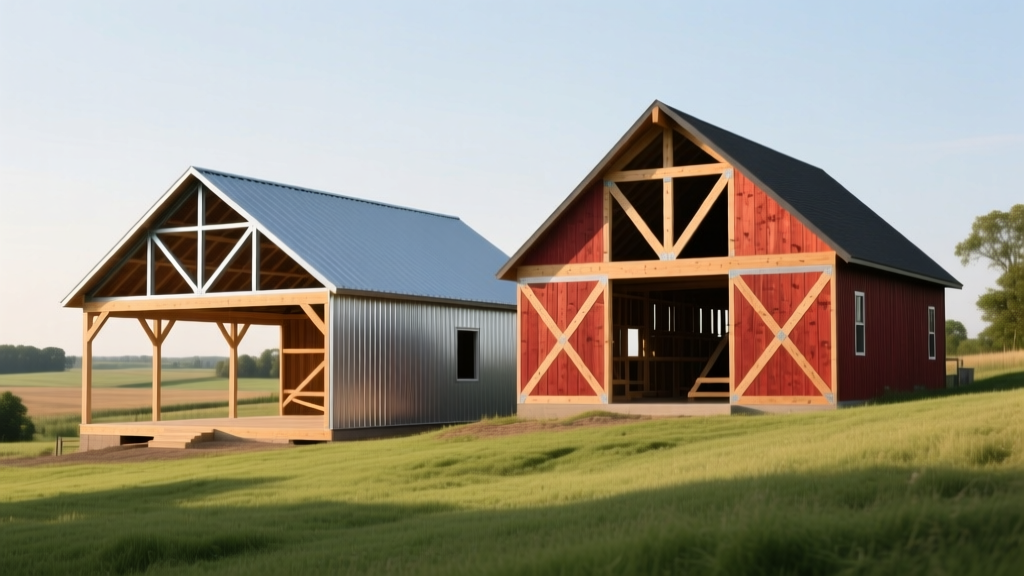
The Baseline: How Much Does It Cost to Build a Barn?
When evaluating how much does it cost to build a barn, the final figure depends entirely on the structural system, intended use, and site conditions. A basic 40x60 pole barn (2,400 square feet) used for equipment storage might cost $45,000 to $70,000, while a fully finished 60x120 timber-frame equestrian facility with wash racks, tack rooms, and climate control can easily exceed $450,000. In 2026, material volatility has stabilized, but labor shortages in rural zoning areas continue to push turnkey prices upward.
| Barn Type | Primary Use | Avg. Cost per Sq. Ft. | Total Cost (40x60 / 2,400 sq ft) |
|---|---|---|---|
| Pole Barn (Post-Frame) | Equipment storage, hay, basic livestock | $25 - $45 | $60,000 - $108,000 |
| Steel-Frame Clearspan | Large machinery, indoor riding arenas | $35 - $60 | $84,000 - $144,000 |
| Timber Frame / Post-and-Beam | Equestrian, event venues, premium ag | $85 - $160+ | $204,000 - $384,000+ |
These estimates encompass site preparation, concrete pier or slab foundations, framing, 26-gauge Galvalume roofing, and basic electrical. They do not include land acquisition, well/septic installation, or specialized interior build-outs.
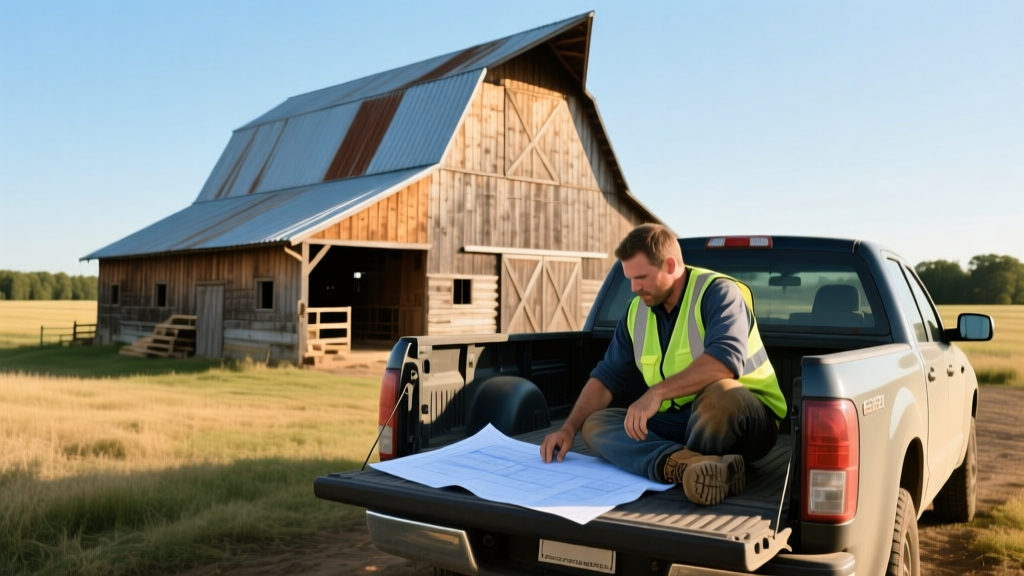
Capital Stack: Matching the Loan to the Structure
Financing agricultural or rural outbuildings requires navigating a different underwriting landscape than residential mortgages. Lenders evaluate the barn's income-producing potential, the borrower's agricultural experience, and the land's collateral value. Below is a breakdown of the primary financing vehicles available for barn construction.
Storing crops/hay/equipment? Look at USDA FSA FSFL loans.
Building a commercial boarding stable? Explore SBA 504 or commercial construction loans.
Adding a barn to your primary rural residence? Consider a Construction-to-Permanent mortgage or HELOC.
1. USDA FSA Farm Storage Facility Loans (FSFL)
For working farmers, the USDA Farm Service Agency (FSA) offers the FSFL program. This is specifically designed to finance the construction of on-farm storage facilities, including barns for hay, grain, and equipment.
Terms: Loan limits reach up to $500,000. Terms range from 7 to 12 years, with fixed interest rates that are typically 1% to 2% below conventional market rates. The down payment requirement is a highly accessible 15%. However, the barn must be strictly for agricultural storage; you cannot use FSFL funds to build a barn that includes a residential apartment or a commercial retail space.
2. Construction-to-Permanent Agricultural Mortgages
If the barn is part of a larger rural estate or hobby farm, lenders like Farm Credit Services offer construction-to-permanent loans. This single-close loan covers the build phase (where you pay interest-only on the funds drawn) and automatically converts to a standard 15- or 30-year amortized mortgage upon completion.
Terms: Expect to put down 20% to 30%. Interest rates for rural construction loans in 2026 hover between 7.5% and 9.2%. Lenders will require a detailed line-item budget, a certified builder contract, and an appraisal based on the 'future improved value' of the land with the completed barn.
3. SBA 504 Loans for Commercial Equestrian & Ag-Business
Building a commercial boarding facility, a veterinary clinic with a surgical barn, or an agri-tourism venue? The SBA 504 Loan Program is ideal for owner-occupied commercial real estate.
Terms: The SBA 504 structure requires only a 10% down payment from the borrower. A Certified Development Company (CDC) covers 40% via a 10- or 20-year fixed-rate debenture, and a private lender covers the remaining 50%. The strict caveat is that the facility must meet job-creation or public-policy goals, and the business must occupy at least 51% of the usable space.
The Lender's Draw Schedule: Managing Cash Flow
Construction loans do not disburse funds in a single lump sum. Lenders use a 'draw schedule' tied to verifiable milestones. If your cash flow planning does not align with the lender's inspection schedule, construction will halt. A standard 5-draw schedule for a $150,000 pole barn looks like this:
- Draw 1 (15% - $22,500): Disbursed at closing for site clearing, grading, and initial material deposits (e.g., ordering the custom truss packages, which often require 50% upfront from manufacturers).
- Draw 2 (20% - $30,000): Released after the foundation is complete. For pole barns, this means the pressure-treated 6x6 laminated columns are set in concrete and verified for plumb and depth by the inspector.
- Draw 3 (30% - $45,000): The largest draw, issued at 'dry-in'. The roof purlins, wall girts, and all metal sheeting (roofing and siding) must be installed. The structure must be weather-tight.
- Draw 4 (25% - $37,500): Disbursed after interior framing, electrical rough-ins, insulation, and concrete slab pouring (if applicable) are finished.
- Draw 5 (10% - $15,000): The retention draw. Held until the local building department issues the final Certificate of Occupancy (CO) and all contractor lien waivers are signed.
Expert Insight: The Interest Reserve
Always negotiate an 'interest reserve' into your construction loan. This allows the lender to capitalize your monthly interest payments during the 6-to-12-month build phase, rolling them into the total loan balance. This prevents you from having to pay out-of-pocket mortgage payments on a barn that isn't yet generating income or utility.
Engineering & Site Costs That Derail Loan Approvals
The most common reason barn construction loans fall through during the underwriting phase is an incomplete site budget. Lenders will reject a loan application if the appraisal reveals unaccounted site-development costs. Ensure your loan application includes line items for the following:
- Geotechnical Soil Testing ($1,500 - $3,500): Required for expansive clay soils. If the soil requires over-excavation and backfilling with crushed aggregate to support a 4-inch reinforced concrete slab, your foundation costs can double.
- Wind-Load Engineering ($800 - $2,000): In coastal or high-wind zones (110+ mph ultimate design wind speeds), standard pole barn truss brackets will fail inspection. You must budget for engineered hurricane ties, closer post-spacing (e.g., 6 feet on-center instead of 8 feet), and heavier gauge metal fasteners.
- NFPA 150 Compliance for Equestrian Facilities ($5,000 - $15,000): If you are building a commercial boarding barn, local fire marshals often enforce NFPA 150 (Fire and Life Safety in Animal Housing Facilities). This may mandate automatic fire sprinkler systems, specialized electrical conduit to prevent dust ignition, and specific aisleway widths, drastically altering the plumbing and electrical budget.
- Heavy Equipment Access ($2,000 - $8,000): Delivering 60-foot roof trusses requires a semi-truck and a crane. If your site lacks a compacted gravel driveway capable of supporting an 80,000-pound GVW vehicle, you must budget for temporary access road construction or off-site staging and telehandler rentals.
Securing financing for a barn requires treating the project not just as a construction endeavor, but as a commercial real estate development. By matching the correct federal or private loan product to your specific barn type, and padding your budget for site-specific engineering requirements, you can secure capital efficiently and break ground without cash-flow interruptions.
Written by
Marcus ChenMarcus Chen is a licensed structural engineer (PE) and building materials analyst with over 12 years of experience across residential, commercial, and industrial construction. He holds a Master of Science in Civil Engineering from UC Berkeley and spent six years at Thornton Tomasetti before transitioning to independent consulting and technical writing. Marcus specializes in material selection for seismic-prone regions, concrete reinforcement strategies, and lifecycle cost analysis. His work has been cited by the American Concrete Institute (ACI) and the Structural Engineers Association of California (SEAOC). When he is not on a job site or at his desk, you will find him hiking the Sierra Nevada or restoring a 1920s craftsman bungalow in Oakland, CA.
More from Marcus Chen
View all
Construction Cost
How Much Did the Eiffel Tower Cost to Build?
How much did the Eiffel Tower cost to build in 1889? We adjust for inflation and compare its budget to modern skyscraper construction.
Aug 4, 2026

Fire Resistance
What Is a Fire Resistant Material? Testing & Certification Guide
Discover what is a fire resistant material through ASTM and UL testing. Learn how fire ratings, certifications, and assemblies work in construction.
Aug 4, 2026

Construction Cost
How Much Did the Burj Khalifa Cost to Build?
How much did the Burj Khalifa cost to build? We break down the $1.5B project and extract 5 money-saving strategies for your next build.
Jul 30, 2026